AML risks can appear in everyday transactions, making employee awareness essential.
UAE AML requirements now include proliferation financing under the 2025 federal law.
AML training should cover all relevant departments, with content tailored to each role.
Employees must know how to identify red flags, report concerns and avoid tipping off customers.
Course completion alone doesn't prove effectiveness. Scenario-based assessments and knowledge gaps offer better insights.
An LMS helps manage training, assessments, reminders and records.
Watch the Video for a Quick Overview: AML Training in UAE
Want a quick overview of AML training in the UAE? Watch this short yet detailed video covering AML training concepts and risks, role-based training, employee responsibilities, training measurement and how an LMS supports effective AML compliance.
Introduction: Why AML training needs to go beyond a completion certificate
Let’s look at a real-world scenario.
A relationship manager at a bank in Dubai notices four overseas transfers into a long-standing client’s account within a week. The client then asks her to move the entire amount to a new beneficiary urgently.
Although she recently completed AML training, she is unsure whether the activity is suspicious, how to raise the concern, and what she can discuss with the client.
She should promptly report her concerns to the bank’s compliance team and follow internal procedures for handling the pending transaction. She should not make decisions outside her authority or disclose any suspicion to the client.
This is where AML training is put to the test. Completing a course is one thing; knowing how to recognise a concern and respond appropriately at work is another.
This guide explores what UAE law and the Central Bank of the UAE (CBUAE) expect from AML/CFT training. It also looks at what employees in different roles need to learn and how financial institutions can deliver, manage and assess training to ensure employees can apply it in practice and demonstrate compliance during inspections.
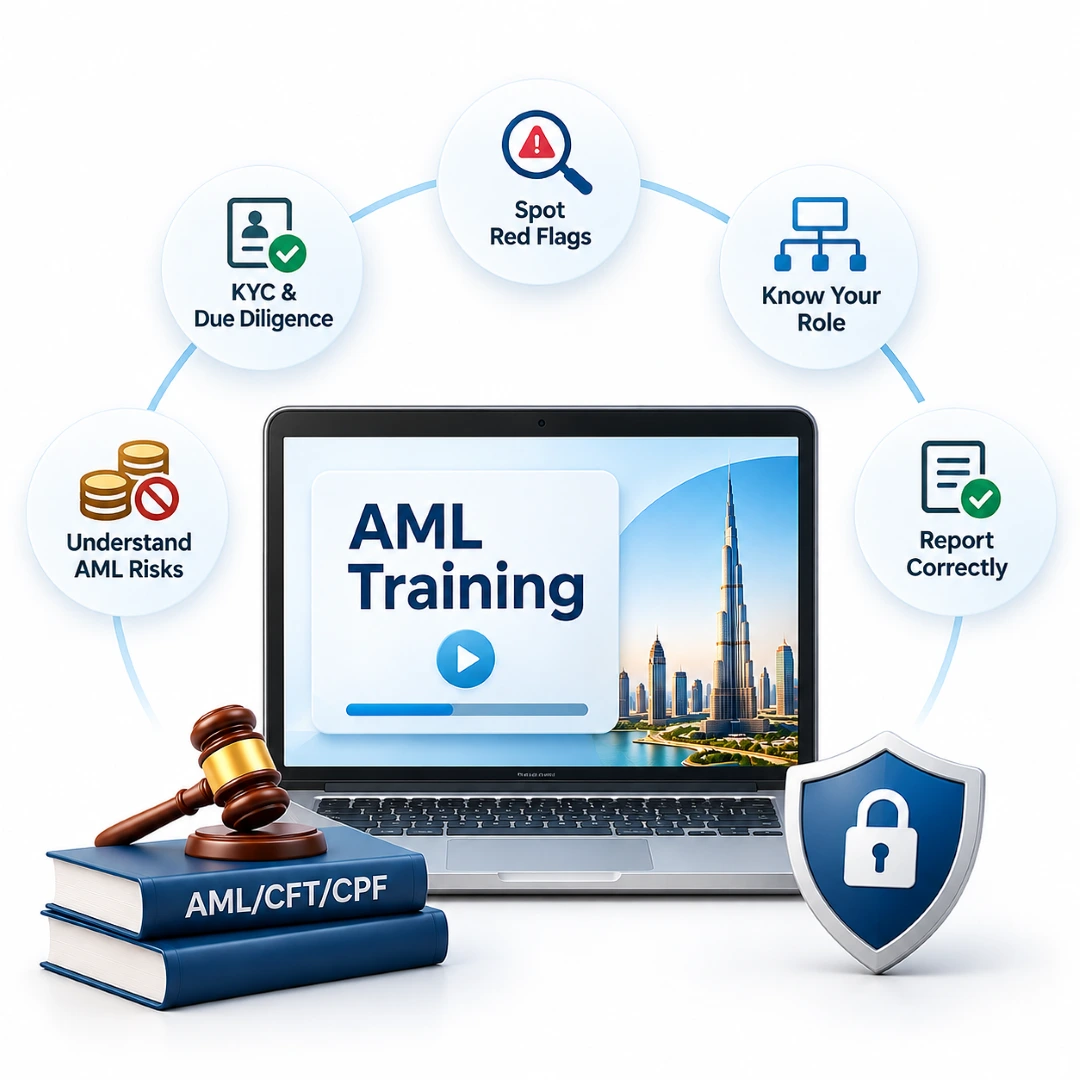
Understanding AML in the UAE: where the risk actually shows up
Money laundering is about making the proceeds of crime look legitimate. In financial services, it rarely stands out. More often, it hides in everyday activity: an account opening, a trade payment, a cash deposit, a change in company ownership, or a request to move funds faster than usual.
The UAE’s AML framework covers anti-money laundering (AML), countering the financing of terrorism (CFT), and countering proliferation financing (CPF), which involves providing funds for the proliferation of weapons of mass destruction. Federal Decree-Law No. 10 of 2025 expressly criminalizes proliferation financing, making it an important topic in training for relevant roles, not only sanctions specialists (Federal Decree Law)
Awareness cannot sit only with the compliance department. Compliance teams review alerts and file reports, but they depend on what front-line colleagues notice and record. An institution's AML controls work as a chain:
Front-line staff collect accurate customer information and notice behavior that does not fit.
Operations and payments teams spot unusual instructions and screening hits during processing.
Compliance and the MLRO (Money Laundering Reporting Officer) investigate, decide, and report to the UAE Financial Intelligence Unit (FIU) where needed.
Internal audit tests whether the whole chain works.
Senior management and the board set the risk appetite and make sure the programme is resourced.
Training is what keeps each link able to do its part.
UAE AML laws and regulatory expectations for training
UAE law requires financial institutions to run an AML/CFT/CPF programme that includes staff training.
The Central Bank of the UAE explains how it expects training to work in practice. Some sectors also have their own binding training rules and which rules apply to you depends on your licence and your jurisdiction.
Layer | What it is | Why it matters for training |
The federal AML/CFT/CPF law. In force from 14 October 2025, replacing Federal Decree-Law No. 20 of 2018 (Al Tamimi & Company) | Training content built on the 2018 law needs updating | |
Cabinet Resolution No. 134 of 2025 | The Executive Regulations, replacing Cabinet Decision No. 10 of 2019 (Greenberg Traurig) | Sets the detailed obligations staff carry out, such as due diligence and reporting |
CBUAE Best Practices on Implementing Role-Based AML/CFT/CPF Training | Supervisory best practice for CBUAE-licensed institutions, reissued in the CBUAE's April 2026 guidance package | Explains what role-based training, plans, assessments and records should look like |
Sector rules, e.g. CBUAE Exchange House Standards, 16.23 | Binding training rules for licensed exchange houses | Sets specific timelines and minimum topics |
DIFC and ADGM rulebooks | DFSA AML Module (DIFC); FSRA AML Rulebook (ADGM) | Financial free-zone firms follow their own regulator's training rules |
Three points matter most for anyone designing training.
The CBUAE’s role-based training guidance does not create new legal obligations. Instead, it explains the regulator’s expectations for implementing existing AML/CFT/CPF training requirements . It applies to banks, foreign bank branches, exchange houses, finance and investment companies, payment service providers, CBUAE-supervised virtual asset and payment token providers, registered hawala providers, and insurers, agencies and brokers.
The knowledge standard has shifted. Under the 2025 law, liability can arise where there are sufficient indications that funds come from crime, not only where someone actually knew (Greenberg Traurig). That raises the practical value of teaching employees to recognize and act on red flags.
Note: Check your training materials against the current legal framework. The CBUAE’s role-based AML/CFT/CPF training guidance, published in August 2025, cites Federal Decree-Law No. 20 of 2018 and Cabinet Decision No. 10 of 2019 as part of its legal basis. As the UAE has since introduced Federal Decree-Law No. 10 of 2025 and Cabinet Resolution No. 134 of 2025, institutions should review their training materials against the updated legislation and regulations, while consulting the CBUAE guidance for relevant training expectations.
What effective AML training should cover
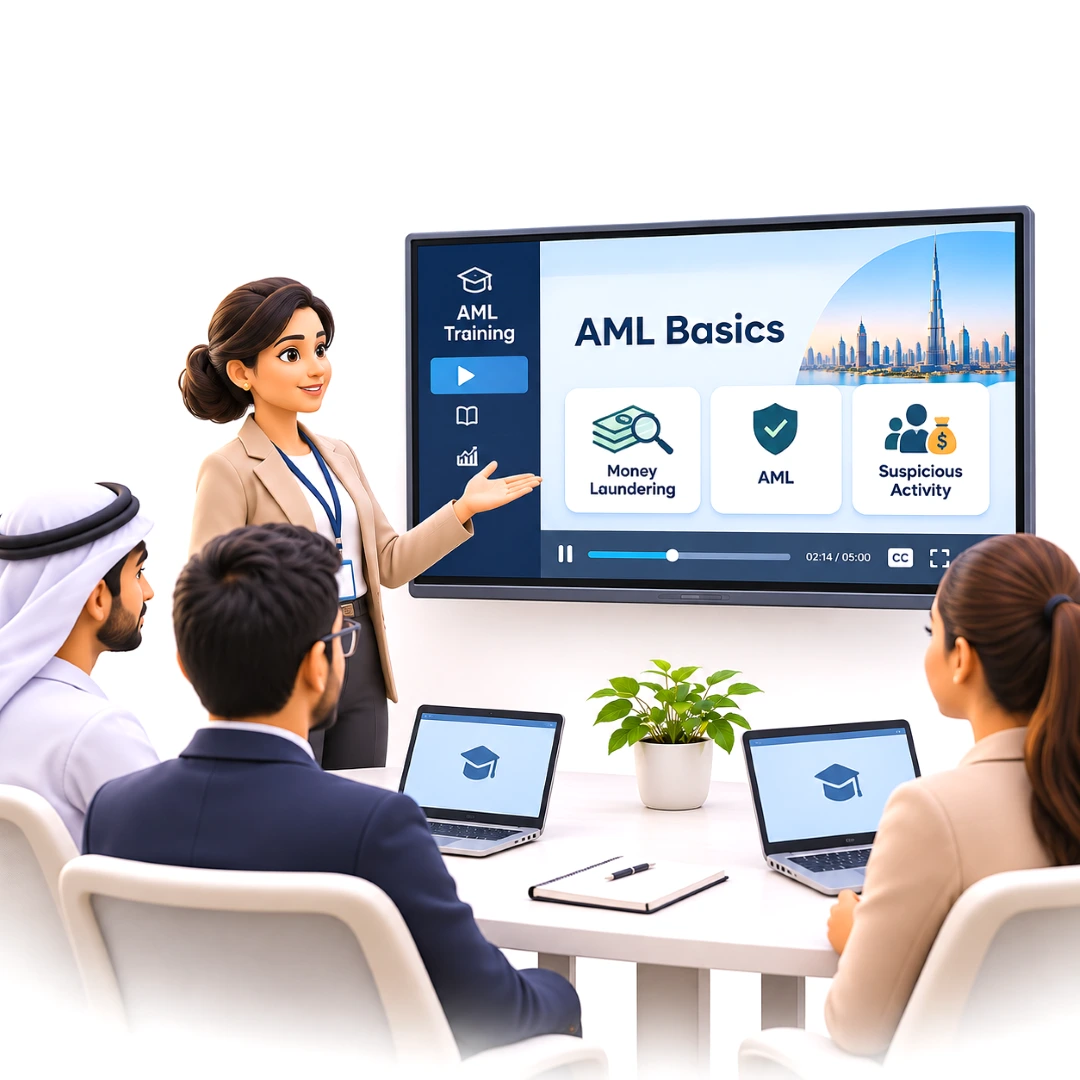
This section covers the core AML knowledge every employee needs, whatever their role. For each topic, the useful question is not "what is it?" but "which decision does it help me make?"
The CBUAE also expects training to cover the institution's own systems and controls, such as the system used to onboard customers or update a customer's risk rating (CBUAE best practice).
Topic | The workplace decision it supports |
Know Your Customer (KYC) and customer due diligence (CDD) | Do I have enough verified information to onboard this customer, and does their profile make sense? |
Beneficial ownership | Who ultimately owns or controls this company, and have nominee arrangements hidden that person? |
Customer risk rating and enhanced due diligence (EDD) | Does this customer need extra checks or senior approval before we proceed? |
Transaction monitoring | Is this activity consistent with what we know about the customer? |
Sanctions and targeted financial sanctions (TFS) screening | Is this a true match, and what must happen immediately if it is? |
Proliferation financing and trade risk | Do the goods, routes or counterparties raise dual-use or transshipment concerns? |
Internal escalation and suspicious transaction reporting | Who do I tell, how, and how fast? |
Tipping off | What can I say to the customer while a concern is being reviewed? |
Record keeping | Have I documented what I saw and what I did? |
Two topics deserve more practice time than they usually get.
Escalation is where training most often falls short. An employee may spot a red flag and still hold back, unsure whether it’s “serious enough” to mention. Training should make the answer clear. The employee’s job is to raise the concern internally. Deciding whether to file a report with the FIU is the MLRO’s responsibility.
Tipping off creates real anxiety for customer-facing staff. They need to know that asking a customer normal business questions is expected. Telling a customer that a report has been or may be made is not permitted.
Common AML risks in financial services, and how to respond
A red flag is a reason to look closer, not proof of wrongdoing. Good training teaches employees to respond in proportion: gather facts, record them, and escalate through the right channel without accusing the customer or ignoring the concern.
The four scenarios below are hypothetical and simplified for training purposes.
Scenario (illustrative) | Appropriate response | What to avoid |
Unusual pattern: A salaried retail customer starts receiving several transfers a week from unrelated individuals, each withdrawn in cash within a day. | Compare the activity with the customer's stated profile. Ask routine questions where your procedures allow. Record the answers and escalate internally if the activity still does not fit. | Closing the account on the spot, or assuming a family explanation without checking it. |
Unclear ownership: A new corporate client's structure runs through two holding companies in different jurisdictions. The ultimate owner is listed as a nominee director. | Pause onboarding until the natural person who ultimately owns or controls the company is identified and verified. Apply EDD if the risk rating requires it. | Accepting the nominee as the beneficial owner to meet an onboarding deadline. |
Inconsistent explanation: A trading company says a large incoming payment is for electronics. The invoice describes industrial components, and the payer is in a third country unrelated to the deal. | Request supporting documents in line with procedures. Consider trade-based money laundering and proliferation financing indicators. Escalate the inconsistency. | Treating the invoice as sufficient because the client is long-standing. |
Screening alert: An outgoing payment generates a sanctions screening hit on the beneficiary's name. | Review it against identifiers such as date of birth, nationality and address. If it may be a true match, stop and escalate immediately under your TFS procedure. | Releasing the payment because the name is common, or discussing the alert with the customer. |
Why AML training must differ by role
A single generic course tends to fall short for two groups at once. It is too general for the people who make detailed AML decisions every day, and too operational for the board members who set the institution's risk appetite.
The reason is simple: employees face different risks and make different decisions. Consider one red flag, structuring (splitting cash into smaller amounts to avoid attention). A teller needs to spot it at the counter. A monitoring analyst needs to judge whether an alert reflects it. A data team member needs to understand how a threshold change affects whether it is detected at all. Senior management needs to know whether the institution's controls for it are adequate. One module cannot prepare all four.
Role-based training should be guided by an annual training needs assessment that identifies the areas of the institution most exposed to money laundering, terrorist financing and proliferation financing risks. This helps ensure that training reflects employees’ responsibilities and the risks they encounter in their roles.
Key groups that may require specialized training include the board, owners and senior management; front-line staff with higher risk exposure; compliance teams; internal audit; and employees responsible for testing, tuning and validating financial crime systems and models.
A practical way to structure this is in three layers:
Core awareness for everyone, covering the topics in the previous section.
Role modules that go deeper into the decisions and systems each team uses.
Event-triggered updates when a role, product, policy or risk changes.
Which AML training is relevant to each role
The table below shows what each team needs to know, the decisions it makes, and a practical exercise that builds the skill. The exercises are illustrative and should be adapted to your own procedures and systems.
Role | Key knowledge | Decisions they make | Practical exercise (illustrative) |
Board and senior management | Institutional risk assessment findings, oversight duties, regulatory updates | Risk appetite, resourcing, approving high-risk relationships | Review a summary of audit findings and agree which remediation actions to priorities and how to track them |
Relationship managers and tellers | Red flags by product and channel, tipping-off rules, internal reporting | Whether customer behavior fits the profile, and when to raise a concern | Role-play a client asking for an urgent onward transfer, then write a short internal report |
Onboarding and KYC teams | Verification, beneficial ownership, nominee arrangements, EDD triggers | Whether to accept a customer, and at what risk rating | Trace a multi-layer ownership chart to the natural person in control, using the onboarding system |
Payments and operations | Screening alerts, wire transfer information, trade documents, urgent TFS steps | Whether to process, hold or refer an instruction | Work through three screening alerts, one of which may be a true match |
Compliance and MLRO | Investigation techniques, report writing, typologies, regulatory updates | Alert disposition, and whether to file a report with the FIU | Assess an internal report and document a clear, reasoned decision |
Internal audit | Testing methods, current supervisory expectations | Whether controls are designed and operating well | Sample-test whether training records match employees' current roles |
Monitoring system and data teams | How scenarios, thresholds and data feeds work | Thresholds, scenarios and model changes | Assess which alerts a proposed threshold change would remove from analysts' queues |
IT and other support functions | Why AML systems matter, confidentiality, change control | Changes that could affect screening or monitoring | Identify which planned system changes need compliance review before release |
Support functions are easy to overlook. The CBUAE says the training plan should also cover departments such as IT and other support functions. They may not see customers, but they build and maintain the systems that AML controls depend on.
AML training frequency, refreshers and audit readiness
How often is AML training required in the UAE? It depends on the rulebook that applies to you. For CBUAE-licensed institutions generally, the CBUAE expects ongoing training, refresher training, and an annual training plan approved by the board or senior management. Some rulebooks set firmer minimums:
CBUAE-licensed exchange houses must train new joiners within 30 calendar days and may not let them serve customers independently until they pass. Staff dealing directly with customers, products or services must be trained at least annually (CBUAE Rulebook).
ADGM firms must train new employees at onboarding and all existing employees annually, according to the FSRA's summary of its AML Rulebook.
In practice, annual training for staff with customer or transaction exposure is the common baseline. Your own risk assessment may justify more.
Events that should trigger extra training. The CBUAE lists several, including:
an employee moving into a new role
a new product, service or technology
new risk indicators for a business line, or new CBUAE guidance
changes to policies, procedures or systems
examination or audit findings about training gaps
an employee failing to follow AML requirements, such as repeatedly not reporting or tipping off a customer
Records that support audit readiness. The CBUAE expects records of each training session: the date, the participants, the topics, the materials used, and assessment reports. Keep these with your training needs assessment, and retain them for the period UAE record-keeping rules require. A useful self-test: could you show an examiner, for any named employee, what they were trained on, when, and how well they understood it.
Moving from passive learning to practical training
Many AML courses still follow the same pattern: slides on the law, a list of red flags, and a quiz that tests whether people remember definitions. That proves exposure, not judgement.
Criteria | Policy-based course | Practical, decision-based training |
Typical question | "What does CDD stand for?" | "This client's ownership has changed. What do you do next?" |
What it shows | Recall | Recognition, judgement and choice of escalation path |
Use of internal systems | Rare | Practices the actual onboarding, alert or reporting steps |
Feedback | Right or wrong | Explains why each option helps or creates risk |
The CBUAE points in the same direction. It recommends real-life, role-specific scenarios, and notes that e-learning can include simulations and gamification.
A good decision-based question offers realistic wrong answers that reflect the mistakes people actually make. For example, after a scenario about a sudden large cash deposit, the options might be:
Process it and say nothing, because the customer is long-standing. (Under-reaction.)
Tell the customer the deposit looks suspicious and ask them to explain. (Risk of tipping off.)
Ask the routine questions your procedure requires, record the answers, and raise an internal report if the explanation does not fit. (Correct.)
Refuse the deposit and close the account. (Over-reaction outside procedure.)
The pattern of wrong answers across a team tells you more than the pass rate. If many people pick option 2, your training on tipping off needs work.
How an LMS supports AML training management
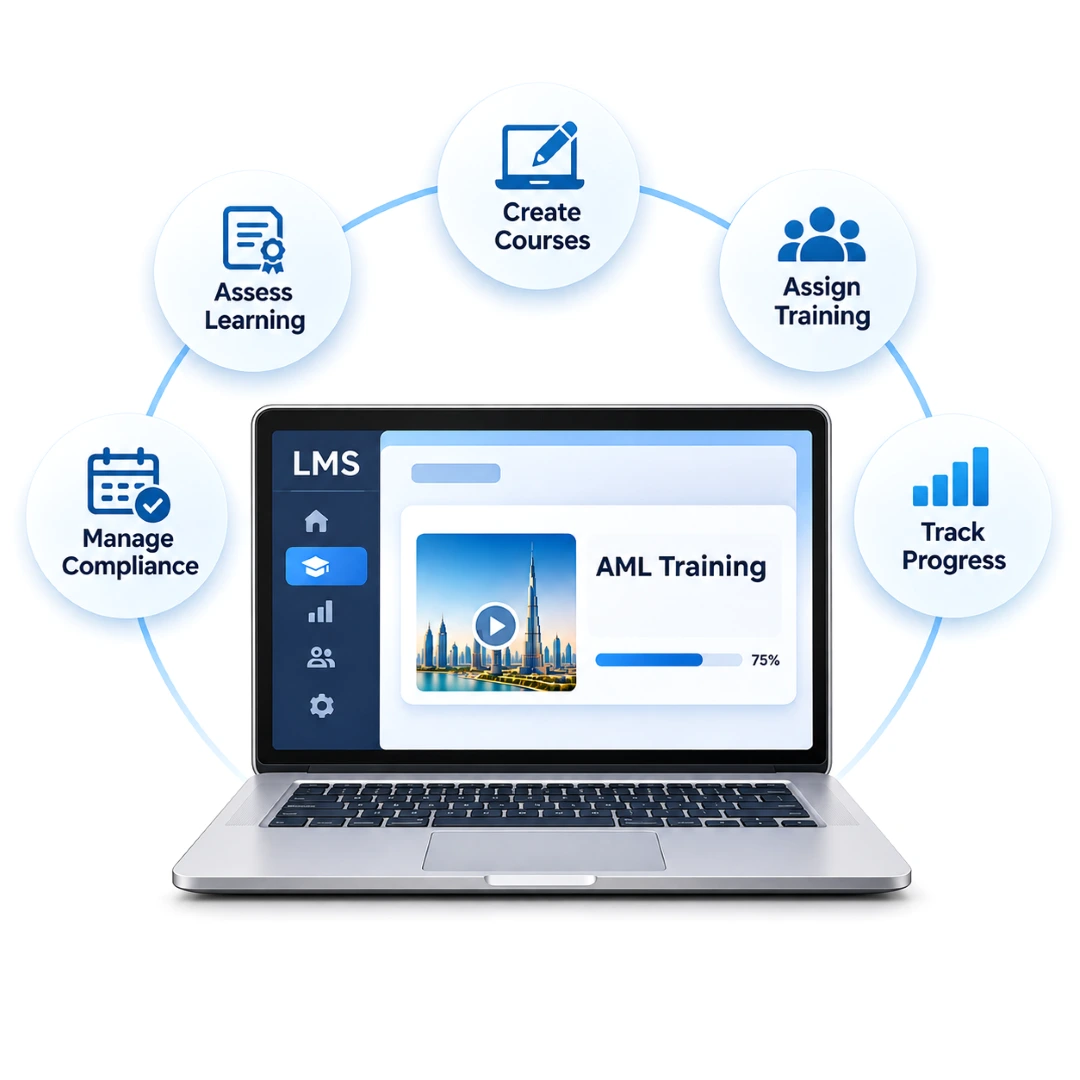
A learning management system (LMS) is software for assigning, delivering and tracking training. For AML training, its value is administrative: making sure the right people receive the right training on time, and that the evidence is complete.
The training plan should be tracked through a designated coordinator or platform, and that digital tools can make tracking and retaining records more efficient.
Task | How an LMS can help |
Course assignment | Assigns courses by department, job title or risk exposure, and updates them when someone changes role |
Training delivery | Delivers e-learning, scenario modules and simulations, and registers attendance at instructor-led sessions |
New joiner deadlines | Enrolls new staff on day one and flags anyone approaching a deadline, such as 30 days for exchange houses |
Reminders | Sends reminders to learners and overdue reports to line managers |
Refresher schedules | Schedules annual refreshers and event-triggered updates, such as after a policy change |
Assessments | Runs post-training assessments and stores results at question level, not only pass or fail |
Completion tracking | Shows completion status by person, team and course in real time |
Training records | Holds dated records, course versions and scores in one place, ready to export for audits and examinations |
An LMS also has limits:
It does not decide what each role needs. That comes from your training needs assessment.
It does not keep content accurate. Compliance must align materials with current law and internal procedures.
It records that training happened. Whether training changed how people act is a separate question, covered in the measurement section below.
It does not replace instructor-led sessions where discussion matters, such as for senior management or complex investigations.
In short, an LMS supports the training programme. Responsibility for the programme stays with the institution.
Why effective AML training matters
An institution's AML controls are only as reliable as the people who operate them. Policies, screening systems and monitoring tools all depend on employees who notice what does not fit, follow the procedure, and raise concerns promptly.
Effective training supports this in five practical ways.
Employee awareness. Staff learn to recognise potential risks in their own work, such as an ownership structure that does not add up or a payment that does not match the customer's profile, and to respond calmly rather than ignore the concern or overreact.
Management oversight. Leaders who understand the institution's risk profile can set a realistic risk appetite, allocate resources, and ask the right questions about control performance. The 2025 framework places clear emphasis on senior management approving and overseeing AML controls (Greenberg Traurig).
Consistent procedures. When every branch and team is trained on the same escalation path, similar situations are handled in similar ways, and customers receive a consistent experience.
Stronger internal controls. Well-trained staff provide better information to the controls that follow them: complete KYC files for reviewers, clear internal reports for the MLRO, and accurate alert decisions for quality assurance.
Continuous improvement. Assessment results and questions from staff show where procedures are unclear, helping compliance teams refine both the training and the procedures themselves.
Training supports compliance, but it does not guarantee it. Compliance also depends on sound policies, effective systems, adequate resources and active oversight. Training is the part that helps people use all of these correctly in their daily work.
How to measure whether AML training works
Completion records show that training was delivered. Measuring effectiveness asks a different question: do employees make better decisions at work? Methods such as feedback surveys, post-training assessments and performance evaluations help assess employees’ understanding and their ability to apply what they have learned. The results can then be used to identify knowledge gaps and improve future training.
Use a mix of indicators from assessments and from day-to-day work:
Indicator | What it tells you |
Assessment performance by question and team | Which topics are understood, and where understanding is weak |
Scenario-based decisions | Whether people choose the right action and escalation path, not just the right definition. The pattern of wrong answers shows whether people tend to under-react, over-react or risk tipping off |
Recurring knowledge gaps | Whether the same weakness returns after refresher training, which suggests the content or method needs to change |
Internal reporting quality | Whether staff describe what they saw clearly enough for compliance to act |
Time from observation to escalation | Whether people hesitate before raising a concern |
KYC file and alert review findings | Whether onboarding and operations training shows up in the quality of completed work |
Employee confidence in escalation | Whether people know who to contact and feel able to do so, measured through short anonymous surveys |
Audit and examination findings | Whether independent reviewers see training gaps |
Read these indicators together rather than relying on any single one. A rise in internal reports after training, for example, can be a good sign that staff now recognize and raise concerns. Compliance should check whether the reports are well-founded before drawing conclusions.
Then close the loop by feeding the results into next year's training needs assessment.
Frequently Asked Questions (FAQs)
Who needs AML training in a UAE financial institution?
All employees need AML awareness, including senior management and the board. Staff with higher exposure, such as front-line, onboarding, payments, compliance and audit teams, need additional role-based training. Exchange house rules extend the requirement to owners, partners and shareholders.
Is AML training mandatory in the UAE?
Yes. Regulated institutions must run an AML/CFT/CPF programme that includes staff training. The detail varies by regulator: the CBUAE, the DFSA in DIFC and the FSRA in ADGM each set their own rules.
How often should AML training be repeated?
At least annually is the common baseline for staff with customer or transaction exposure, and is explicit for CBUAE-licensed exchange houses and ADGM firms. Additional training should follow changes in law, policy, products or role.
Do new employees need training before serving customers?
In CBUAE-licensed exchange houses, yes: new joiners must be trained within 30 calendar days and cannot serve customers independently until they pass. Other institutions should check their own rulebook and policy.
What AML training records should we keep?
The date, participants, topics, materials, assessment results and the training needs assessment. Records should be available for audits and CBUAE examinations.
Does training need an assessment?
The CBUAE expects training effectiveness to be assessed, and exchange houses must periodically assess staff awareness. Scenario-based questions show understanding better than definition recall.
Does training now need to cover proliferation financing?
Yes. Proliferation financing is a standalone offence under Federal Decree-Law No. 10 of 2025, and the CBUAE's training guidance is framed as AML/CFT/CPF.
Conclusion: Making AML awareness part of everyday decisions
Effective AML training is about more than completing a course. Employees need to know how to spot unusual activity, record their observations, and raise concerns with the right team. They should also understand how to handle pending transactions according to their organization's procedures and avoid tipping off customers.
To make training effective, institutions need to focus on three things: teaching employees what matters in their roles, giving them practical scenarios to work through, and using assessment results to identify where they need more support. The goal is simple: help employees recognize potential risks, know what to do next, and act with confidence.


Vivetha is a digital marketing professional specializing in content marketing and SEO. She focuses on developing optimized, high-quality content that improves search visibility, supports brand objectives, and drives measurable results. With a structured and analytical approach, she ensures content aligns with business and audience needs.