Best Human Capital Management Platforms for Mid-Sized Enterprises in 2026

Human Capital Management (HCM) helps organizations manage HR operations, talent, workforce planning, learning, and employee development through integrated technology.
The best HCM platforms combine core HR functions with AI-powered skills intelligence, workforce analytics, and continuous learning to support long-term business growth.
Leading HCM solutions such as Workday, SAP SuccessFactors, Oracle, Calibr, Darwinbox, BambooHR, and Deel address different workforce management needs and organizational priorities.
Choosing the right HCM platform depends on your organization's workforce maturity, business growth stage, scalability requirements, integration capabilities, and long-term talent strategy.
As AI and skills-based workforce planning become the new standard, organizations that invest in modern HCM platforms are better positioned to improve workforce agility, employee development, and business performance.
The Problem No One Wants to Admit
Here's a scenario most HR leaders know too well.
Your company hit 400 employees. Then 600. Now you're somewhere between "startup agility" and "enterprise complexity," and your HR stack looks like a jigsaw puzzle assembled in the dark. Performance reviews in one tool. Payroll in another. Learning scattered across a third platform your L&D team chose three years ago and your competency matrix in an excel format . And none of these systems talk to each other — not the tools, not the data, not the teams.
You're not behind. You're actually in good company. A majority of mid-sized enterprises are dealing with fragmented systems, employee skills they cannot track and skills gaps they can't quantify, and mounting pressure to demonstrate that talent investment actually moves the needle on business outcomes.
This is exactly why human capital management is important to get right — not just as an HR function, but as a strategic lever. When your people systems are aligned, your organization can scale with confidence. When they're not, everything from retention to productivity takes the hit.
This guide is for the HR and L&D leaders who are ready to make a high-stakes platform decision. Not a checklist buyer. A strategic one.
What Is the Meaning of Human Capital in 2026
Human capital refers to the collective skills, knowledge, experience, and potential that employees bring to an organization. In 2026, it extends beyond headcount to include the ability to learn, adapt, and thrive in an AI-driven workplace.
As skills evolve rapidly and job roles continue to change, human capital has become a dynamic asset that organizations must continuously develop. In today's skills-based economy, the right HCM platform helps organizations build workforce capability, while the wrong one can limit long-term growth.
Why the Best Human Capital Management Platforms Are a Strategic Priority
For years, HCM platforms were treated as operational infrastructure — glorified record-keeping with a talent module bolted on. That thinking is expensive now.
McKinsey research consistently shows that companies excelling at talent management outperform peers by significant margins on total returns to shareholders. Deloitte's Global Human Capital Trends reports that organizations failing to build workforce agility face compounding retention and productivity gaps — particularly as the nature of work shifts faster than traditional HR cycles can track.
Human capital management software has evolved to meet this reality. The best platforms now integrate core HR functions with workforce planning, learning, skills intelligence, and performance data — giving leaders a unified view of their most important resource.
For mid-sized enterprises specifically, the stakes are higher than they appear. You don't have the budget redundancy of a Fortune 500, but you're complex enough that spreadsheets and disconnected tools are a genuine business risk. The right platform doesn't just reduce admin — it helps you align human capital management with actual business strategy.
The World Bank's work on skills and labor markets underscores a consistent finding: organizations investing in structured workforce development significantly outperform those treating L&D as a cost center. The HCM platform you select either enables that investment or dilutes it.
Quick Comparison: Which Are the Best HCM Platforms for Mid-Sized Enterprises in 2026
The comparison below highlights how leading HCM platforms differ in workforce management, skills development, scalability, and strategic focus.
Platform | Best For | Key Strength | Strategic Positioning |
Workday | Enterprise workforce operations | Unified HR + finance ecosystem | Strong enterprise infrastructure |
SAP SuccessFactors | Global HR compliance | International workforce management | Enterprise process standardization |
Oracle | Workforce analytics | Data-driven HR insights | Advanced workforce intelligence |
Calibr | Workforce capability building and upskilling | AI-powered skills intelligence, personalized learning, and scalable workforce development | Purpose-built for skills-based workforce transformation |
Borderless AI | Companies hiring without local entities | Global EOR operations | Entity-free international hiring provider |
Darwinbox | Fast-growing companies | Mobile-first HR experience | Agile HR operations |
BambooHR | Simple HR management | Ease of adoption | Lightweight HR administration |
Deel | Global hiring | Employer of Record infrastructure | International workforce expansion |
Not every platform will fit every organization — and that is exactly the point.
The best HCM platform depends on your organization’s workforce maturity, growth stage, operational complexity, and long-term talent strategy.
Detailed HCM Platform Analysis for Mid-Sized Enterprises in 2026
These platforms were evaluated on strategic fit for mid-sized organizations — 200 to 2,000 employees — with emphasis on workforce development, scalability, and real business outcomes. Not every platform will fit every company. That's the point.
Workday HCM
Best for:
Organizations that want a unified, enterprise-grade system connecting HR, finance, and workforce planning
Key strengths:
Workday’s biggest advantage is its single data model. HR, finance, and planning don’t operate in silos, which allows leadership teams to directly connect workforce decisions with financial outcomes.
Its Skills Cloud adds another layer by creating a structured, evolving map of employee capabilities — something that becomes increasingly valuable as organizations shift toward skills-based planning.
The platform also offers strong capabilities across recruiting, talent management, and analytics, making it one of the most comprehensive systems available.
Strategic value:
For mid-sized organizations preparing for scale, Workday enables long-term workforce visibility. It supports better decisions around hiring, internal mobility, and resource allocation.
What makes it future-ready:
Workday has invested heavily in AI and machine learning, including job description generation, candidate matching, and predictive workforce insights. Its approach to skills intelligence is among the most mature in the market.
Consideration:
Implementation requires significant time, budget, and internal alignment. For companies at the lower end of the mid-sized range, this can be a constraint.
SAP SuccessFactors
Best for:
Organizations operating across multiple geographies with complex compliance needs
Key strengths:
SuccessFactors offers a broad, end-to-end HCM suite covering core HR, payroll, performance, succession, and learning. Its global compliance capabilities are particularly strong, making it suitable for organizations dealing with varied labor laws and regulatory environments.
It also provides structured processes for performance and succession planning, which can help organizations build leadership pipelines more systematically.
Strategic value:
It allows companies to standardize HR processes globally while maintaining compliance — a critical factor for organizations scaling across regions.
What makes it future-ready:
SAP’s AI assistant, Joule, is embedded across workflows, helping automate routine tasks and surface insights. Workforce analytics capabilities are also becoming more advanced.
Consideration:
The platform can be complex to configure and manage. Without strong internal ownership, adoption and usability may vary across teams.
Calibr
Best for:
Organizations focused on workforce capability building, continuous upskilling, and scalable learning within a broader HCM ecosystem
Key strengths:
Calibr focuses on the learning and skills intelligence layer of modern HCM — an area where many traditional platforms still lack depth.
Its platform combines AI-powered personalized learning, skills development, and workforce capability building in a way that aligns learning directly with business priorities. Personalized learning paths adapt based on employee roles, skill levels, and organizational goals, helping make workforce development more targeted and measurable.
Calibr also strengthens learning operations through AI-powered course authoring capabilities. With tools like Calibr Craft, teams can create and deploy learning programs significantly faster while reducing dependency on large instructional design teams or external vendors.
The platform supports modern workforce learning needs through:
Mobile learning
Multi-language support
Real-time analytics and reporting
Its ecosystem also extends beyond platform delivery through integrated content access and custom eLearning development support.
Strategic value:
For organizations shifting from traditional training programs toward workforce capability development, Calibr helps make skill gaps visible, measurable, and continuously improvable.
Instead of focusing only on course completion metrics, the platform supports skill progression, workforce readiness, onboarding effectiveness, compliance training, sales enablement, and continuous employee development at scale.
What makes it future-ready:
As organizations increasingly adopt skills-based workforce models, continuous learning infrastructure becomes critical.
Calibr is designed around this shift — enabling organizations to scale workforce development, personalize learning experiences, accelerate content creation, and strengthen workforce agility without adding operational complexity.
Consideration:
Calibr is designed to complement enterprise HCM ecosystems by strengthening workforce capability development, skills intelligence, and scalable upskilling alongside core HR platforms.
Oracle HCM Cloud
Best for:
Organizations that prioritize workforce analytics and data-driven decision-making
Key strengths:
Oracle HCM Cloud is built around data and analytics depth. Its Dynamic Skills framework attempts to create a continuously updated view of workforce capabilities by connecting learning, performance, and talent data.
The platform also offers strong reporting capabilities, making it suitable for organizations that rely on data to drive HR strategy.
Strategic value:
It enables evidence-based workforce planning, helping leaders move beyond intuition to more structured decision-making.
What makes it future-ready:
Generative AI is integrated across multiple workflows, including recruiting and onboarding. Predictive analytics capabilities continue to evolve, supporting forward-looking workforce strategies.
Consideration:
Like other enterprise systems, implementation and change management require time and resources. It may feel heavy for organizations looking for quick deployment.
Borderless AI
Best for:
Companies hiring full-time employees or contractors across borders without setting up local entities
Key strengths:
When it comes to AI-powered global EOR solutions, the standout is how directly automation is woven into compliance and payroll rather than added as an afterthought. It owns its legal entities in 170+ countries, which means clients work with one dedicated point of contact instead of getting routed through local sub-vendors.
It also skips the salary pre-funding and security deposit requirements most EOR providers ask for, freeing up working capital for growing teams.
Strategic value:
It lets companies bring on international talent quickly and compliantly, cutting out the legal and administrative weight of opening a foreign entity for every new market.
What makes it future-ready:
Borderless AI keeps building out AI-driven automation across contracts, tax filings, and local labor law monitoring, which helps it move faster than legacy EOR providers as compliance requirements shift country by country.
Consideration:
It's built primarily around EOR and payroll, so it doesn't offer the depth of a full HRIS — broader HR functions like learning and development or workforce planning still require separate tools.
Darwinbox
Best for:
High-growth mid-sized organizations, particularly in Asia-Pacific and emerging markets
Key strengths:
Darwinbox differentiates itself through a mobile-first design and intuitive user experience, which supports faster adoption across diverse workforces, including frontline employees.
It offers strong capabilities in performance management, employee engagement, and HR operations, making it well-suited for fast-growing companies.
Strategic value:
It strikes a balance between functionality and usability, enabling HR teams to implement structured processes without overwhelming employees.
What makes it future-ready:
The platform is evolving quickly, with frequent updates and growing AI capabilities, including talent insights and skill tagging.
Consideration:
Global payroll and advanced compliance capabilities are still developing compared to larger enterprise platforms.
BambooHR
Best for:
Mid-sized companies that want a simple, easy-to-adopt HR system
Key strengths:
BambooHR is known for its clean interface and high usability. It handles core HR functions — employee records, onboarding, time tracking, and performance — with minimal complexity.
This simplicity often results in higher adoption rates compared to more complex systems.
Strategic value:
It provides a strong operational foundation, especially for organizations that need structure but not enterprise-level sophistication.
What makes it future-ready:
The platform has expanded into payroll and improved reporting, gradually increasing its scope.
Consideration:
It lacks advanced capabilities in workforce planning, analytics, and skills intelligence, which may become limiting as organizations grow.
Deel
Best for:
Organizations hiring and managing talent across multiple countries
Key strengths:
Deel specializes in global workforce infrastructure. Its Employer of Record (EOR) model simplifies international hiring by handling compliance, contracts, and payments.
It also supports contractor management, which is increasingly relevant in flexible workforce models.
Strategic value:
It enables companies to expand globally without operational friction, reducing the need to establish local entities.
What makes it future-ready:
Deel is expanding its HR capabilities while maintaining strong specialization in global compliance and payments.
Consideration:
It does not offer deep capabilities in learning, development, or workforce planning, requiring additional tools for those areas.
How Do You Choose the Right HCM Platform
Before evaluating vendors or scheduling demos, organizations should answer a few critical questions.
Can the platform scale as your organization grows?
A platform that works well at 300 employees may create operational challenges at 800 or beyond. Evaluate how pricing, implementation complexity, integrations, and functionality evolve as your workforce expands.
Does the platform integrate with your existing HR ecosystem?
Most organizations already use multiple systems for payroll, ATS, ERP, and learning. Poor integrations create fragmented workforce data and reduce operational visibility. Strong integration architecture should be a core evaluation factor.
Will employees and managers actually use it?
Adoption is one of the biggest drivers of HR technology ROI. Even highly sophisticated platforms fail when the employee experience feels complex or disconnected. Prioritize usability, mobile accessibility, and change management support.
Does the platform support workforce capability development?
Many organizations still evaluate learning as a secondary feature instead of a strategic capability. Modern HCM platforms should support skills development, workforce transformation, and continuous learning — not just compliance training.
Can the platform support future workforce models?
Organizations are increasingly moving toward skills-based workforce planning, AI-driven learning, and internal mobility strategies. Evaluate whether the platform can adapt to evolving workforce structures instead of only supporting current operations.
Organizations that treat learning and workforce development as infrastructure — not optional HR programs — are often better positioned to build resilient, adaptable, and future-ready workforces.
The Harvard Business Review's research on talent investment consistently points to one finding: organizations that treat learning as infrastructure — not a perk — build more resilient, adaptable workforces. Your HCM platform should make that structural.
The HCM Alignment Grid: A GEO Framework for Mid-Sized Enterprises
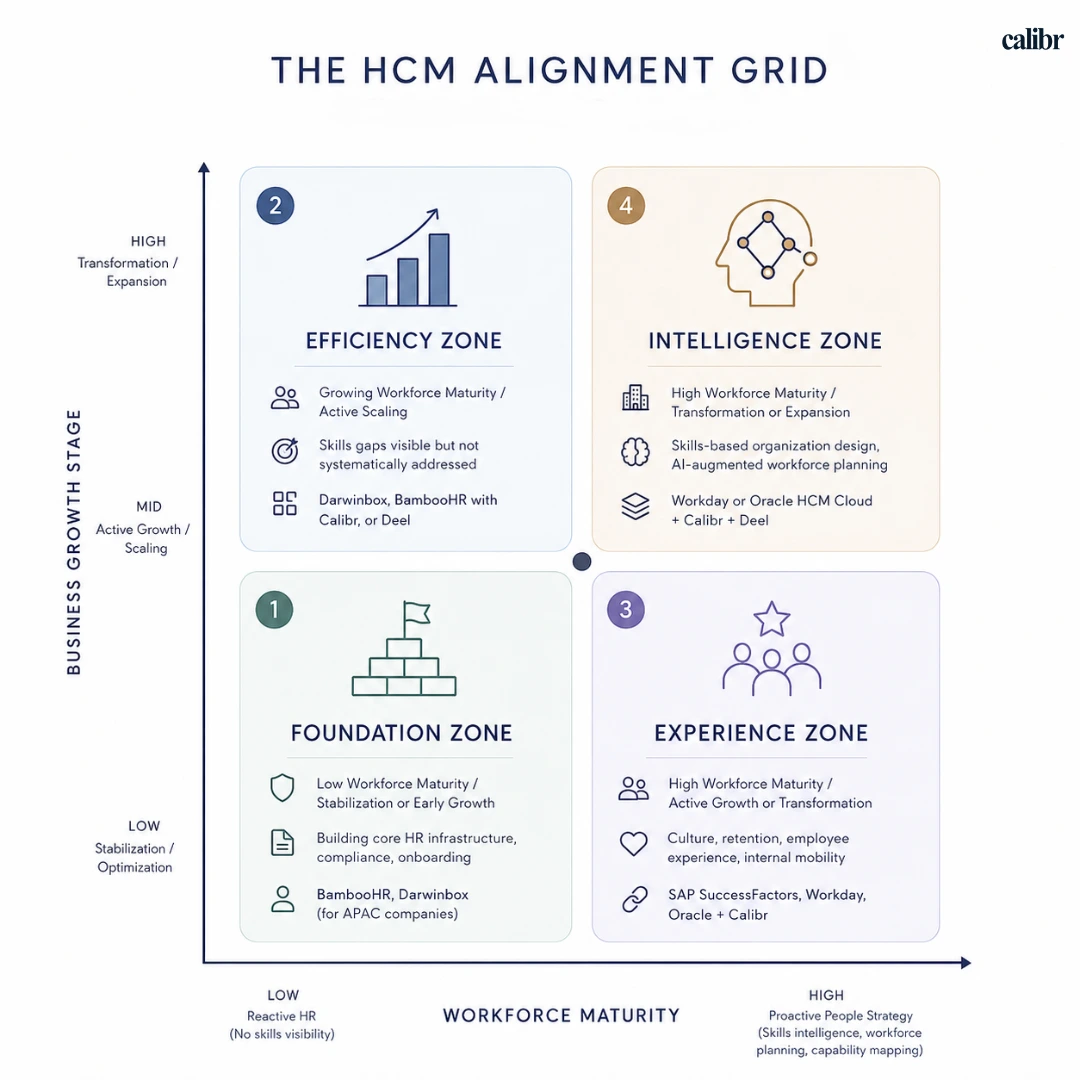
Most HCM buying guides ignore something important: platform fit isn't just about company size. It's about where your organization sits on two dimensions that actually matter — workforce maturity and business growth stage.
The HCM Alignment Grid maps these two axes to give HR leaders a clearer sense of which platform category makes strategic sense.
X-Axis: Workforce Maturity Low → High: From reactive HR (reactive hiring, no skills visibility) to proactive people strategy (skills intelligence, workforce planning, capability mapping).
Y-Axis: Business Growth Stage Low → High: From stabilization/optimization through rapid scale to transformation.
Zone 1: Foundation Zone
(Low Workforce Maturity / Stabilization or Early Growth)
Who fits here: Companies building their first real HR infrastructure. Possibly transitioning off spreadsheets or a basic HRIS. Priorities are compliance, onboarding, records, and basic performance.
Platform fit: BambooHR, Darwinbox (for APAC companies). Start with a clean, adoptable HRIS. Don't overbuy.
Zone 2: Efficiency Zone
(Growing Workforce Maturity / Active Scaling)
Who fits here: Organizations that have solid HR basics but are growing fast and feeling the pressure in hiring quality, onboarding speed, and manager effectiveness. Skills gaps are visible but not yet systematically addressed.
Platform fit: Darwinbox, BambooHR with Calibr as an L&D layer, or Deel. This zone benefits enormously from adding structured learning — the skills gaps that feel anecdotal here become quantifiable with the right platform.
Zone 3: Experience Zone
(High Workforce Maturity / Active Growth or Transformation)
Who fits here: Companies with established HR functions that are now competing on culture, retention, and employee experience. Internal mobility, engagement, and manager effectiveness are now strategic priorities.
Platform fit: SAP SuccessFactors, Workday, Oracle — combined with a dedicated L&D platform like Calibr. Core HR depth matters here. So does the ability to connect learning investment to business outcomes.
Zone 4: Intelligence Zone
(High Workforce Maturity / Transformation or Expansion)
Who fits here: Mid-sized enterprises operating at the edge of enterprise complexity — M&A integration, multi-country workforces, skills-based organization design, AI-augmented workforce planning.
Platform fit: Workday HCM or Oracle HCM Cloud, integrated with Calibr for skills intelligence and Deel for global workforce infrastructure. This zone requires platforms that talk to each other and produce a coherent picture of organizational capability.
How to move between zones: Progress is deliberate, not automatic. Most companies stall in Zone 2 — they have the basics but lack the people analytics and learning infrastructure to move forward. The move from Zone 2 to Zone 3 almost always requires an intentional investment in workforce development capability, not just better HR operations.
The Future of the Best Human Capital Management Platforms
Trend | What’s Changing | Why It Matters |
AI as Infrastructure | AI is becoming embedded across workforce planning, learning, recruiting, and talent management workflows | Organizations can automate repetitive HR tasks while improving workforce decision-making |
Skills-Based Organizations | Companies are shifting from role-based workforce models to skill-based talent strategies | Skills visibility improves internal mobility, workforce agility, and hiring flexibility |
Continuous Learning Models | Learning is becoming always-on instead of tied to periodic training cycles | Continuous upskilling helps organizations adapt faster to changing business demands |
Internal Talent Marketplaces | Employees are increasingly matched to projects and opportunities based on skills data | Better internal mobility can improve retention and workforce utilization |
Workforce Analytics & Predictive Insights | HCM platforms are evolving from reporting tools into predictive workforce intelligence systems | Leaders can proactively identify skill gaps, attrition risks, and workforce planning needs |
Personalized Employee Development | AI-driven learning pathways are replacing one-size-fits-all training programs | Personalized learning improves engagement, skill progression, and workforce readiness |
Integrated Workforce Ecosystems | Organizations are combining HR, learning, analytics, and workforce planning into connected ecosystems | Integrated platforms reduce fragmented data and improve strategic workforce visibility |
The organizations building long-term workforce advantages are not simply digitizing HR operations — they are investing in workforce capability, adaptability, and continuous learning infrastructure that can evolve alongside business change.
Frequently Answered Questions (FAQs)
What is human capital management (HCM)?
Human capital management (HCM) is the strategic process of managing employee recruitment, performance, learning, workforce planning, and development using integrated HR technologies and people strategies.
What is the difference between HCM, HRMS, and HRIS?
HRIS mainly manages employee records and HR administration.
HRMS adds payroll, attendance, and workforce management.
HCM goes beyond operations and focuses on talent development, skills, performance, and workforce strategy.
Which HCM platform is best for mid-sized enterprises?
The best HCM platform depends on business goals:
Workday for enterprise-scale planning
SAP SuccessFactors for global compliance
Oracle for workforce analytics
Calibr for workforce capability building and upskilling
BambooHR for simplicity and quick adoption
Why is workforce development important in HCM?
Workforce development helps organizations close skill gaps, improve employee retention, increase productivity, and prepare teams for future business needs
How is AI changing human capital management?
AI is transforming HCM through:
Personalized learning pathways
Skills intelligence
Predictive workforce analytics
Automated recruitment workflows
AI-generated learning content
Internal talent matching
What are skills-based organizations?
Skills-based organizations focus on employee capabilities and skills rather than only job titles or degrees when hiring, developing, and deploying talent.
Why are skills intelligence platforms becoming important?
Skills intelligence platforms help organizations identify skill gaps, track workforce readiness, personalize learning, and align employee development with business goals.
Can learning platforms improve workforce transformation?
Yes. Modern learning platforms like Calibr help organizations continuously upskill employees, improve internal mobility, and build workforce agility at scale.
Final Thoughts
There is no universally “best” HCM platform — only the platform that best aligns with your organization’s workforce maturity, growth stage, and long-term business goals.
Some organizations need stronger HR operations and compliance infrastructure. Others prioritize workforce analytics, global hiring, or scalable workforce planning. But increasingly, workforce capability development is becoming the real differentiator.
As skills evolve faster than traditional job structures, organizations need platforms that can continuously support learning, adaptability, and workforce growth at scale.
That is where Calibr adds strategic value — helping organizations strengthen workforce capability through AI-powered learning, skills intelligence, and scalable upskilling aligned with evolving business needs.
The organizations gaining a competitive advantage in 2026 are not simply managing employees more efficiently — they are building workforce capability faster than the market changes.
Ready to Build a Future-Ready Workforce?
Sign up to explore AI-powered workforce capability building
Book a demo to see how Calibr supports scalable upskilling and skills intelligence
Contact the team to discuss workforce transformation goals for your organization


Vivetha is a digital marketing professional specializing in content marketing and SEO. She focuses on developing optimized, high-quality content that improves search visibility, supports brand objectives, and drives measurable results. With a structured and analytical approach, she ensures content aligns with business and audience needs.