
Introduction: Why Training Often Fails to Deliver Results

Organizations invest significant time and resources in training programs every year. Employees complete courses, attend workshops, and earn certifications, yet many organizations still struggle to see measurable improvements in workplace performance.
The challenge is not always the quality of content. More often, it is the gap between learning and application. Employees may remember information presented during training, but remembering a concept is very different from applying it to solve real business problems, make better decisions, or drive innovation.
As organizations navigate digital transformation, automation, and changing workforce expectations, training can no longer focus solely on knowledge transfer. Learning initiatives must develop capabilities that translate directly into workplace outcomes.
This is where Bloom's Taxonomy becomes valuable. Rather than viewing learning as a one-time event, Bloom's Taxonomy provides a structured framework that helps organizations move employees from basic knowledge acquisition to higher-order thinking, problem-solving, and creation.
For learning and development (L&D) leaders, HR professionals, and corporate training teams, Bloom's Taxonomy offers a practical approach for designing learning experiences that support measurable business performance rather than simply tracking course completions.
What Is Bloom's Taxonomy?
Bloom's Taxonomy is a hierarchical framework that categorizes learning objectives based on increasing levels of cognitive complexity.
Originally developed by educational psychologist Benjamin Bloom and his colleagues, the framework helps educators and trainers design learning experiences that progressively build knowledge, understanding, and capability.
The revised version of Bloom's Taxonomy consists of six cognitive levels:
Remember
Understand
Apply
Analyze
Evaluate
Create
Each level represents a different stage of learning development. Learners begin by recalling information and gradually progress toward generating new ideas, solving complex problems, and creating innovative solutions.
In workplace learning, Bloom's Taxonomy serves as more than an instructional design model. It helps organizations define learning objectives, develop assessments, measure competency growth, and align training outcomes with business goals.
As organizations increasingly focus on capability building and continuous learning, Bloom's Taxonomy provides a structured way to ensure learning translates into workplace performance.
Why Bloom's Taxonomy Matters in the Workplace
The nature of work is changing rapidly. New technologies, evolving business models, and shifting customer expectations require employees to continuously develop new skills.
According to the World Economic Forum, employers expect 39% of workers core skills to change by 2030.
This shift means organizations cannot rely on traditional training approaches that focus primarily on information delivery. Employees must develop the ability to apply knowledge, analyze situations, evaluate alternatives, and create solutions.
This is where Bloom's Taxonomy in Corporate Training becomes especially relevant. The framework helps organizations design learning experiences that support continuous growth rather than one-time knowledge acquisition.
By aligning learning objectives with workplace expectations, organizations can:
Build job-ready capabilities
Accelerate reskilling initiatives
Improve decision-making skills
Strengthen problem-solving abilities
Increase employee adaptability
Support long-term workforce transformation
Most importantly, Bloom's Taxonomy enables organizations to focus on outcomes rather than activity. Instead of measuring how many courses employees complete, companies can evaluate whether learning is improving performance.
The Six Levels of Bloom's Taxonomy
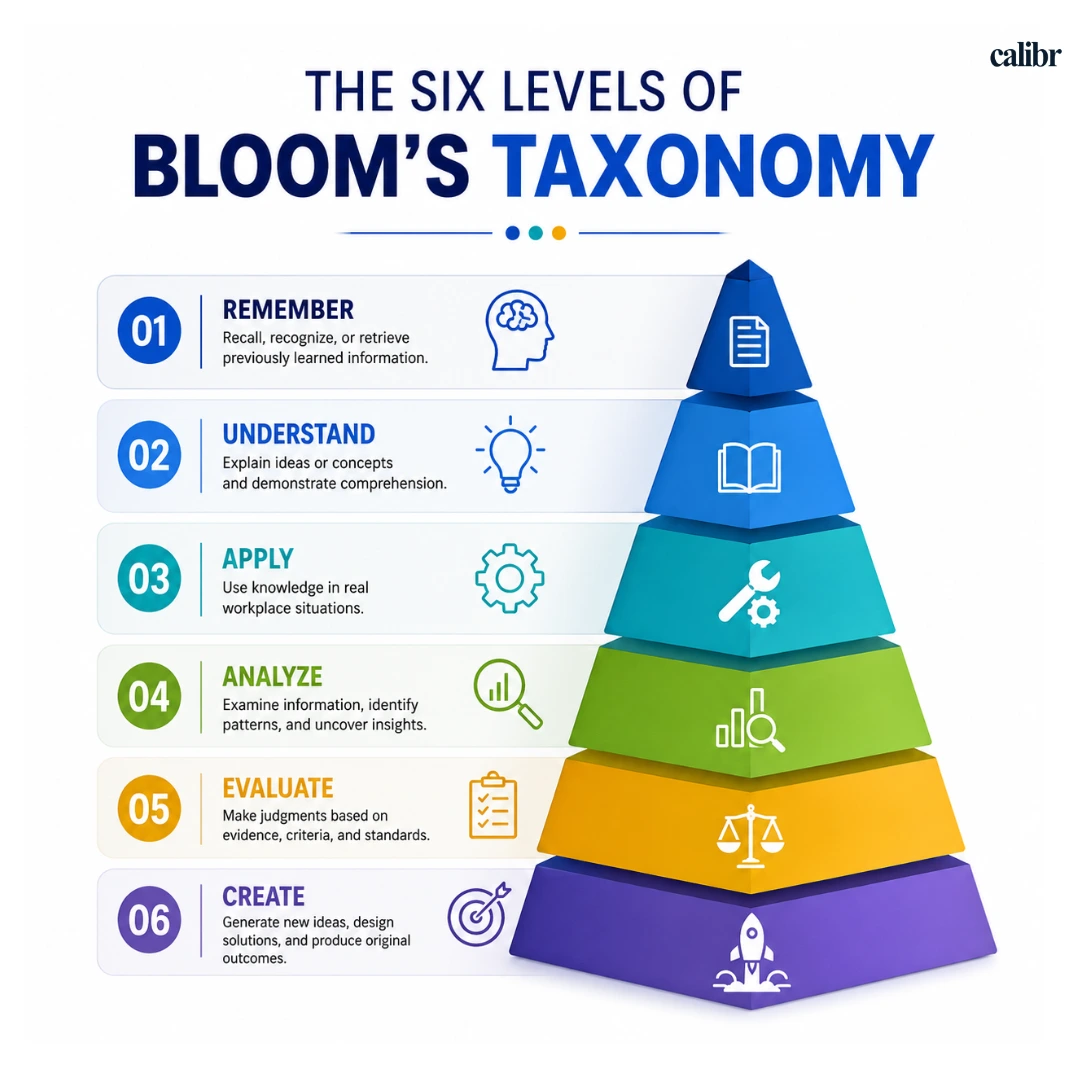
1. Remember
Definition
The Remember level focuses on the ability to recall, recognize, or retrieve previously learned information. It is the foundation of Bloom's Taxonomy because employees must first acquire knowledge before they can use it effectively in the workplace.
Purpose
This level ensures that employees possess the essential facts, terminology, procedures, and guidelines needed to perform their roles. While remembering information alone does not guarantee workplace competence, it provides the knowledge base required for higher-level thinking and performance.
Workplace Example
A customer support executive memorizes product specifications, troubleshooting procedures, escalation protocols, and service policies. When customers contact support, the employee can quickly recall the appropriate information and provide accurate responses.
Similarly, a compliance officer remembers regulatory requirements and organizational policies to ensure processes remain compliant.
Why It Matters
Employees who lack foundational knowledge often struggle to apply skills effectively. Strong recall improves efficiency, reduces errors, and helps employees perform routine tasks with confidence.
Common Learning Activities
Product knowledge modules
Compliance training
Policy and procedure reviews
Knowledge assessments
Flashcards and microlearning content
2. Understand
Definition
The Understand level goes beyond memorization. It focuses on the ability to explain concepts, interpret information, summarize ideas, and demonstrate comprehension.
Purpose
Employees must not only know information but also understand what it means and why it matters. This level helps learners connect facts to real-world workplace situations.
Workplace Example
A cybersecurity employee understands why multi-factor authentication is important and can explain how it reduces security risks. Instead of simply knowing the policy, they can communicate its purpose to colleagues and encourage adoption.
Similarly, a sales representative understands customer pain points and can explain how a product addresses specific business challenges.
Why It Matters
Understanding improves communication, collaboration, and decision-making. Employees who understand concepts can adapt their knowledge to different situations and explain information effectively to customers, peers, and stakeholders.
Common Learning Activities
Case studies
Group discussions
Instructor-led sessions
Scenario-based learning
Concept mapping exercises
3. Apply
Definition
The Apply level involves using knowledge, methods, or procedures in real workplace situations. This is often where learning begins to demonstrate measurable business value.
Purpose
The goal is to ensure employees can transfer learning into action. Instead of simply understanding a concept, they actively use it to perform tasks and solve problems.
Workplace Example
A project manager learns a new project management framework and applies it to organize project timelines, allocate resources, and manage risks.
Similarly, a sales executive uses newly learned negotiation techniques during customer meetings to improve conversion rates.
Why It Matters
Organizations invest in training to improve performance, not just knowledge. Application bridges the gap between learning and execution, making it one of the most critical stages in workplace learning.
Common Learning Activities
Simulations
Hands-on practice
On-the-job training
Role-playing exercises
Software labs
4. Analyze
Definition
The Analyze level focuses on examining information, identifying patterns, understanding relationships, and breaking complex situations into smaller components.
Purpose
Employees develop critical thinking skills that enable them to investigate issues, identify root causes, and uncover insights that support better decision-making.
Workplace Example
A business analyst reviews customer data to identify reasons behind declining retention rates. By analyzing trends and customer feedback, they uncover specific issues affecting customer satisfaction.
Similarly, an HR professional analyzes employee engagement survey results to identify recurring concerns and improvement opportunities.
Why It Matters
Modern workplaces generate large volumes of data and information. Employees who can analyze information effectively are better equipped to solve problems and make informed decisions.
Common Learning Activities
Data interpretation exercises
Root-cause analysis workshops
Business case studies
Process mapping activities
Problem-solving challenges
5. Evaluate
Definition
The Evaluate level involves making judgments based on evidence, criteria, and standards. Employees assess options, determine effectiveness, and recommend improvements.
Purpose
This level develops decision-making capabilities and encourages employees to think strategically about outcomes and alternatives.
Workplace Example
A procurement manager evaluates multiple vendors based on cost, reliability, quality, and long-term business value before selecting a supplier.
Similarly, a team leader evaluates project performance and determines which strategies should be continued, modified, or discontinued.
Why It Matters
Organizations depend on employees to make informed decisions every day. Strong evaluation skills help reduce risk, improve resource allocation, and support strategic business objectives.
Common Learning Activities
Peer reviews
Decision-making simulations
Strategic planning exercises
Risk assessment activities
Performance evaluation workshops
6. Create
Definition
Create is the highest level of Bloom's Taxonomy. It involves generating new ideas, designing solutions, developing strategies, and producing original outcomes.
Purpose
The objective is to enable innovation, continuous improvement, and business transformation. Employees at this level use their knowledge, experience, and critical thinking skills to develop something new and valuable.
Workplace Example
A product development team creates a new customer onboarding process that reduces implementation time by 40%.
Similarly, a marketing team develops an innovative campaign strategy that reaches a previously untapped customer segment and drives revenue growth.
Why It Matters
Organizations compete through innovation. Employees who can create new solutions, improve processes, and generate ideas contribute significant strategic value and help businesses adapt to changing market conditions.
Common Learning Activities
Innovation workshops
Design-thinking projects
Business improvement initiatives
Strategic planning exercises
Cross-functional collaboration projects
Moving Through the Levels
The true strength of Bloom's Taxonomy lies in progression.
Employees who only remember information may perform routine tasks effectively, but employees who reach the Analyze, Evaluate, and Create levels become problem-solvers, decision-makers, and innovators.
As learners move upward through the framework, their contribution shifts from knowledge consumption to business impact, making Bloom's Taxonomy a powerful model for workforce development and organizational growth.
How to Use Bloom's Taxonomy for Employee Training and Development
Understanding Bloom's Taxonomy is only the first step. The real value comes from applying the framework to create learning experiences that drive measurable workplace outcomes.
Rather than focusing solely on what employees should know after training, organizations should define what employees should be able to do. This shift helps transform training from knowledge delivery into capability development.
By aligning learning objectives with job responsibilities and business goals, organizations can create structured learning paths that progressively build skills, improve performance, and support long-term workforce development.
The following example shows how Bloom's Taxonomy can be applied across different workplace roles.
Role-Based Example
Role | Learning Objective | Bloom Level | Expected Outcome |
|---|---|---|---|
Sales Representative | Explain product benefits | Understand | Improved customer conversations |
Sales Representative | Use CRM workflows | Apply | Increased productivity |
Team Leader | Assess team performance data | Evaluate | Better coaching decisions |
Data Analyst | Develop predictive reports | Create | Enhanced business insights |
Customer Support Agent | Analyze recurring issues | Analyze | Faster problem resolution |
This approach supports Skill Development by connecting learning objectives directly to workplace behaviors and measurable outcomes.
Organizations that focus on how to use bloom's taxonomy for employee training and development often achieve stronger alignment between learning investments and business performance.
Measuring Learning Effectiveness with Bloom's Taxonomy
Designing effective learning experiences is only part of the process. Organizations must also determine whether employees are progressing through Bloom's levels and successfully applying their learning on the job.
By linking learning activities to observable workplace evidence, learning teams can move beyond completion rates and assess whether training is generating meaningful performance improvements.
The following matrix illustrates how each level of Bloom's Taxonomy can be connected to workplace outcomes and measurement methods.
Workplace Implementation Matrix
Bloom Level | Learning Activity | Workplace Evidence | Measurement Method |
|---|---|---|---|
Remember | Product knowledge training | Correct information recall | Knowledge quizzes |
Understand | Case study discussions | Accurate explanations | Scenario assessments |
Apply | Simulations and practice exercises | Task completion | Performance observation |
Analyze | Root-cause analysis workshops | Problem identification | Project evaluations |
Evaluate | Decision-making exercises | Quality recommendations | Manager review |
Create | Innovation projects | New solutions developed | Business impact metrics |
This framework helps organizations establish a clear connection between learning activities, employee capability growth, and workplace performance.
From Learning to Business Impact: The Bloom-to-Performance Map
Measuring learning effectiveness is important, but organizations ultimately care about business outcomes. As employees progress through Bloom's Taxonomy, the value they create for the organization increases.
While foundational knowledge supports consistent execution, higher-order skills such as analysis, evaluation, and creation contribute directly to problem-solving, innovation, and business growth.
Bloom-to-Performance Map
Learning Level | Business Impact |
|---|---|
Remember | Consistent foundational knowledge |
Understand | Improved communication and comprehension |
Apply | Better execution of daily responsibilities |
Analyze | Faster problem-solving and insight generation |
Evaluate | Stronger decision-making and risk management |
Create | Innovation, transformation, and competitive advantage |
This progression illustrates why Bloom's Taxonomy in Corporate Training has become an increasingly valuable framework for organizations focused on workforce capability building, performance improvement, and long-term business success.
Why Organizations Need a Skills-First Approach
Today's workforce challenges extend beyond knowledge gaps. Organizations need employees who can continuously learn, adapt, and apply new skills.
According to the World Economic Forum, 59% of the global workforce will require reskilling by 2030.
A skills-first approach focuses on what employees can do, not just what they know. Bloom's Taxonomy supports this by helping organizations define measurable competencies and learning outcomes that align with business goals.
As a result, organizations can identify skill gaps more effectively, improve workforce agility, and better prepare employees for evolving job demands.
How AI Is Transforming Bloom's Taxonomy
AI is making it easier for organizations to implement Bloom's Taxonomy at scale. Modern AI-powered LMS and LXP platforms can personalize learning paths, identify skill gaps, recommend relevant content, and adapt assessments based on learner progress.
For example, if an employee understands a concept but struggles to apply it, the platform can recommend scenario-based exercises, targeted learning resources, or practice activities to strengthen practical skills. This helps learners progress through Bloom's levels more efficiently while improving training effectiveness.
Platforms such as Calibr leverage AI to support skills based learning by helping organizations map learning to competencies, identify development opportunities, and track progress toward performance goals. As a result, L&D teams can create more personalized learning experiences while gaining better visibility into workforce capability development.
This combination of AI and Bloom's Taxonomy enables organizations to move beyond one-size-fits-all training and focus on building measurable workplace skills.
Key Considerations When Applying Bloom's Taxonomy
While Bloom's Taxonomy is a valuable framework, organizations should remember that learning is not always linear. Employees may move between levels depending on their experience, role, and work context.
The effectiveness of the framework also depends on assessment quality and workplace factors such as manager support, resources, and organizational culture.
Rather than treating Bloom's Taxonomy as a rigid structure, organizations should use it as a guide for designing meaningful learning experiences that support performance outcomes.
Key Takeaways
Bloom's Taxonomy helps transform learning into measurable workplace performance.
The framework progresses from remembering information to creating innovative solutions.
Organizations can align learning objectives with business outcomes using Bloom's levels.
A skills-first workforce strategy requires learning that extends beyond knowledge acquisition.
AI-powered learning platforms can support personalized progression through Bloom's levels.
Effective implementation requires strong assessments and workplace alignment.
Higher Bloom levels often generate greater business value and competitive advantage.
Frequently Asked Questions (FAQs)
What is Bloom's Taxonomy in employee training?
Bloom's Taxonomy is a learning framework that helps organizations design training programs that progress from basic knowledge acquisition to higher-order skills such as problem-solving, decision-making, and innovation. It ensures learning translates into workplace performance.
Why is Bloom's Taxonomy important in corporate training?
Bloom's Taxonomy in Corporate Training helps organizations create structured learning experiences that develop practical skills, improve job performance, and align training outcomes with business goals rather than focusing solely on course completion.
How can organizations apply Bloom's Taxonomy in employee development?
Organizations can apply Bloom's Taxonomy by defining clear learning objectives, aligning them with job responsibilities, designing activities for each cognitive level, and measuring workplace outcomes. This approach supports effective Skill Development and capability building.
What are the six levels of Bloom's Taxonomy?
The six levels are:
Remember
Understand
Apply
Analyze
Evaluate
Create
Each level represents a deeper stage of learning, helping employees move from recalling information to creating innovative solutions.
How does Bloom's Taxonomy improve workplace performance?
By guiding learners through progressively complex levels of thinking, Bloom's Taxonomy helps employees apply knowledge, solve problems, make better decisions, and contribute more effectively to organizational goals, resulting in stronger business performance.
Final Thoughts: The Future of Bloom's Taxonomy
As workforce skills continue to evolve, organizations need learning approaches that go beyond knowledge transfer and focus on measurable capability development. Bloom's Taxonomy remains a valuable framework because it helps transform learning into workplace performance by guiding employees from foundational knowledge to higher-order thinking and innovation.
As AI, automation, and workforce transformation continue to reshape the world of work, organizations that align learning objectives with business outcomes will be better positioned to build agile, future-ready teams. By focusing on capability development rather than content consumption, Bloom's Taxonomy can help create a culture of continuous learning, adaptability, and long-term success.
Ready to Turn Learning Into Performance?
Bloom's Taxonomy provides a proven framework for building workforce capabilities that drive measurable business results. With the right learning strategy and technology, organizations can transform training into continuous skill development and performance improvement.
Discover how Calibr can help you align learning, skills, and business outcomes.
Sign up for a demo or contact our team today to explore how Calibr can support your workforce development goals.


Vivetha is a digital marketing professional specializing in content marketing and SEO. She focuses on developing optimized, high-quality content that improves search visibility, supports brand objectives, and drives measurable results. With a structured and analytical approach, she ensures content aligns with business and audience needs.