
The CEFR Framework measures employee capability and proficiency, not just training completion.
It uses six proficiency levels (A1–C2) to track skill development from beginner to mastery.
Organizations can use CEFR to identify skill gaps, define expectations, and personalize learning paths.
The framework supports hiring, performance management, career development, succession planning, and workforce planning.
CEFR can be adapted across different roles, functions, and industries while maintaining a consistent proficiency structure.
As organizations adopt skills-based workforce strategies and AI-powered talent solutions, CEFR provides a practical way to measure and develop workforce capability.
Training Completed. But Is the Skill Really There?
Most organizations track learning activity extensively.
They measure training completion rates, certifications earned, learning hours consumed, and courses completed. These metrics are easy to capture and often appear prominently on learning dashboards.
But they rarely answer the most important question:
Can employees actually perform the skill on the job?
An employee may complete a leadership program, earn a project management certificate, or finish multiple communication courses. Yet managers often struggle to determine whether that individual can effectively lead a team, manage a complex project, or communicate with stakeholders under real workplace conditions.
This gap between learning activity and workplace capability is one of the biggest challenges facing modern Workforce Development initiatives.
As organizations move toward skills-based talent strategies, there is growing demand for frameworks that measure actual proficiency rather than participation.
This is where the CEFR Framework provides valuable insight.
Originally designed to assess language proficiency, the framework has increasingly been adapted to support workforce capability measurement, employee skill development, talent mobility, and competency-based career progression.
Rather than asking whether someone completed training, the CEFR approach asks:
What can they actually do today, and what level of proficiency have they reached?
What Is the CEFR Framework?
CEFR stands for Common European Framework of Reference.
Developed by the Council of Europe, the framework was originally created to establish a common method for assessing language proficiency across countries, institutions, and educational systems.
The framework introduced a structured progression model that classifies proficiency into six levels:
A1
A2
B1
B2
C1
C2
Over time, organizations recognized that the underlying proficiency model could be applied beyond language learning.
Today, many workforce development programs adapt CEFR principles to assess workplace skills, leadership capabilities, technical expertise, customer communication, project management, and other critical competencies.
The value of the framework lies in its simplicity.
Instead of relying on vague labels such as beginner, intermediate, or advanced, organizations can define observable behaviors associated with each proficiency level.
This creates a more objective and measurable approach to talent development
Why Proficiency Frameworks Matter in Workforce Development
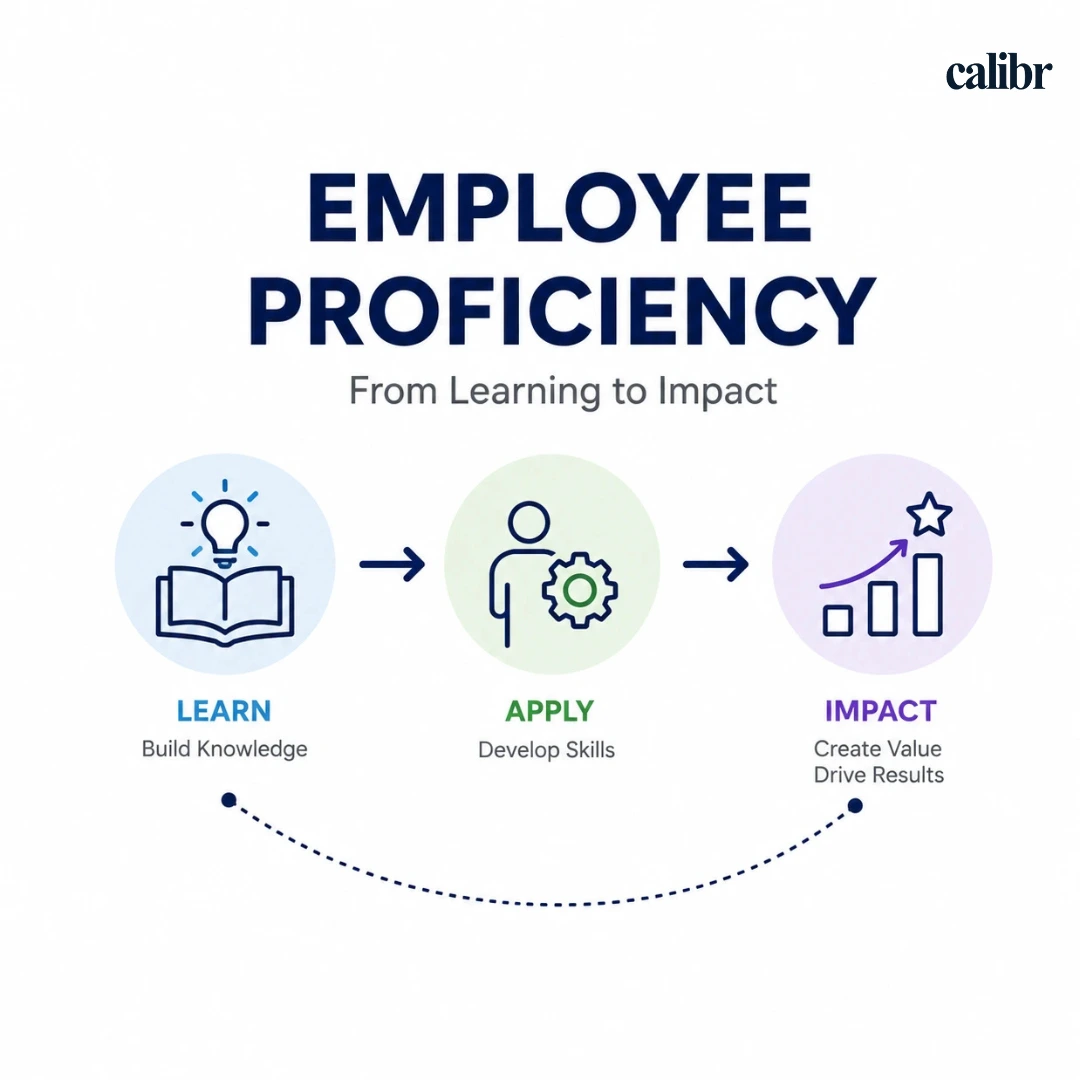
Modern organizations need more than course catalogs and certification records.
They need visibility into workforce capability.
A proficiency framework helps organizations answer questions such as:
What skills currently exist within the workforce?
How capable are employees in specific areas?
Where are the most critical skill gaps?
Which employees are ready for larger responsibilities?
What development interventions are needed?
By creating clear progression pathways, proficiency frameworks turn skill development into a measurable business process.
Why Organizations Are Adopting CEFR-Inspired Skill Frameworks
Organizations increasingly use CEFR-inspired Skill Frameworks because they help:
Benefit | Business Impact |
Create a common language for skills | Improves consistency across teams and locations |
Define proficiency expectations | Clarifies performance standards |
Personalize learning journeys | Supports targeted development |
Identify skill gaps | Enables focused investments |
Improve workforce planning | Strengthens talent forecasting |
Support talent mobility | Facilitates internal career movement |
The result is a more transparent and skills-driven organization.
How the CEFR Framework Works in Practice
Consider presentation skills.
Traditional learning metrics may show that three employees completed the same communication course.
However, their actual proficiency levels could be very different.
Employee | Training Status | Actual Capability |
Employee A | Completed | Can deliver basic presentations using prepared content |
Employee B | Completed | Can adapt messaging for different audiences |
Employee C | Completed | Can influence executives and manage complex discussions |
All three completed the training.
Only a proficiency framework reveals the difference in capability.
This distinction is essential for effective Talent Development and Workforce Planning.
The CEFR Skill Progression Framework
The CEFR Skill Progression Framework organizes capability into six progressive proficiency levels.
While the framework was originally designed to assess language proficiency, organizations increasingly use its progression model to measure workplace skills, developing leadership capabilities, technical expertise, and professional competencies.
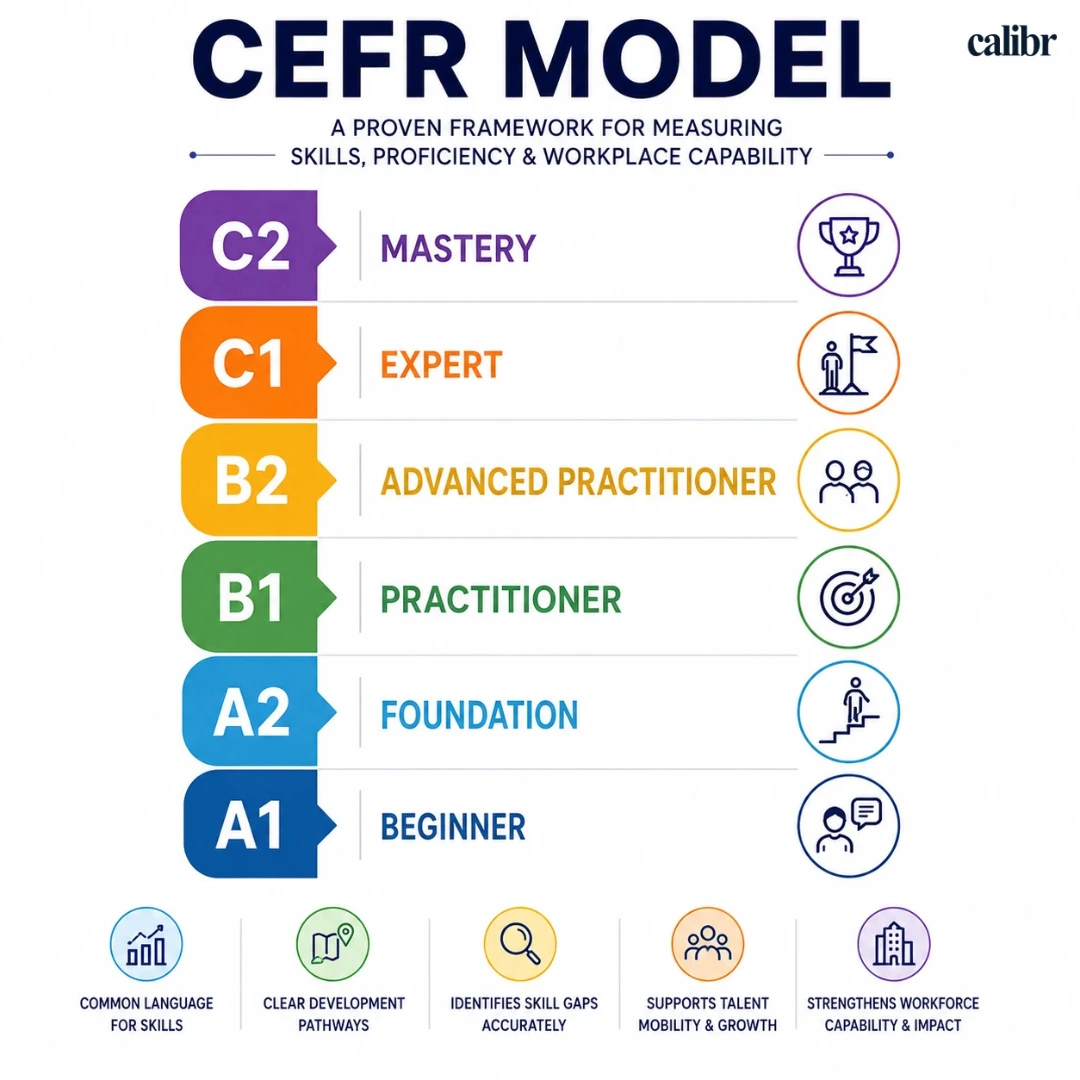
Each level represents a meaningful shift in how employees apply knowledge, solve problems, make decisions, and contribute to business outcomes.
CEFR Proficiency Levels in the Workplace
The CEFR Proficiency Levels are given below in the form of a table:
Level | Proficiency Stage | Workplace Capability | Typical Behaviors |
A1 | Beginner | Understands basic concepts and terminology | Requires close guidance and follows structured instructions |
A2 | Foundation | Performs simple tasks in familiar situations | Applies basic skills with occasional support |
B1 | Practitioner | Independently performs routine work activities | Demonstrates consistent application of skills |
B2 | Advanced Practitioner | Handles complex situations and adapts effectively | Solves problems independently and supports peers |
C1 | Expert | Demonstrates deep expertise and strategic judgment | Leads initiatives, coaches others, and influences decisions |
C2 | Mastery | Shapes organizational capability and best practices | Drives innovation, develops standards, and mentors experts |
The progression is not simply about gaining more knowledge. As employees move through the levels, they become more independent, solve increasingly complex problems, and create greater value for the organization.
How Employees Grow from Beginner to Expert
Area | A1–A2 | B1–B2 | C1–C2 |
Knowledge | Understands core concepts and terminology | Applies knowledge across different situations | Creates, refines, and shares expertise |
Independence | Requires regular guidance and support | Works independently with confidence | Operates strategically with minimal oversight |
Problem Solving | Resolves straightforward issues | Handles complex challenges and adapts solutions | Solves ambiguous, high-impact business problems |
Decision Making | Follows established processes | Makes informed operational decisions | Influences strategic business decisions |
Influence | Contributes as an individual performer | Supports and influences team outcomes | Shapes organizational direction and best practices |
Learning Approach | Learns and builds foundational knowledge | Applies and continuously improves skills | Mentors others and develops organizational capability |
Employee growth typically follows four broader stages:
Learning (A1–A2): Employees build foundational knowledge, understand key concepts, and learn how work is performed.
Application (B1): Employees begin applying skills independently and consistently in day-to-day responsibilities.
Optimization (B2): Employees improve efficiency, solve more complex problems, and adapt their skills to different situations.
Leadership & Strategic Impact (C1–C2): Employees influence decisions, guide others, establish best practices, and contribute to long-term organizational success.
This progression makes the CEFR Framework valuable for Workforce Development because it measures not just what employees know, but how effectively they can apply, improve, and leverage their skills to create meaningful business impact.
Applying the CEFR Framework Within Organizations
The proficiency levels remain consistent across industries, but the skills, behaviors, and expectations associated with each level vary based on the role, function, and business context.
Role-Based Example
Level | Sales Professional | Software Developer | Customer Support Specialist | People Manager |
A1 | Understands product basics | Understands coding fundamentals | Learns support processes | Learns management principles |
B1 | Manages customer conversations independently | Delivers assigned development tasks | Resolves routine customer issues | Leads day-to-day team activities |
C1 | Influences major customer decisions | Architects technical solutions | Handles critical escalations | Leads strategic workforce initiatives |
The structure remains identical.
The behavioral indicators change according to job requirements.
This flexibility makes CEFR-inspired Competency Frameworks highly scalable across organizations.
Organizational Applications
Organizations can use the framework across multiple talent processes.
Workforce Area | Application |
Hiring | Define proficiency expectations for job candidates |
Learning & Development | Build personalized development pathways |
Performance Management | Evaluate capability growth objectively |
Career Development | Create transparent progression routes |
Succession Planning | Identify future leaders and experts |
Workforce Planning | Assess organizational capability and skill gaps |
When integrated effectively, the framework creates alignment between business strategy and workforce capability.
Common Challenges When Implementing the CEFR Framework
While CEFR frameworks offer substantial benefits, successful implementation requires careful planning.
Challenge | Why It Matters | How to Overcome It |
Unclear proficiency definitions | Creates confusion and inconsistency | Develop observable behavioral indicators |
Inconsistent evaluations | Reduces assessment reliability | Train managers and assessors |
Role differences | One model may not fit all roles | Customize behaviors by function |
Employee resistance | Employees may fear evaluation | Position the framework as a development tool |
Maintaining framework relevance | Skills evolve rapidly | Review and update frameworks regularly |
Organizations that treat proficiency frameworks as living systems achieve stronger long-term adoption.
Future of CEFR-Based Skill Frameworks
Is the CEFR Framework Still Relevant?
Yes.
In fact, proficiency-based frameworks are becoming more important as organizations shift toward Skills-Based Organization models.
The challenge today is no longer access to learning.
The challenge is understanding workforce capability accurately.
Modern organizations need reliable methods to identify what employees can do, where capability gaps exist, and how skills align with evolving business needs.
This is exactly what proficiency frameworks provide.
How Technology Is Enhancing Proficiency Frameworks
Modern technologies are making CEFR-inspired skill frameworks more scalable, accurate, and business-focused by enabling organizations to:
Conduct AI-assisted skills assessments to evaluate proficiency levels using performance data, work outputs, and assessment results.
Leverage skills intelligence platforms to map workforce capabilities and identify emerging skill gaps across the organization.
Implement dynamic competency mapping that evolves alongside changing business priorities and workforce needs.
Deliver personalized learning recommendations based on each employee's current proficiency level and development goals.
Enable internal talent marketplaces that match employees to projects, roles, and opportunities based on demonstrated skills rather than job titles.
Track workforce capabilities in real time to provide leaders with visibility into organizational readiness, strengths, and development needs.
Technology is not replacing proficiency frameworks—it is making them more actionable, data-driven, and aligned with business outcomes.
AI-powered learning platforms such as Calibr help organizations operationalize proficiency frameworks by combining skills assessments, personalized learning pathways, competency mapping, and workforce analytics within a single learning ecosystem.
What Organizations Should Do Next
Organizations seeking to strengthen workforce capability should:
Identify critical business skills.
Define proficiency expectations clearly.
Establish role-specific behavioral indicators.
Align learning pathways to proficiency levels.
Integrate skills assessments into talent processes.
Use workforce analytics to monitor capability growth.
The organizations that measure capability effectively will make better talent decisions and build stronger competitive advantage.
Frequently Asked Questions (FAQs)
What is the CEFR Framework in Workforce Development?
The CEFR Framework is a proficiency-based model that helps organizations assess and develop employee skills through defined capability levels. Rather than measuring training completion, it focuses on what employees can actually do and how effectively they can apply their skills in the workplace.
How does the CEFR Framework differ from traditional training metrics?
Traditional metrics track learning activities such as course completions, certifications, and learning hours. The CEFR Framework measures actual skill proficiency and workplace performance, providing a clearer picture of employee capability and readiness.
Can the CEFR Framework be used for skills beyond language proficiency?
Yes. While originally developed for language assessment, organizations now adapt CEFR principles to evaluate leadership, project management, customer communication, technical skills, sales capabilities, and other workplace competencies.
How does the CEFR Framework support Talent Development and Workforce Planning?
The framework helps organizations identify skill gaps, define proficiency expectations, personalize learning journeys, support internal mobility, and make better hiring, succession planning, and workforce development decisions.
Is the CEFR Framework still relevant in the age of AI and Skills-Based Organizations?
Absolutely. In fact, proficiency frameworks are becoming more valuable as organizations adopt AI-assisted skills assessments, skills intelligence platforms, personalized learning recommendations, and real-time workforce capability tracking. CEFR provides the structure needed to measure and develop workforce capability at scale.
Key Takeaways
The CEFR Framework focuses on measuring proficiency and capability rather than training completion.
The six-level structure provides a clear pathway from beginner to mastery.
Organizations can adapt the framework across industries, roles, and functions.
CEFR-based Skill Frameworks support hiring, learning, performance management, and workforce planning.
Role-specific behavioral indicators improve assessment accuracy and development effectiveness.
Proficiency frameworks remain highly relevant as organizations adopt skills-based workforce strategies and AI-enabled talent systems.
Final Thoughts
Training completion metrics alone no longer provide an accurate picture of workforce readiness.
Organizations need a deeper understanding of employee capability.
They must know what employees can actually do, how proficiency develops over time, where capability gaps exist, and how workforce skills align with business priorities.
The CEFR Framework offers a practical and scalable approach to achieving that visibility.
By focusing on measurable proficiency levels, organizations can create clearer development pathways, improve talent decisions, strengthen Workforce Capability, and accelerate Employee Skill Development.
As skills-based organizations continue to emerge, proficiency frameworks like CEFR will play an increasingly important role in connecting learning investments to real business outcomes.
As organizations operationalize proficiency-based workforce strategies, having the right technology becomes essential. AI-powered LMS and LXP platforms like Calibr help organizations assess skills, map proficiency levels, deliver personalized learning pathways, and build a more capable workforce at scale.
Ready to turn skill data into workforce capability? Sign up now or Contact our team to see how AI-powered learning can support your CEFR-based development strategy.
The future of Workforce Development belongs to organizations that measure capability—not just participation.


Vivetha is a digital marketing professional specializing in content marketing and SEO. She focuses on developing optimized, high-quality content that improves search visibility, supports brand objectives, and drives measurable results. With a structured and analytical approach, she ensures content aligns with business and audience needs.