Cognitive Load Theory: The Most Ignored Secret in Instructional Design


Most employees do not forget training because they are poor learners. They forget because many learning experiences overload the brain before real learning even begins.
Cognitive Load Theory explains how excessive information, confusing design, and unnecessary distractions reduce learning retention and engagement.
In modern workplace learning environments filled with meetings, notifications, and multitasking, poorly designed training becomes another source of mental overload.
Effective instructional design reduces this unnecessary mental effort by simplifying navigation, chunking information, reducing visual clutter, and focusing attention on what matters most.
As AI and modern learning technologies continue evolving, instructional designers must create learning experiences that are not only informative, but also clear, searchable, easy to process, and easier to retain.
The Real Reason Employees Forget Training
Think about the last time your organization launched a new learning initiative. Hours of content built. Subject matter experts consulted. An LMS configured. A completion deadline is set.
Then three weeks later — almost nothing retained.
The usual explanation is familiar: learners were not engaged enough. They lacked motivation. The content was not relevant. But in many cases, the real problem starts much earlier.
Most employees do not forget training because they are poor learners. They forget because many learning experiences overwhelm the brain before real learning even begins.
Modern workplace learning happens in an environment filled with constant distractions and mental pressure. Employees are already managing notifications, deadlines, meetings, emails, and multiple tasks throughout the day.
At the same time, they are expected to complete training that demands sustained focus and attention.
A typical eLearning module may contain multiple learning objectives, dense information, complex interactions, and long narration — all delivered within the same busy workday.
For the learner, training is no longer a separate learning experience. It becomes another task competing for mental attention.
When too much information competes for attention at once, the brain struggles to process and retain it effectively. Employees may complete the training, but very little stays with them afterwards.
This is exactly why Cognitive Load Theory matters.
It reminds instructional designers of a simple but important truth: learning cannot happen effectively when the brain is overwhelmed. The role of learning design is not just to deliver information, but to make information easier to process, understand, and retain.
Yet despite its importance, Cognitive Load Theory remains one of the most underutilised frameworks in modern instructional design.
What Is Cognitive Load?
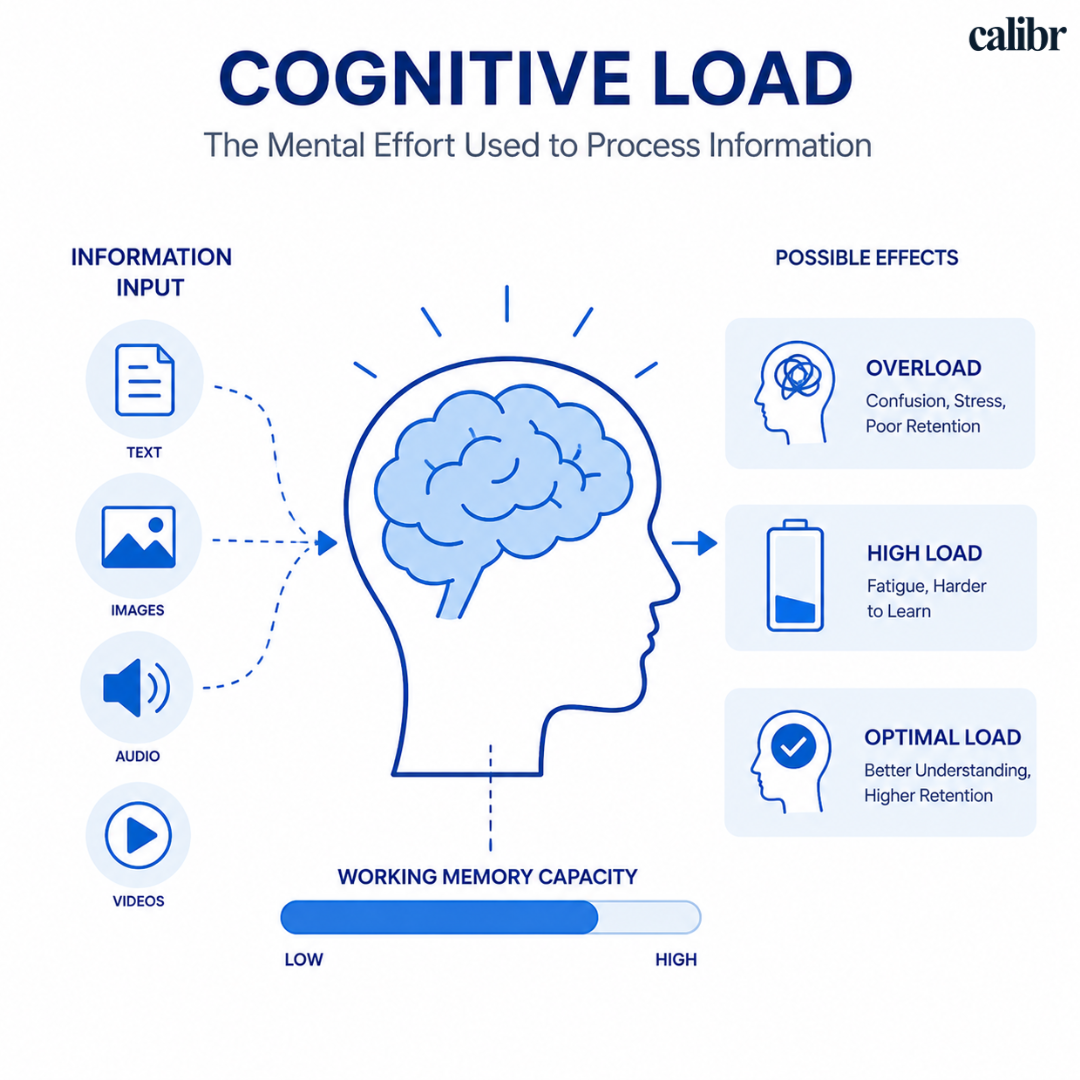
Cognitive load is the amount of mental effort the brain uses while learning or processing information. When learners receive too much information at once, the brain struggles to understand, organise, and remember it effectively.
For example, imagine an employee opening a training module filled with long paragraphs, narration, multiple tabs, animations, and several learning objectives all on the same screen. Instead of focusing on understanding the topic, the learner spends most of their mental energy simply trying to keep up.
This is called cognitive overload.
In workplace learning, cognitive overload happens when training experiences demand more mental effort than the brain can comfortably handle. As a result, learners may lose focus, forget important information, or complete training without truly understanding it.
Cognitive Load Theory Explained: What John Sweller Identified
Cognitive Load Theory was introduced by educational psychologist John Sweller in 1988 and remains one of the most influential frameworks in instructional design. Sweller argued that the way information is presented directly affects whether learners can process and retain it.
Because working memory has limited capacity, poorly structured instruction can overwhelm the brain before meaningful learning occurs. Cognitive Load Theory explains that effective learning design reduces unnecessary mental effort so learners can focus on understanding, schema formation, and long-term retention.
Every instructional design decision either supports learning efficiency — or competes with it. For example, a clean screen with one key message helps learners focus, while cluttered slides, excessive animations, and duplicate narration increase unnecessary mental effort.
Why Cognitive Load Theory Matters Today
Cognitive Load Theory in workplace learning has become increasingly important as employees navigate high-information, high-distraction environments. Modern learners are expected to absorb new knowledge while simultaneously managing meetings, notifications, deadlines, multitasking, and constant context switching.
In many organisations, learning no longer happens in isolated training environments. It happens alongside daily operational pressure. As a result, instructional design must account not only for what employees need to learn, but also for the cognitive conditions under which learning takes place.
This is why reducing unnecessary cognitive friction — the mental strain created by confusing or overloaded learning experiences has become essential to improving retention, engagement, and performance outcomes in workplace learning.
The Hidden Reason Most Instructional Design Fails
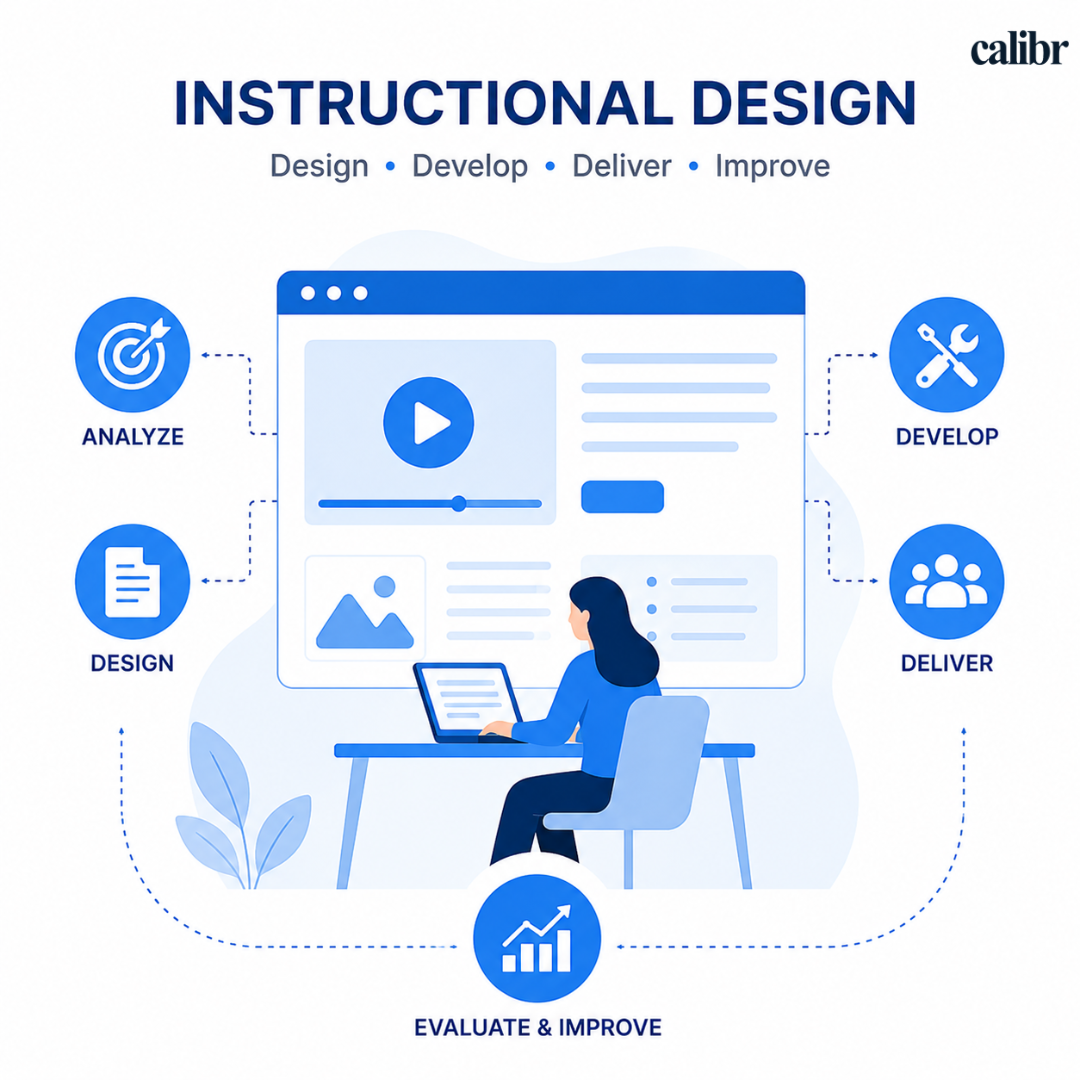
Most instructional design is still built around a content delivery model. Subject matter experts provide information. Designers structure it into slides, modules, or videos. Learners consume it. Completion is tracked. The process is repeated.
The problem is that this model optimizes for content coverage, not cognitive processing. And those are not the same thing. As organizations rethink workforce capability development, platforms like Calibr are increasingly shifting toward adaptive, skills-based learning experiences designed to reduce unnecessary cognitive friction and support continuous capability development.
Great instructional design is not information delivery. It is cognitive energy management.
Imagine an employee opening a mandatory compliance course after a full day of meetings. The module contains dense text, narration, multiple tabs, complex navigation, and 47 slides to complete before the end of the day.
Within minutes, the learner is no longer focused on understanding the content. They are simply trying to get through it. This is cognitive overload in practice.
This is where cognitive friction begins — the unnecessary mental effort created by poorly designed learning experiences.
Confusing navigation, cluttered screens, excessive instructions, and duplicate information all force the brain to work harder than necessary. For example, reading dense on-screen text while listening to narration that communicates nearly the same thing increases mental effort without improving learning.
None of this extra effort helps the learner understand better. It simply drains attention and reduces retention.
Every unnecessary click, instruction, or distraction increases cognitive friction.
The irony of content-heavy learning design is that more material often produces less learning. Overloaded eLearning modules create learner fatigue not because the topic is too hard, but because the experience makes the brain work harder than the content actually requires.
Completion rates are not evidence that learning occurred. They are evidence that the module ended. The two are not the same.
Instructional designers who understand cognitive load stop asking “How do we cover all of this content?” and start asking “How do we protect cognitive space for what matters most?” That shift in question is where effective learning design begins.
The 3 Types of Cognitive Load — And How They Create Cognitive Overload
Not all cognitive load is harmful. The brain is designed to handle mental effort when that effort is well-directed. The problem arises when unnecessary mental demands compete with genuine learning.
Cognitive Load Theory identifies three distinct types of load. Understanding each one allows instructional designers to make deliberate decisions about where mental energy goes.
Type | What It Means | Workplace Learning Example |
Intrinsic Load | The mental effort needed to understand the topic itself | Learning a new software system, compliance policy, or coding concept |
Extraneous Load | Extra mental effort caused by poor course design | Confusing navigation, too much text on screen, unnecessary animations, duplicate narration |
Germane Load | Mental effort that helps learners truly understand and remember | Scenario-based activities, case studies, practice exercises, real-world simulations |
The goal is not to remove all cognitive load. Some mental effort is necessary for learning to happen. The real objective is to reduce unnecessary mental effort caused by poor instructional design so learners can focus on understanding, applying, and retaining the most important information.
Effective instructional design does not overwhelm learners with excessive content or distractions. It creates clear, structured learning experiences that help employees absorb information more efficiently and apply it with confidence in real workplace situations.
Cognitive Overload Examples in Workplace Learning
Cognitive overload happens when learners are asked to process more information than the brain can comfortably handle at one time.
In workplace learning, this is far more common than most organisations acknowledge.
These are some common workplace learning situations where cognitive overload occurs.
• 90-slide PowerPoint-based training sessions that present information linearly without meaningful processing activities
• Long compliance modules with dense text narration and simultaneous on-screen text conveying the same content
• Onboarding portals that present new employees with 20 mandatory modules in their first week
• eLearning courses with cluttered visual interfaces, multiple competing focal points, and inconsistent navigation
• Videos that run 15 to 20 minutes without natural pause points, recaps, or comprehension checks
• Multitasking environments where learners are expected to complete training while managing their normal workload
• Excessive interactions and unnecessary clicks that interrupt cognitive flow without adding instructional value
Most workplace learning does not fail because employees cannot learn. It fails because learning experiences waste mental energy on unnecessary processing.
These examples show that cognitive overload is often created by the learning experience itself, not the learner’s ability to learn.
When courses contain excessive content, unnecessary interactions, or confusing design, learners spend more mental effort navigating the experience than understanding the actual concepts.
Effective instructional design reduces this unnecessary effort so learners can focus on what truly matters.
How Instructional Designers Can Reduce Cognitive Overload in Training
Reducing cognitive load is not about making learning easier. It is about making learning more efficient. Complexity that belongs to the subject should be preserved, while complexity created by poor instructional design should be eliminated.
For example, instead of placing large amounts of text, multiple animations, and several learning activities on a single screen, an instructional designer can simplify the layout, break content into smaller sections, and highlight only the most important information. These small design decisions make learning easier to process and remember.
Effective instructional designers reduce cognitive overload in training by simplifying interfaces, chunking information into manageable sections, removing unnecessary distractions, and reducing cognitive friction throughout the learning experience.
These principles create space for stronger understanding and long-term retention
The following eight strategies provide a practical foundation for designing learning experiences that are easier to understand and retain
1. Chunk Information
The brain processes information more effectively when it is broken into smaller, logically connected units. Long continuous content creates a single, unbroken cognitive demand. Chunking creates natural processing pauses that give learners time to process information before moving forward. Microlearning, modular design, and clearly segmented lessons all apply this principle.
2. Simplify Navigation
Navigation is not neutral. A learner who has to work out how to move through a course is spending cognitive energy on the interface rather than the content. Learner engagement drops when navigation is ambiguous, inconsistent, or overly complex. Simple, predictable navigation reduces unnecessary mental effort before the lesson begins.
3. Reduce Visual Noise
Every visual element on a screen competes for cognitive attention. Decorative graphics, unnecessary animations, dense text blocks, and competing colour schemes all create processing demands that do not contribute to learning. Clarity is a design goal. The best instructional design often feels invisible because it removes friction before learners notice it.
4. Design Progressive Learning Paths
Intrinsic load is unavoidable, but it can be sequenced intelligently. Starting with foundational concepts before introducing complexity allows learners to build understanding step by step before encountering higher-demand material. Progressive learning paths help learners build confidence and understanding gradually instead of overwhelming them with complexity too early.
5. Avoid Redundant Information
The redundancy effect is well-documented in Cognitive Load Theory research. Presenting the same information through multiple simultaneous channels — narration and identical on-screen text being the most common example — increases cognitive load without improving comprehension. Present information once, through the channel best suited to the learning objective.
6. Use Scenario-Based Learning
Well-designed scenarios generate germane load — the useful kind. They ask learners to apply knowledge in a meaningful context, which builds the kind of understanding that transfers beyond the training environment. More importantly, they reduce the extraneous load created by abstract information delivery. People learn better when they apply concepts instead of simply memorizing information.
7. Reduce Split Attention
Split attention happens when learners must constantly switch focus between different pieces of information. For example, if a diagram appears on one screen while its explanation appears somewhere else, learners spend extra mental effort trying to connect both. Keeping related information together makes learning easier and clearer.
8. Prioritize Clarity Over Decoration
Good learning design should feel clear and easy to follow. Too many colours, animations, graphics, or decorative elements can distract learners from the actual content. Every design choice — including layout, text, colour, and pacing — should help learners focus on understanding the information clearly.
Cognitive Offloading and the Future of Learning
One of the most practical applications of Cognitive Load Theory is the deliberate use of cognitive offloading — the practice of externalising mental processing to reduce in-the-moment cognitive demands.
Job aids, checklists, reference guides, and decision trees are all forms of cognitive offloading. They do not replace learning. They support performance by removing the need to hold complex information in working memory during execution.
A surgeon does not memorize a pre-operative checklist from memory. A pilot follows a procedure document.
Not because they lack expertise, but because offloading predictable cognitive tasks preserves mental capacity for the decisions that actually require it.
Performance support systems represent a matured version of this thinking. AI-native learning ecosystems, including platforms such as Calibr, are increasingly enabling contextual learning support, personalized retrieval, and intelligent performance assistance directly within employee workflows. Rather than requiring employees to retrieve everything from memory, well-designed performance support makes the right information available at the moment of need, in a format that does not overload the user.
AI learning assistants are now extending this further. Personalized retrieval prompts, adaptive content recommendations, and intelligent job aids that respond to contextual signals are beginning to make cognitive offloading dynamic rather than static.
In the AI era, reducing cognitive friction may become the most valuable skill in instructional design.
As learning technology evolves, the organizations that design for cognitive efficiency — rather than content volume — will produce learning experiences that are not just more engaging, but measurably more effective.
Designing Learning Content for the AI Search Era
Today’s learners no longer consume learning content in a completely linear way. They search for answers, scan summaries, ask AI tools questions, and access information at the moment they need it.
As AI-powered search and generative engines increasingly shape how employees discover information, instructional content must now be designed not only for learning, but also for discoverability, clarity, retrieval, and AI-assisted understanding.
For instructional designers, this creates a new challenge: learning content must reduce cognitive overload while also helping learners quickly find, process, and apply information efficiently.
This is where the S.E.A.R.C.H framework becomes useful.
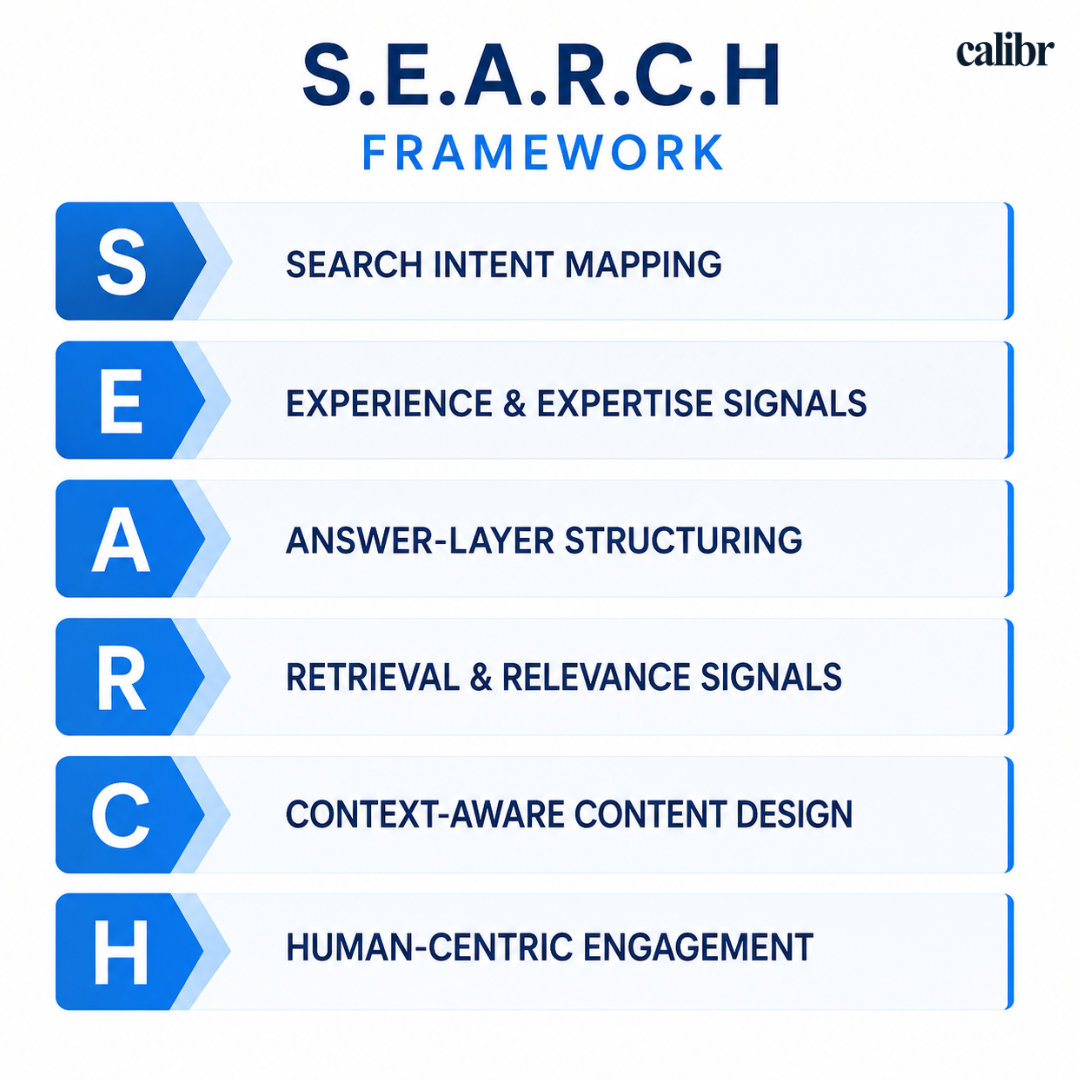
Letter | Principle | What It Means in Practice |
S | Search Intent Mapping | Design content around what learners actually need help with, not just what SMEs want to include |
E | Experience & Expertise Signals | Use real examples, practical insights, and credible guidance that build learner trust |
A | Answer-Layer Structuring | Present key answers clearly using summaries, headings, and concise explanations |
R | Retrieval & Relevance Signals | Organise content using clear structure, keywords, and logical flow so information is easy to find and understand |
C | Context-Aware Content Design | Design learning content that adapts to learner context, workflows, and real-world usage scenarios |
H | Human-Centric Engagement | Keep the learner experience simple, clear, and cognitively manageable at every stage |
At its core, the S.E.A.R.C.H framework supports cognitive-first learning design by reducing the mental effort required to search, understand, and apply information in modern AI-driven learning environments.
As workplace learning continues evolving alongside AI, instructional designers will increasingly need to design not only for content delivery, but also for clarity, discoverability, retrieval, and real-world performance support.
Key Takeaway
The brain can handle only a limited amount of information at one time. Too much information can reduce learning and retention.
Cognitive overload is usually caused by poor course design, not poor learners.
Confusing navigation, cluttered screens, and too much content make learning harder than it needs to be.
Good instructional design makes learning feel clear, simple, and easier to follow.
Learners remember more when they can focus on the most important information without unnecessary distractions.
Job aids, checklists, and AI-powered learning support can reduce mental overload by giving learners help when they need it.
As AI changes how people search and learn, instructional designers must create content that is clear, easy to find, and easy to understand.
Frequently Asked Questions (FAQs)
Why do employees forget training so quickly?
Employees often forget training because learning experiences overload the brain with too much information, distractions, or unnecessary complexity at once.
What is cognitive load in simple terms?
Cognitive load is the amount of mental effort the brain uses while learning or processing information.
What causes cognitive overload in workplace learning?
Cognitive overload happens when learners are asked to process more information than they can comfortably handle at one time.
How does poor instructional design affect learning retention?
Poor instructional design can overwhelm learners with excessive content, confusing navigation, and unnecessary distractions, making information harder to understand and remember.
What are the 3 types of cognitive load?
The three types are:
Intrinsic Load — the effort needed to understand the topic itself
Extraneous Load — extra mental effort caused by poor course design
Germane Load — useful mental effort that helps learners understand and remember information better
How can instructional designers reduce cognitive overload?
Instructional designers can reduce cognitive overload by simplifying navigation, breaking content into smaller sections, reducing visual clutter, and using practical learning activities.
Why do long eLearning courses reduce engagement?
Long courses often overwhelm learners with too much information without giving enough time to process or apply concepts effectively.
What is an example of cognitive overload in training?
A common example is a long compliance module filled with dense text, narration, multiple interactions, and complex navigation all presented in a single session.
What is cognitive friction in instructional design?
Cognitive friction is the unnecessary mental effort caused by confusing or overloaded learning experiences.
How does Cognitive Load Theory improve learning design?
It helps instructional designers create learning experiences that are easier to process, understand, and retain.
What is cognitive offloading in workplace learning?
Cognitive offloading means reducing mental effort by providing support tools such as job aids, checklists, reference guides, or AI-powered assistance when learners need them.
How can AI help reduce cognitive overload?
AI can reduce cognitive overload by helping learners quickly access relevant information, personalised guidance, and performance support at the right moment.
Why do employees struggle to retain compliance training?
Compliance training often contains large amounts of dense information delivered in long modules, making it difficult for learners to process and retain effectively.
What makes learning content easier to understand and remember?
Clear structure, simple navigation, practical examples, reduced distractions, and concise information all improve learning retention.
How should instructional design change in the AI era?
Instructional design should focus on creating learning experiences that are clear, searchable, easy to retrieve, and supportive of real-time learning needs.
Final Thoughts
Workplace learning often fails not because employees cannot learn, but because learning experiences overwhelm them with too much information, complexity, and distraction at once.
Cognitive Load Theory reminds instructional designers that effective learning is not about adding more content. It is about helping learners focus on what matters most and making information easier to understand, process, and apply.
Simple improvements such as clearer navigation, shorter learning sections, reduced visual clutter, and practical scenarios can significantly improve retention and engagement.
As AI and modern learning technologies continue changing how employees access information, instructional design must also evolve. Learning experiences should not only deliver information, but also support employees with the right guidance at the right moment.
Organizations that design learning around how the brain actually processes information will create training experiences that are more useful, more engaging, and far more effective in real workplace situations.
Rethinking Learning for the Cognitive Era
As organizations move toward AI-native and skills-driven learning ecosystems, cognitive-first instructional design will become a competitive advantage — not just a learning preference.
Modern learning platforms such as Calibr are increasingly helping organizations build adaptive learning experiences designed for continuous workforce evolution, capability intelligence, and scalable performance support.


Vivetha is a digital marketing professional specializing in content marketing and SEO. She focuses on developing optimized, high-quality content that improves search visibility, supports brand objectives, and drives measurable results. With a structured and analytical approach, she ensures content aligns with business and audience needs.