Employee burnout is more than temporary stress or exhaustion.
Burnout often appears through emotional withdrawal and disengagement before performance visibly declines.
High performers are frequently the most vulnerable to burnout.
Modern workplace culture — including constant connectivity and AI-driven pressure — has intensified burnout risks.
Preventing burnout requires organizational and cultural changes, not just wellness programs.
Early recognition, supportive leadership, and sustainable workloads play a major role in burnout prevention.
Frameworks like the RENEW Model can help organizations build a more structured approach to burnout prevention and recovery.
The Quiet Crisis Nobody Puts in a Performance Review
There's a particular kind of tiredness that doesn't show up on a timesheet. It doesn't trigger an alert in your HRIS. It rarely appears in exit interviews — at least not honestly. It builds slowly, invisibly, until one day a high-performing employee who used to send ideas at midnight is now responding to Slack messages in monosyllables. Their output looks fine on paper. But something has fundamentally changed.
That's employee burnout in its most dangerous form: not the dramatic resignation, but the slow erosion of someone's capacity to care.
For HR leaders and managers navigating today's hybrid, always-on, AI-accelerated workplace, burnout isn't a wellness issue to hand off to an EAP provider. It's a structural, cultural, and strategic problem — and solving it requires treating it like one.
What Is Employee Burnout
The World Health Organization defines burnout as chronic workplace stress that hasn't been successfully managed. But in reality, burnout is more than stress.
It's the gradual loss of energy, motivation, and emotional connection to work. Over time, employees begin feeling exhausted, detached, and disconnected from the impact of what they do.
Burnout doesn't happen after one difficult week. It develops when workplace demands consistently outweigh the support, recovery, autonomy, and clarity employees need to sustain themselves.
But understanding burnout conceptually is one thing. Recognizing how it actually shows up at work is another.
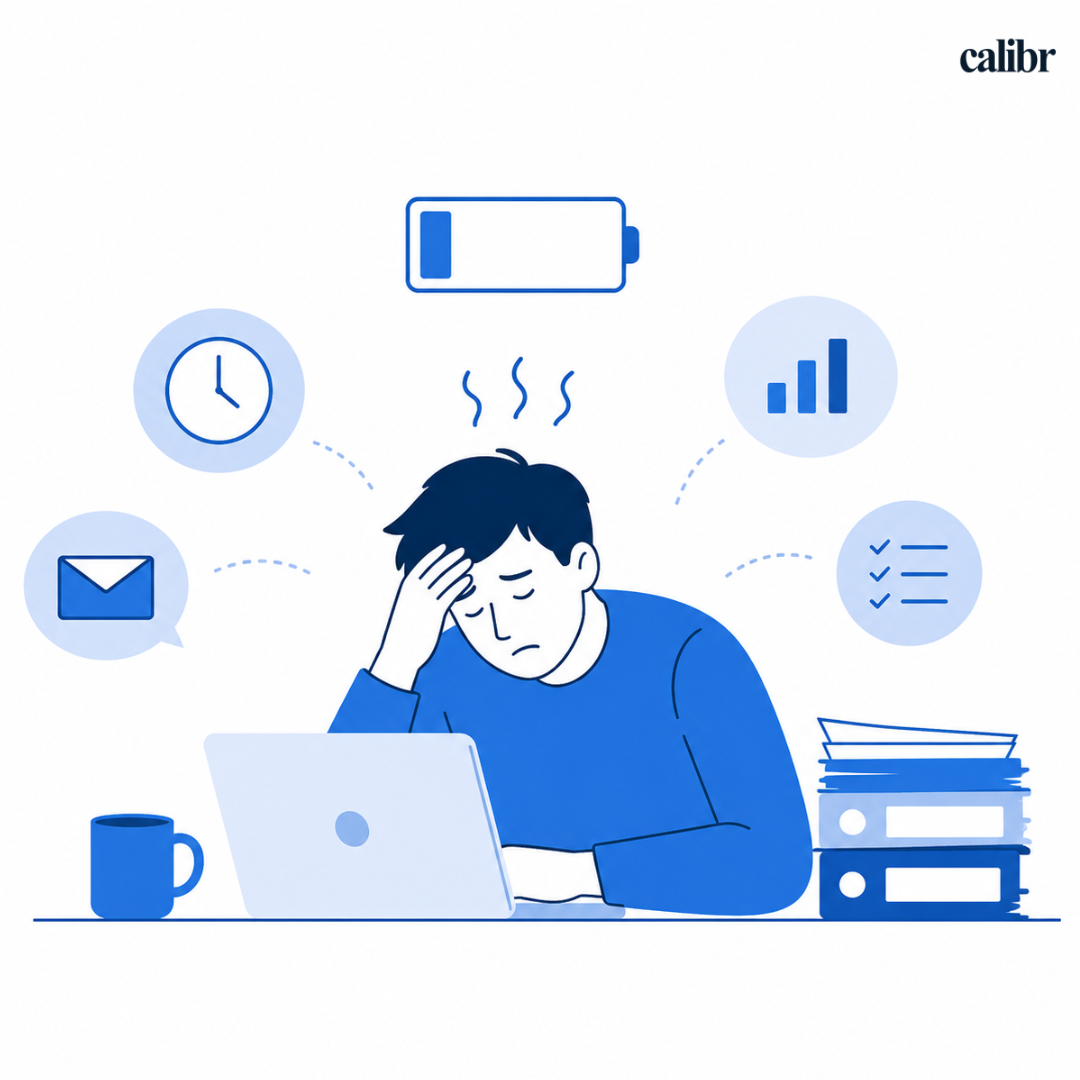
How Employee Burnout Actually Looks Like at Work
Forget the image of someone sitting at their desk looking visibly overwhelmed. In modern workplaces, burnout is often far less obvious.
It looks like the senior manager who still meets every deadline but hasn't shared a new idea in months. The customer success executive who once solved problems proactively but now only closes tickets. The team lead who keeps their camera off in meetings and speaks only when directly asked.
More often than not, burnout looks like quiet withdrawal. Employees who once went above and beyond slowly begin doing only what is necessary. The shift from engaged to emotionally disconnected happens gradually.
And because these changes are subtle, they're easy to dismiss:
"She's just busy."
"He's probably dealing with something personal."
"This team has always been quieter."
By the time the disengagement becomes obvious, the employee has often already checked out mentally.
Still, not every stressful period automatically means burnout — and confusing the two is one of the most common mistakes organizations make.
Burnout vs. Stress: What’s the Real Difference
One of the most common misreads managers make is confusing burnout with ordinary work pressure. The difference matters, because the interventions are entirely different.
Dimension | Temporary Stress | Burnout |
Duration | Short-term, tied to a specific event or project | Chronic, persists beyond any specific trigger |
Energy | Overwhelmed but still engaged | Depleted, detached, disengaged |
Emotion | Anxious, urgent, reactive | Numb, cynical, flat |
Motivation | Still cares about the outcome | Has stopped caring |
Recovery | Resolves with rest or after the stressor ends | Does not resolve without deeper intervention |
Outlook | "I need to get through this" | "Nothing I do makes a difference anyway" |
Productivity | May actually spike under pressure | Gradually deteriorates |
Stress is a sign that someone is still in the fight. Burnout means they've left it, psychologically, even if they're still showing up.
What Are the Signs of Employee Burnout
The following burnout signs, especially when they appear in combination or represent a shift from someone's baseline, deserve attention.
Sign | What It Looks Like |
Declining output quality | Work that once exceeded expectations now barely meets the minimum bar |
Emotional withdrawal | Noticeably less participation in team discussions, lower energy in 1:1s |
Increased absenteeism | More frequent sick days, late arrivals, or early departures without clear explanation |
Cynicism or detachment | Negative or dismissive comments about the company, team, or leadership |
Irritability or conflict | Short tempers, defensiveness, or friction that wasn't previously characteristic |
Difficulty concentrating | Increased errors, missed details, or slower decision-making |
Loss of initiative | Stops volunteering for projects, avoids stretch opportunities they'd previously sought |
Physical symptoms | Reports of headaches, fatigue, or sleep disturbances |
Reduced collaboration | Pulls back from cross-functional work, stops contributing to team conversations |
Missed deadlines | Uncharacteristic delays, particularly from previously reliable performers |
No single sign is conclusive. But a cluster of these, especially when they represent a behavioral shift, is a signal worth investigating through supportive conversation, not surveillance.
The bigger question is why these burnout patterns are becoming so common across modern workplaces today.
Why Burnout Feels Different in Modern Workplaces
The psychological architecture of work has changed dramatically, and burnout has changed with it.
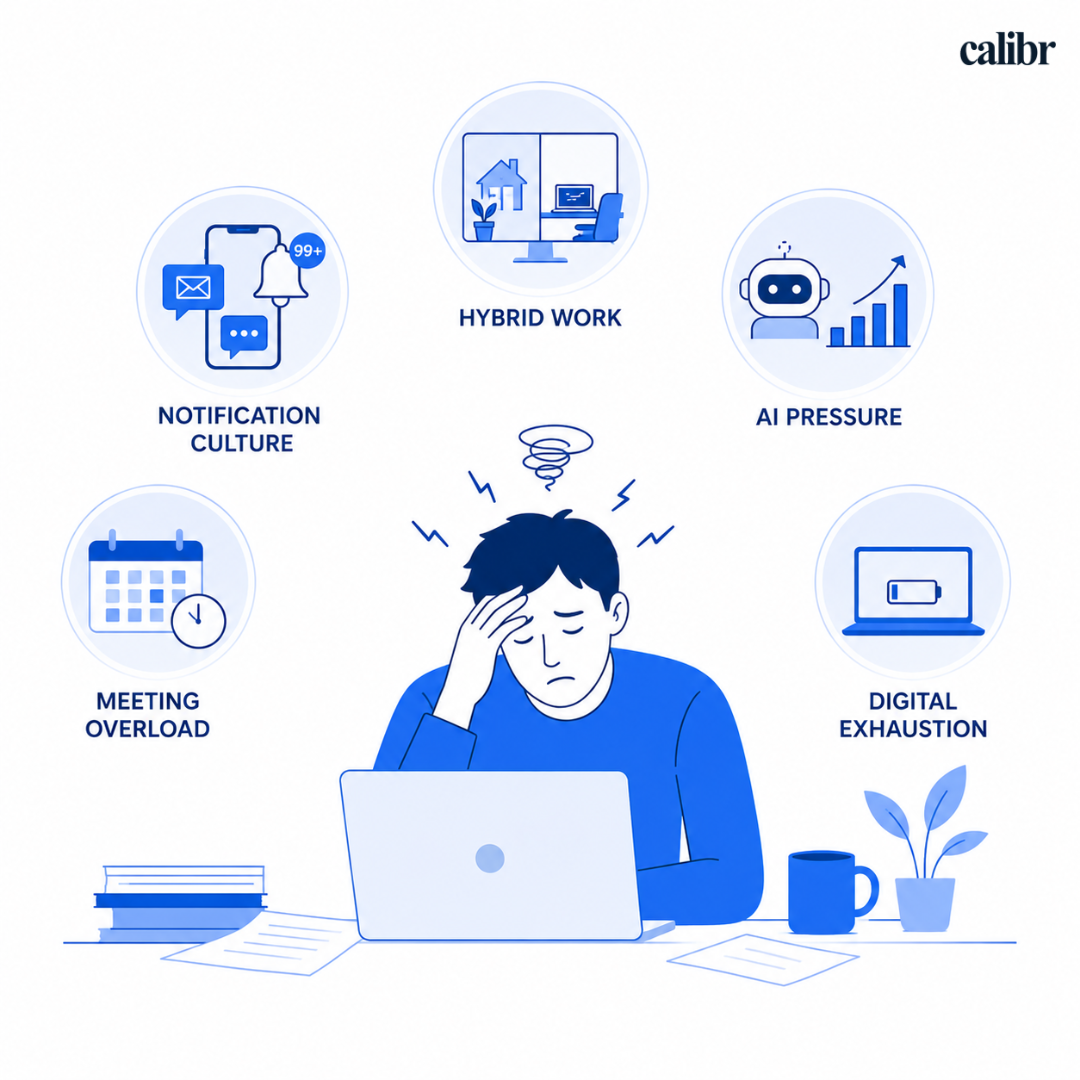
Hybrid work removed the natural boundaries between professional and personal life. Without a commute to decompress, without a physical building to leave, many employees never fully disengage. The home became the office — permanently.
Notification culture created a new kind of cognitive overload. Research consistently shows that constant interruptions fragment attention and elevate cortisol. When someone is expected to respond to messages within minutes across three platforms, their nervous system never fully settles. That sustained low-grade alertness is exhausting in ways that are hard to articulate.
AI pressure has introduced a new anxiety: the fear of being outpaced or replaced. Rather than reducing workload, AI tools have often raised the baseline expectation of productivity — especially as organizations adapt to faster, AI-driven ways of working. If a task can be done faster with AI, the assumption becomes that everyone should be doing more. The result is acceleration without restoration.
Meeting overload remains one of the biggest drivers of workplace fatigue. The Microsoft Work Trend Index reports that the average knowledge worker now spends close to a third of their workweek in meetings.
Digital exhaustion is its own category. Screens, notifications, video calls, and the ambient noise of collaboration tools create a kind of sensory load that previous generations of workers simply didn't face. Presence no longer means being physically in an office; it means being perpetually available, visible, and responsive.
The modern workplace, for all its flexibility, has created conditions that are structurally hostile to sustained wellbeing — and that's the honest conversation more HR teams need to have.
The Burnout Signs Most Organizations Overlook
The loudest burnout signals are usually the easiest to notice. The harder part is recognizing the quieter behavioral shifts that appear long before burnout becomes obvious.
Watch for the employee who is still performing but has stopped growing. They still meet expectations, but the curiosity, initiative, or ambition they once showed begins fading. That shift is often one of the earliest signs of emotional exhaustion.
Notice changes in personality and communication. Employees experiencing burnout often become more transactional, less enthusiastic, and emotionally distant from the team around them.
Some subtle burnout signs include:
Shorter or less collaborative communication
Reduced participation in discussions
Fewer questions, ideas, or opinions
Emotional distance from the organization
Loss of interest in growth opportunities or stretch projects
Sometimes the biggest warning sign is silence.
An employee who stops challenging ideas, contributing actively, or engaging deeply may not be “easy to manage.” They may simply be disconnecting psychologically from the work itself.
And in many organizations, the employees' leaders worry about least are often the ones most vulnerable to burnout.
Why High Performers Often Burn Out First
One uncomfortable reality of modern workplaces is that high performers are often the most likely to experience burnout.
They take on more responsibility, absorb pressure quietly, solve problems consistently, and rarely say no. Because organizations trust them, they often become the default people for urgent work, extra projects, and team gaps.
For many high performers, work also becomes closely tied to identity and self-worth. So when constant pressure starts feeling unsustainable — or when effort no longer feels meaningful — the emotional impact runs deeper than ordinary stress.
Ironically, the same behaviors organizations reward can slowly lead to burnout:
working late regularly
always being available
taking ownership constantly
handling excessive workloads without complaint
By the time the warning signs become visible, these employees have often been carrying unsustainable pressure for months.
Rewarding overwork without addressing its long-term impact is one of the fastest ways organizations burn out their best people.
How to Prevent Employees Experiencing Burnout
When burnout has already taken hold, recovery requires a different kind of leadership response than most organizations are used to giving. Here are some 5 tips that can be applied in the real workplace to prevent employee burnout:
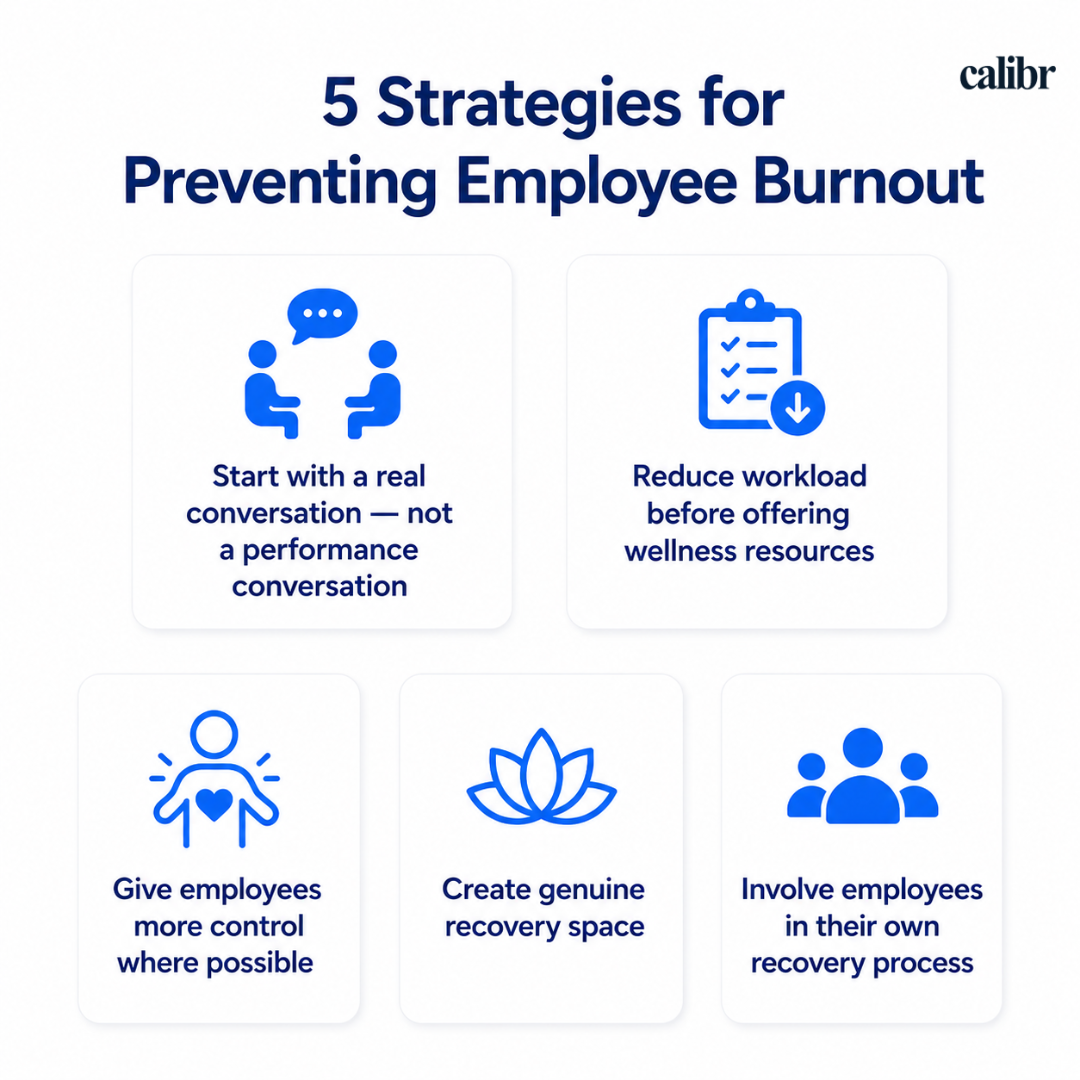
Start with a real conversation — not a performance conversation
The instinct to treat burnout as a performance issue is understandable but often counterproductive. Instead of focusing immediately on output, approach the employee with genuine curiosity and concern.
For example:
“I’ve noticed some shifts lately and wanted to check in to see how you’re doing.”
Reduce workload before offering wellness resources
Sending someone to a mindfulness session while their workload remains unchanged sends the message that the problem is the individual, not the environment.
Meaningful support starts with examining:
what can be paused
what can be delegated
what can be removed temporarily
Give employees more control where possible
Autonomy is one of the strongest protectors against chronic workplace stress.
Even small increases in control can help employees regain a sense of stability, including:
flexibility in how work is structured
clearer prioritization
more control over schedules or communication
Create genuine recovery space
Encourage employees to disconnect fully — not just in theory, but in practice.
Leaders who visibly take breaks, disconnect after work, and respect boundaries create permission for teams to do the same.
Involve employees in their own recovery process
Avoid prescribing solutions immediately. Instead, involve employees in conversations about what sustainable work actually looks like for them.
Questions like:
“What feels most overwhelming right now?”
“What needs to change for this to feel sustainable again?”
often lead to far more effective support than generic wellness plans.
Quick Insight: Why Wellness Programs Alone Don’t Prevent Burnout
Burnout cannot be solved through wellness programs alone when the workplace itself remains unhealthy.
Preventing burnout requires structural changes like:
healthier workload expectations
better communication boundaries
supportive leadership
real recovery time
clearer role expectations
Employee wellbeing is shaped by how work is designed, not just by the wellness resources offered. Research from Deloitte Insights also emphasizes that workplace wellbeing depends heavily on organizational culture and work design.
Beyond policy and culture changes, organizations are also increasingly using workplace data and behavioral signals to identify burnout risks earlier.
Tools to Detect Early Signs of Employee Burnout
Technology can't replace human attention, but used well, it can extend a manager's visibility into conditions they might otherwise miss. Here are some tools that we can use to detect early signs of employee burnout:
Pulse surveys — short, frequent, and psychologically safe — are among the most reliable early detection tools available. The key word is frequent. An annual engagement survey is nearly useless for identifying emerging burnout; a weekly or bi-weekly three-question pulse is far more actionable.
Workload analytics can surface concerning patterns in collaboration tools. Are certain individuals consistently working outside normal hours? Are meeting loads concentrated in particular teams or roles?
Absenteeism tracking, when done thoughtfully, can reveal early signals. An uptick in unplanned absences, particularly in previously engaged employees, is worth investigating.
Engagement trend analysis — tracking shifts in participation, contribution volume, and response rates over time — is more predictive than any single data point.
Sentiment tracking in anonymous feedback channels can surface emerging issues before they become crises.
Collaboration overload indices — available in tools like Microsoft Viva Insights — measure meeting load, after-hours work, and focus time availability at a team level, giving managers data to act on before individuals reach their limit.
Increasingly, organizations are combining these tools with AI-powered people analytics to gain deeper workforce insights. AI can help prevent burnout by analyzing patterns across pulse surveys, workload data, absenteeism, collaboration trends, and employee feedback to identify early warning signs and enable proactive interventions before burnout affects employee well-being and productivity.
A Practical Framework: The RENEW Model
Effective burnout prevention is rarely solved through a single initiative. It requires consistent action across culture, leadership, workload management, and employee support.
The RENEW framework offers a practical structure organizations can use to approach burnout more sustainably.
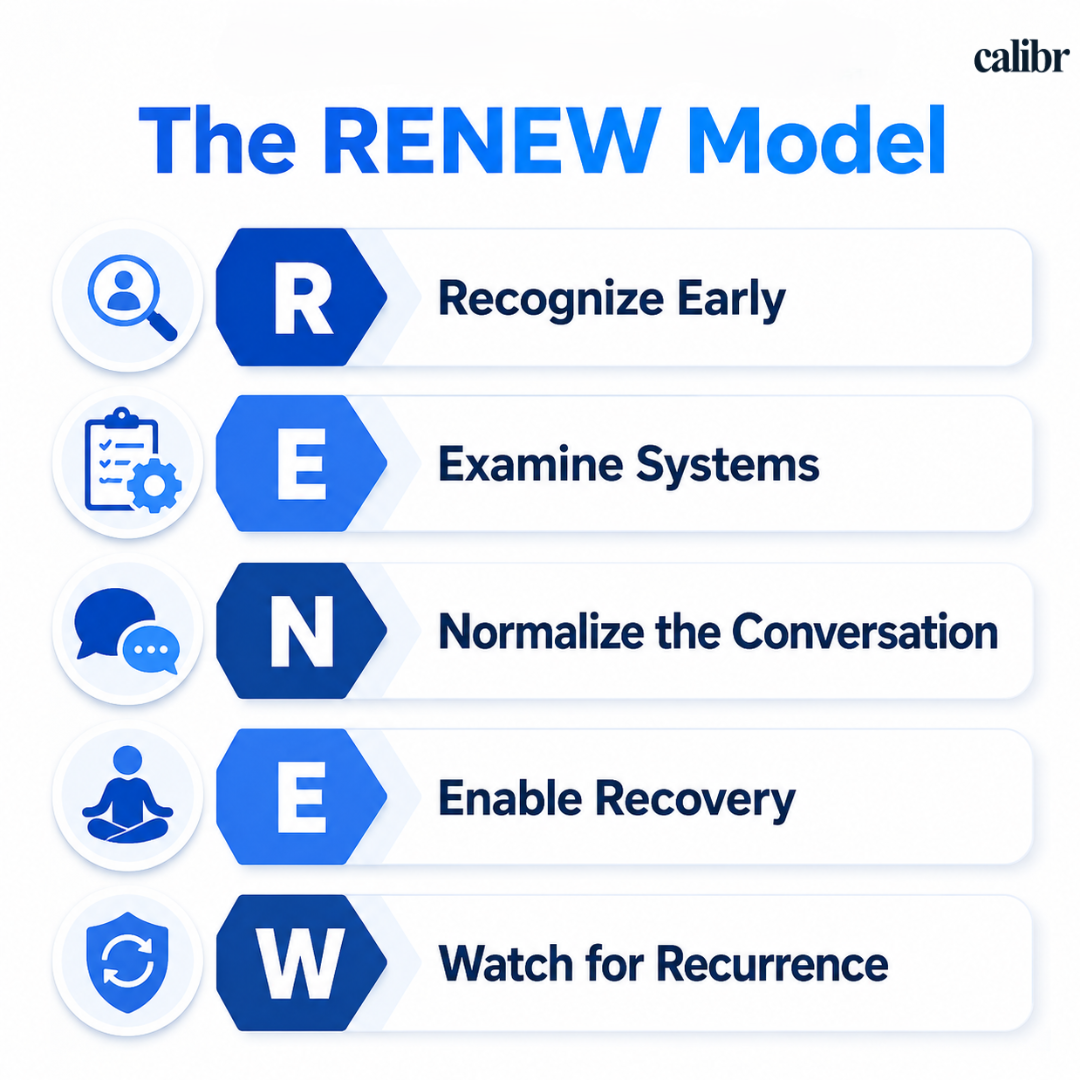
R — Recognize Early
Pay attention to behavioral shifts, not just visible performance decline.
Early burnout signs often appear through:
emotional withdrawal
lower enthusiasm or curiosity
reduced participation
changes in communication patterns
Use pulse surveys, 1:1 conversations, and regular check-ins to identify concerns before they escalate.
E — Examine Systems
Before treating burnout as an individual problem, examine the work environment itself.
Ask questions like:
Is the workload sustainable?
Are expectations clear?
Is meeting overload affecting focus and recovery?
Do employees have enough autonomy and support?
Burnout is often rooted in how work is structured.
N — Normalize the Conversation
Create a workplace culture where employees feel safe discussing stress, exhaustion, and workload challenges early.
Supportive leadership, psychological safety, and open communication help employees speak up before burnout becomes severe.
E — Enable Recovery
When burnout is already present, meaningful recovery requires more than wellness resources.
Support employees through:
realistic workload adjustments
genuine recovery time
clearer priorities
greater flexibility and control over work
Recovery becomes more effective when employees actively participate in defining what sustainable work looks like for them.
W — Watch for Recurrence
Burnout can return if underlying workplace conditions remain unchanged.
Regular check-ins, workload reviews, pulse feedback, and healthier team norms help organizations prevent burnout from becoming a repeating cycle.
Frequently Asked Questions
What is employee burnout?
Employee burnout is a state of chronic workplace stress that leads to emotional exhaustion, detachment from work, and reduced motivation or effectiveness.
What are the signs of employee burnout?
Common signs include emotional withdrawal, declining work quality, exhaustion, cynicism, difficulty concentrating, reduced initiative, and disengagement from colleagues or work.
How can organizations prevent employee burnout?
Organizations can help prevent burnout by creating healthier workloads, improving communication boundaries, reducing meeting overload, supporting psychological safety, and encouraging sustainable work practices.
How do you support employees experiencing burnout?
Support starts with open conversations, workload adjustments, recovery time, clearer priorities, and involving employees in creating a more sustainable work structure.
Why do high performers burn out more often?
High performers often take on more responsibility, absorb pressure quietly, and struggle to disconnect from work, making them more vulnerable to long-term exhaustion.
Are wellness programs enough to prevent burnout?
No. Wellness programs can help, but burnout prevention also requires structural and cultural workplace changes.
What Causes Employee Burnout?
Employee burnout is usually caused by chronic workplace stress, excessive workloads, lack of control, poor communication boundaries, constant connectivity, and insufficient recovery time. Burnout often develops when workplace demands consistently outweigh the support and resources employees need to sustain themselves.
Can Employee Burnout Affect Productivity?
Yes. Employee burnout can significantly reduce productivity, focus, creativity, and decision-making quality. Burnout often leads to disengagement, slower work, increased errors, absenteeism, and lower collaboration across teams.
How Long Does Employee Burnout Last?
Employee burnout recovery varies depending on the severity of exhaustion and whether workplace conditions improve. Mild burnout may improve within weeks, while severe burnout can take months without meaningful workload, leadership, or organizational changes.
Final Thoughts
Employee burnout is often framed as a problem employees bring to work — the result of poor resilience, insufficient coping skills, or an inability to manage modern demands.
That framing lets organizations off the hook in ways they no longer can afford.
The real insight is this: burnout is most often a symptom of how work has been designed and what leadership has permitted to become normal.
The most effective intervention isn't a new wellness app. It's a leadership culture willing to have an honest conversation about what it's actually asking of people — and what it owes them in return.
Organizations that invest seriously in burnout prevention aren't just being humane. They're protecting the judgment, creativity, and commitment of the people their strategy depends on.
In a market where talent is genuinely differentiated, that's not an ethical nicety. It's a competitive necessity.
The question isn't whether you can afford to address this. It's whether you can afford not to.

Vivetha is a digital marketing professional specializing in content marketing and SEO. She focuses on developing optimized, high-quality content that improves search visibility, supports brand objectives, and drives measurable results. With a structured and analytical approach, she ensures content aligns with business and audience needs.