Understand what HACCP training is and why it matters.
Identify biological, chemical and physical food safety hazards.
Learn prevention practices and critical control points (CCPs).
Understand role-based training, including Food Handler and PIC training.
Assess employee competency through practical training, assessments and regular refreshers.
HACCP Training: A Quick Overview
Want a quick overview of the HACCP training programme in Dubai? Watch this short video to understand how the training works, who needs it, what it covers and how food businesses can deliver effective training to their employees.
What is HACCP training?
HACCP training teaches employees how to identify, prevent and control food safety hazards as food is received, stored, prepared, cooked and served. HACCP stands for Hazard Analysis and Critical Control Points, a preventive approach that builds safety into each step instead of relying on checks of the finished plate.
In Dubai, "HACCP training" is often used as an umbrella term. In practice it covers three distinct levels of food safety training, each with its own purpose and audience:
Training type | Purpose | Who typically needs it |
Basic Food Safety Training | Covers the essentials of hygiene, cross-contamination, temperature control and safe handling, so staff can work safely from their first shift | Everyone who handles food or food contact surfaces, such as cooks, kitchen helpers, staff who plate or serve food, and storekeepers |
Person in Charge (PIC) Training | Prepares supervisors and managers to oversee daily food safety, train and supervise staff, and act when something goes wrong. It leads to DM PIC certification at the level set for the establishment's activity and risk | Supervisors and managers designated as the PIC |
Food Safety Management System (HACCP) Training | Teaches how to build and maintain a HACCP-based programme: hazard identification and analysis, critical control points (CCPs), monitoring, corrective actions and verification | QA and food safety teams, HACCP team members, and supervisors who develop, review or verify the programme |
These levels build on each other, but they are not interchangeable. A kitchen helper does not need to design a HACCP plan, and a PIC certificate is not the same as the training needed to write one.
Dubai Municipality (DM) requires food handling staff, supervisors and managers to be trained at a level that matches their work, so the right training and certificate depend on the person's role and the establishment.
An illustrative scenario: It is 6:40 a.m. in the banquet kitchen of a hotel in Dubai. A commis chef opens the walk-in chiller to collect cooked chicken for 300 breakfast sandwiches. The display reads 9°C. Service starts in 50 minutes.
Does she use the chicken, move it, bin it or call someone? What she does next depends almost entirely on her training. This guide explains what HACCP training in Dubai should cover, who needs which level, and how to tell whether employees can apply it. We come back to her decision later.
Why HACCP training matters for food businesses in Dubai
Dubai Municipality builds employee training into how every food establishment is expected to operate. Three requirements matter most:
A HACCP-based food safety programme. Under the Dubai Municipality Food Code, establishments should keep a documented, DM-approved food safety programme based on HACCP principles, review it at least annually, and have it audited by a DM-approved auditor unless DM grants a waiver (Section 3.1.3).
A certified PIC on site. Every establishment shall employ at least one full-time, on-site certified PIC. Food service establishments handling high-risk, ready-to-eat or raw foods need one present during every shift (Section 3.1.1).
Staff trained before they start work. The PIC should ensure employees are trained before starting and are competent in practice (Section 3.1.2).
These requirements sit within Federal Law No. 10 of 2015 on Food Safety, the UAE's national food safety law.
Training is what connects them. A written programme protects customers only when the people working each shift know what to check and what to do when something is wrong.
Who needs HACCP training in Dubai?
Anyone who handles food, supervises food operations or makes decisions that affect food safety needs some level of HACCP and food safety training. The Food Code's scope (Section 1.4) covers restaurants, hotels and cafés, hospital and school kitchens, bakeries, butcheries, supermarkets, caterers, food factories and warehouses, kiosks and mobile vendors. Commercial and cloud kitchens also fall within its definition of a food establishment: any place where food is manufactured, prepared, traded or sold.
What changes from role to role is depth:
Food handlers, kitchen staff and storekeepers need foundational food safety knowledge plus confidence in the specific checks they personally carry out.
Supervisors, sous chefs and PICs need deeper HACCP knowledge: reviewing monitoring records, deciding on corrective actions and coaching staff. PIC certification follows the level DM sets for the type of business.
Quality assurance (QA) teams and managers need to understand hazard analysis, verification and programme review, and to provide the time, equipment and staffing that the programme depends on.
Training should reflect the food safety risks of the job
Not every employee needs the same level of training. The Food Code indicates that training should reflect the employee's work and the risks associated with the establishment. Factors to consider include:
The type of food handled.
The preparation, cooking, storage and serving methods used.
Menu complexity and the processes involved.
The volume of food prepared or served.
The size and type of establishment.
The customers served, particularly groups who may be more vulnerable to foodborne illness.
For example, a food handler preparing ready-to-eat salads needs strong training in hand hygiene and preventing cross-contamination. A chef responsible for cooking and cooling large batches needs additional training in temperature monitoring and corrective actions. A PIC needs the knowledge to supervise the overall food safety programme.
Training should therefore be assigned according to each employee's actual responsibilities and the risks they may encounter.
What HACCP training teaches employees: identify, prevent, control
Good HACCP training builds three abilities in order: spotting a hazard, stopping it from getting into food or growing, and checking the points that keep food safe, then acting when a check fails.
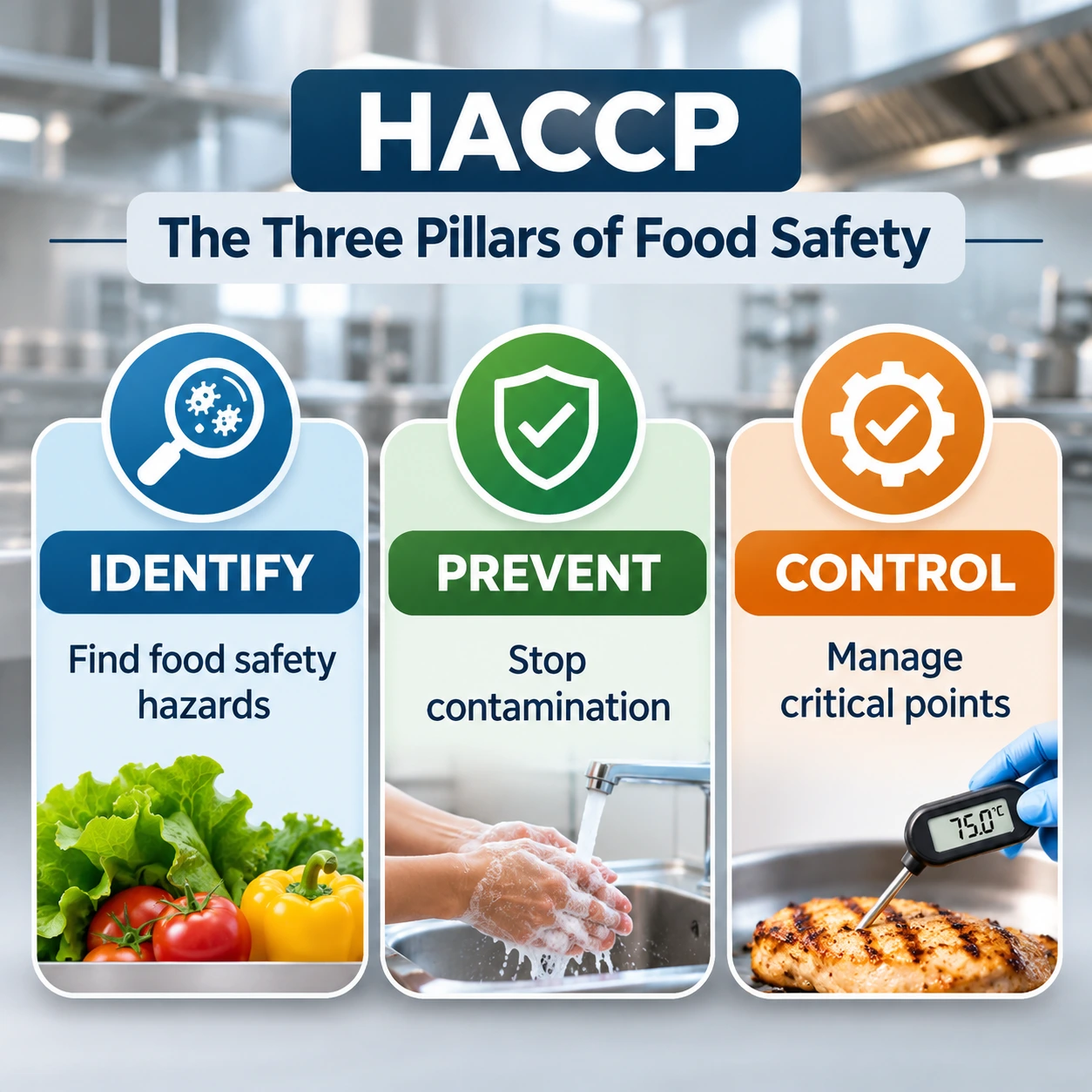
Identify: Recognizing Food Safety Hazards
The Food Code defines a hazard as a biological, chemical or physical agent in, or condition of, food with the potential to cause harm. The table shows how each type typically appears in a kitchen and what employees should notice.
Hazard type | Examples | How it gets into food | Signs employees should notice |
Biological | Bacteria, viruses, parasites | Raw chicken juices on a board later used for salad; cooked rice left at room temperature; a food handler working while unwell | Chillers above 5°C, food left out between 5°C and 60°C, raw food stored above ready-to-eat food, a colleague with vomiting or diarrhoea |
Chemical | Cleaning chemicals, pesticide residues, undeclared allergens | Degreaser decanted into an unlabelled water bottle; sanitiser sprayed near open food; sesame carried over on a shared board | Unlabelled containers, chemicals on food shelves, shared fryers or utensils for allergen-free orders |
Physical | Glass, metal, hard plastic, jewellery, hair | A broken light cover; wire brush bristles on a grill; staples from packaging | Chipped crockery, cracked containers, unshielded lights over open food |
Many programmes treat allergens as their own category; the Food Code covers them separately in Section 3.4.3. Either way, identifying hazards is mostly about noticing conditions, because the hazard itself is usually invisible. Training should give each station its own clear "this is wrong" cues.
Prevent: Everyday Practices That Keep Hazards Out
Prevention covers the routine practices on which a HACCP system rests, often called prerequisite programmes. The Food Code expectations below are a sensible core for training:
Wash hands at dedicated handwash stations supplied with liquid soap and paper towels (Section 2.18).
Keep raw and ready-to-eat foods apart, never store ready-to-eat food below raw animal products, and use separately marked or colour-coded cutting boards (Section 3.4.1).
Clean and disinfect food contact surfaces between raw and ready-to-eat use. Equipment used continuously for high-risk foods at room temperature, such as a slicer, should be cleaned and disinfected at least every four hours (Section 4.2.1).
Store cleaning chemicals separately in a lockable area (Section 2.12).
Hold high-risk foods at 5°C or below, or 60°C or above, and frozen foods at -18°C (Section 3.6.2).
Rotate stock first-in, first-out and accept food only from DM-approved sources (Sections 3.6.4 and 3.2.2.1).
Declare common allergens and prevent cross-contact (Section 3.4.3).
Teach the reason as well as the rule. A cook who knows that harmful bacteria multiply rapidly between 5°C and 60°C, the range the Code calls the temperature danger zone, makes better decisions in situations no procedure anticipated.
Control: Monitoring Critical Control points and Acting On Deviations
A Critical Control Point (CCP) is a step where control is essential to prevent or eliminate a hazard or reduce it to an acceptable level, according to the HACCP principles published by the US FDA. Each CCP has a critical limit: a measurable line between safe and unsafe. In restaurants, CCPs often include cooking, cooling and hot or cold holding, but each establishment's own hazard analysis decides which steps are CCPs.
The Dubai Food Code sets temperature requirements that establishments commonly use as critical limits:
Process step | Food Code requirement |
Cooking raw foods of animal origin | Core temperature of at least 75°C, or an equivalent time and temperature (Section 3.2.8) |
Hot holding | At least 60°C (Section 3.2.10) |
Cooling after cooking | From 60°C to 20°C within 2 hours, then to 5°C or less within a further 4 hours (Section 3.2.11) |
Reheating for hot holding | Above 75°C internally, within 1 hour (Section 3.2.13) |
Chilled and frozen storage | 5°C or below; frozen at -18°C (Section 3.6.2) |
Illustrative example: A grill cook probes a batch of chicken thighs. The thickest piece reads 68°C. That is a deviation, not a near miss. The correct response is to keep cooking until the core reaches 75°C, probe again, record both readings, and tell the supervisor if the grill seems to be running cool. The Food Code expects cooking temperatures to be checked with a calibrated thermometer at the slowest-heating point and recorded (Section 3.2.8).
The difference between prevention and control matters. Preventive practices such as handwashing apply all the time and are checked by observation. CCP controls apply at specific steps, have a numerical limit, are monitored on a schedule and leave a record. When employees blur the two, a missed temperature log starts to look like missing paperwork rather than a missing safety check.
How HACCP Training differs by Employee Roles
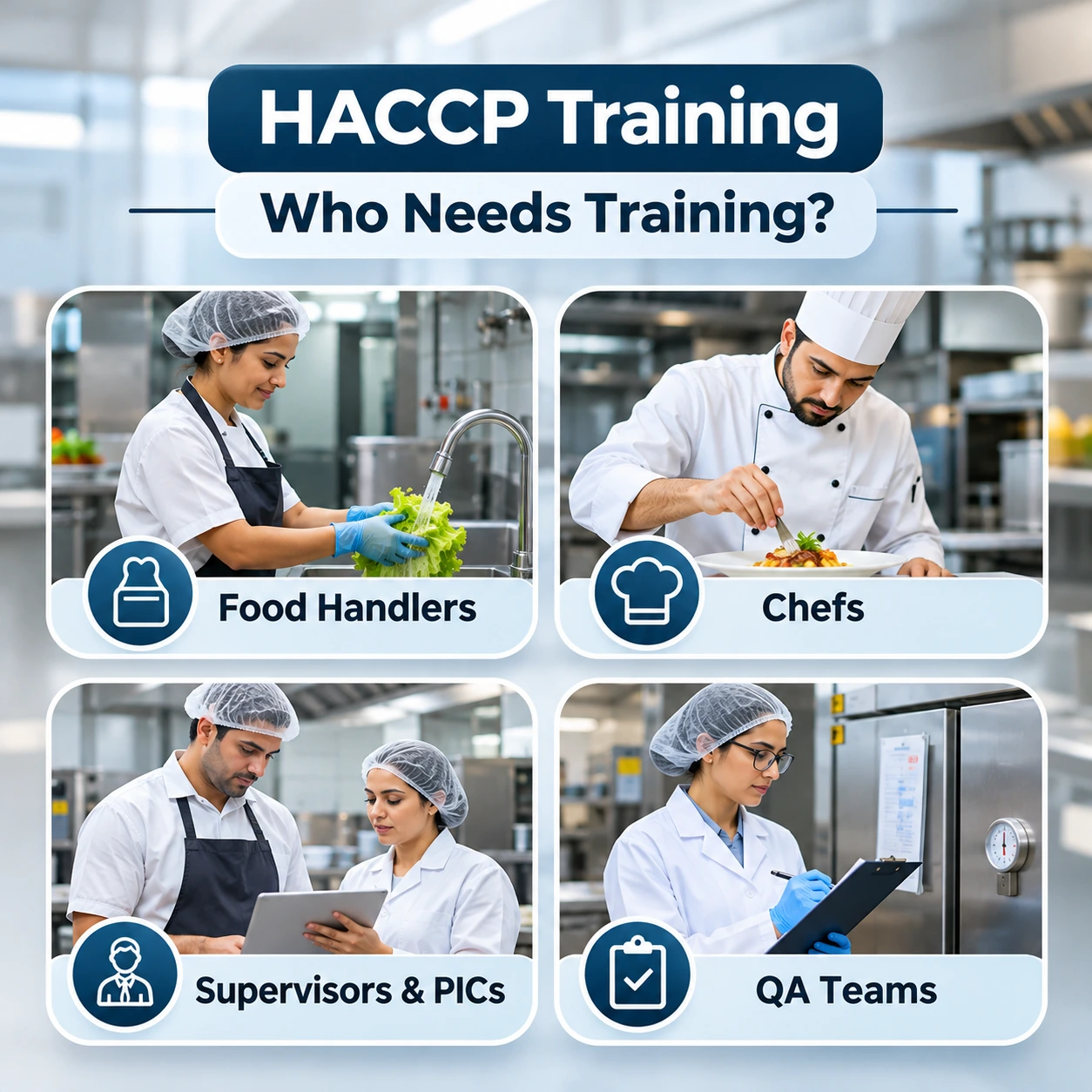
Every role needs the same foundations, but monitoring, corrective action and verification duties differ, and role-based HACCP training should follow those duties. The table shows what each role should be able to do under each heading.
Employee role | Identify | Prevent | Control |
Chefs and kitchen staff | Contamination risks and unsafe food temperatures at their station | Separate raw and ready-to-eat food, follow safe preparation and cooking practices | Probe and record cooking, cooling and reheating temperatures where assigned; report concerns at once |
Food handlers | Spoiled food, unsafe handling, illness symptoms in themselves | Hand hygiene, food separation, safe handling and personal hygiene procedures | Follow established controls; stop and report unsafe conditions |
Storekeepers and inventory staff | Expired, damaged or temperature-abused deliveries and unsuitable storage | First-in, first-out rotation, correct storage heights and separation, chemicals kept apart | Check delivery and storage temperatures, reject non-conforming goods, keep stock and rejection records |
Food safety supervisors and PICs | Hazards across the whole operation, including gaps between shifts | Put preventive procedures in place and coach staff on them | Monitor CCPs where applicable, review records daily, decide on and oversee corrective actions |
QA and food safety teams | Biological, chemical and physical hazards at every process step | Design and update prerequisite programmes and procedures | Verify controls, calibrate equipment, review documentation, prepare for audits |
Restaurant and food business managers | Operational risks and training gaps | Provide resources, staffing, equipment and time for training | Make sure responsibilities are assigned and the programme is reviewed and resourced |
One hazard, several responses. Consider an illustrative case: an unlabelled spray bottle on a preparation shelf next to open herbs. A food handler should not use it, should move the herbs away from it and tell the supervisor. A chef should check whether any food was sprayed and set that food aside. The supervisor should identify the chemical, decide whether any food must be discarded and record the incident. QA should ask why the chemical was decanted, and the manager should check whether dispensing equipment or labels were missing. Same hazard, five different jobs, and five different things to train.
The common mistake runs in both directions. Training everyone at supervisor depth wastes time and confuses front-line staff. Training supervisors only at food handler depth leaves no one able to judge a corrective action.
How to Deliver and Manage Effective HACCP Training
Effective HACCP training is short, matched to the role and practiced where the work happens. It also continues after the course: checks, refreshers and records show whether learning has turned into daily practice.
Deliver training that fits the job
Role-based learning paths that follow the role table above, so a storekeeper is not sitting through cooling procedures they never perform.
Practical demonstrations at the actual equipment: probing the thickest piece of meat, cleaning and calibrating a thermometer, setting up colour-coded boards.
Short videos and visual guides in the languages your teams use. A one-page visual at the chiller or handwash station reinforces the course at the moment it matters.
Scenario-based assessments that test decisions, not definitions.
Where a certificate is required, such as Basic Food Safety or PIC certification, the course must come from a provider approved by DM; the Food Code defines a food safety course as one approved by the Department (Section 1.6). In-house sessions then add what an external course cannot: your menu, your equipment and your procedures.
Plan refresher and additional training
Some refresher points are fixed. PIC certificates are valid for five years (Food Code, Section 3.1.1), and the Code expects continuing education beyond the first course (Section 6.3). For food handler certificates, confirm current renewal rules with a DM-approved training centre.
Additional training is usually needed sooner when:
new menu items, processes or equipment are introduced;
an employee moves into a new role, such as a cook starting to supervise a section;
an inspection or audit identifies a finding;
monitoring records show the same error repeatedly;
assessment results show a shared knowledge gap.
Use an LMS to manage training and spot gaps
A learning management system (LMS) such as Calibr handles the administration that becomes difficult across several shifts or branches. It can assign courses by role and site, deliver videos and quizzes on phones, run assessments, track progress, send reminders before refreshers fall due, and keep training records ready for audits and inspections.
Illustrative example. A catering group runs eight kitchens in Dubai. LMS reports show that most staff at two kitchens answer the same question on cooling cooked rice incorrectly. The training manager assigns a five-minute cooling module and a practical demonstration to those two teams only. Each PIC then checks the cooling logs for the next two weeks to confirm the practice has changed.
An LMS has clear limits. It does not make a course or provider DM-approved; approval comes from DM. Course completion shows that someone finished training, not that they can apply it on a busy shift. An LMS cannot replace practical competency checks, PIC supervision, CCP monitoring or DM inspections, and the establishment remains responsible for all of them.
HACCP Training Checklist: Are Employees ready to apply what they learned?
The most reliable way to answer this checklist is to ask, watch and check the record, rather than look at a certificate. Use it during shift walk-throughs or after training.
Category | Checklist |
Identify | Can the employee name a biological, chemical and physical hazard at their own station? |
Identify | Can they point out where cross-contamination could happen in their area? |
Identify | Do they recognise unsafe handling or storage conditions without prompting? |
Prevent | Do they wash hands at the right moments, not only when observed? |
Prevent | Can they explain, in their own words, how they keep raw and ready-to-eat food apart? |
Prevent | Do they follow the cleaning, storage and preparation procedures for their role? |
Control | Do they know which controls they are personally responsible for? |
Control | Can they recognise when a limit has been missed? |
Control | Do they know whom to tell, and how quickly? |
Control | Can they follow the corrective action assigned to their role? |
Control | Are their records complete, accurate and written at the time of the check? |
This checklist is a learning aid. It does not replace formal competency assessment, verification under the food safety programme, third-party audits or DM inspections.
Frequently Asked Questions (FAQs)
What is HACCP training?
HACCP training teaches employees to identify, prevent and control biological, chemical and physical food safety hazards, using the Hazard Analysis and Critical Control Points system. Depth varies from basic hygiene for food handlers to hazard analysis and verification for supervisors and QA teams.
Who needs HACCP training in Dubai?
Everyone who handles food, supervises food operations or manages a food business. DM requires food handling staff, supervisors and managers to be formally trained at a level that matches their work activity.
What are the three main types of food safety hazards?
Biological (bacteria, viruses, parasites), chemical (cleaning chemicals, pesticide residues and, in many programmes, allergens) and physical (glass, metal, plastic and other foreign objects).
Does HACCP training differ according to employee roles?
Yes. Everyone needs foundational knowledge, but CCP monitoring, corrective action decisions and verification sit with specific roles. Training should match the duties each person actually performs.
Is HACCP certification mandatory for restaurants in Dubai?
The Food Code calls for a documented, DM-approved food safety programme based on HACCP principles, audited by a DM-approved third-party auditor unless waived. It does not state that every restaurant must also hold a separate HACCP certificate from a certification body. Some clients, such as hotel groups or retailers, may ask suppliers for certification under contract. Confirm the position for your business activity with DM.
What is the difference between HACCP training and HACCP certification?
Training builds an individual's knowledge and skills. Certification, when obtained, is an external assessment of a business's food safety management system. A trained team is what makes a certified system work day to day.
Is food safety training mandatory in Dubai?
Dubai Municipality's food safety requirements call for food handlers, supervisors and managers to receive food safety training appropriate to their roles. The Food Code also requires food establishments to have a certified Person in Charge (PIC), subject to the applicable requirements. The exact training and certification requirements depend on the employee's responsibilities and the type of food establishment.
How often should food handlers receive refresher training in Dubai?
The Dubai Food Code, Section 6.3, states that food handlers should attend a refresher or updating course after one year of training. It also states that they must be retrained if their food handling practices deteriorate.
However, Dubai Municipality's DM-FSD-GU64 training guidance contains a separate refresher-training framework. Because the documents use different intervals, food businesses should confirm the current applicable refresher schedule with Dubai Municipality or an approved training provider before setting their renewal policy. Refresher training should also be arranged when competency gaps or unsafe practices are identified.
PIC certification is separate: the Food Code states that a PIC certificate is valid for five years.
Is HACCP certification mandatory for every restaurant in Dubai?
The Dubai Food Code requires food establishments to implement a documented food safety programme based on HACCP principles and sets requirements relating to a certified PIC. This should not be interpreted as meaning that every restaurant must hold an identical, separate third-party HACCP certificate.
The training required for employees, the PIC certification requirements and any food safety management system approval or audit requirements are different matters. Businesses should confirm the requirements that apply to their activity with Dubai Municipality.
Conclusion: Turning HACCP Knowledge into Everyday Practice
HACCP training is effective when employees can recognize food safety hazards, follow preventive practices and respond correctly when a control fails.
In a busy kitchen, this means knowing when to stop, protect food and report a problem rather than making assumptions. With role-based training, practical assessments and regular follow-up, food businesses can turn HACCP principles into everyday food safety practices.


Vivetha is a digital marketing professional specializing in content marketing and SEO. She focuses on developing optimized, high-quality content that improves search visibility, supports brand objectives, and drives measurable results. With a structured and analytical approach, she ensures content aligns with business and audience needs.