HSE training helps employees understand workplace risks and work safely.
UAE employers must provide training based on the risks employees face.
The training required depends on the industry, job role and type of work.
It covers basic safety awareness, job-specific skills and specialist training.
Companies should identify workplace hazards, assess risks and put proper safety measures in place.
Training can include videos, e-learning, classroom sessions and hands-on practice.
Employees need refresher training when work conditions, equipment or procedures change.
Training effectiveness should be checked through assessments, practical demonstrations and workplace safety results.
Keeping proper training records helps companies stay prepared for audits and inspections.
An LMS makes it easier to assign courses, track employee progress and manage training records.
Introduction: One Site, Three Risks, One Question
It is 11:40 on a July morning at a mid-rise construction site in Dubai. A steel fixer notices a bundle of loose rebar stacked near the edge of an upper slab. Below, a labourer who started last week is still mixing mortar in full sun, looking pale. Near the site store, a drum of solvent sits uncapped beside a drain.
Every worker on that site has a training certificate on file. So the real question is not whether they attended an HSE course. It is whether any of them will recognise these three hazards, feel confident enough to speak up, and know exactly what to do next.
That gap between attendance and action is what this guide is about. HSE training (health, safety and environment training) is the structured way an organisation builds awareness, knowledge and practical competence across all three areas. Below, we cover what UAE law requires, how to work out who needs what, how to deliver and measure training, and how technology can support the process. We return to the site at the end.
Watch: What Is HSE Training?
What exactly is HSE training, and why is it important in the workplace? Let’s watch a short video to find out.
Is HSE Training Mandatory in the UAE? The Regulatory Context
Yes. UAE federal law requires private-sector employers to give workers appropriate training to avoid workplace risks. What the law does not do is prescribe one universal course, certificate or refresher interval for every business. The content and depth must match your activities, and some emirates and sectors add their own rules on top.
The federal layer
The UAE Government Portal summarises the core framework. Under Federal Decree-Law No. 33 of 2021 on the Regulation of Labour Relations, employers must provide a safe work environment. The portal lists their obligations as providing protective means, displaying awareness material, providing appropriate training and periodically checking compliance. Workers, in turn, must use protective equipment and follow safety instructions.
The detail sits in Cabinet Resolution No. 1 of 2022 (Articles 22 and 26), Ministerial Resolution No. 44 of 2022 on Occupational Health and Safety and Labour Accommodation, and Administrative Decision No. 19 of 2023, all issued or enforced by the Ministry of Human Resources and Emiratisation (MoHRE). For training, Administrative Decision No. 19 of 2023 is the most practical document. It requires employers to:
develop a health and safety programme suited to their size, activities and headcount, including OSH training programmes designed around the nature of their work (Article 2)
inform employees about the risks of their occupation before they start work (Article 4)
keep OSH records, including training delivered, the number of employees trained and fire drills (Article 3)
train selected workers in first aid and keep a register of trained first aiders (Article 6)
It also places a duty on workers to attend training related to the risks of their job (Article 9). Two further federal points matter for training planners. Establishments with 50 or more workers need a system for monitoring work injuries that includes training programmes for workers in high-risk activities. Industrial and construction establishments with 100 or more workers must appoint a qualified occupational health and safety officer, according to the UAE Government Portal.
The emirate and sector layer
In Abu Dhabi, the Abu Dhabi Occupational Safety and Health System Framework (OSHAD SF) applies, with the Abu Dhabi Public Health Centre supervising its implementation and sector regulatory authorities monitoring entities in their sectors, as explained by the Abu Dhabi Department of Municipalities and Transport. In Dubai, Decree No. (19) of 2025 makes Dubai Municipality's Code of Construction Safety Practice binding on contractors and engineering consultants across the emirate, including free zones such as the DIFC. Some free zones and sector regulators issue further HSE requirements, so check with your licensing authority.
Layer | Example | Status |
|---|---|---|
Federal law and regulations | Federal Decree-Law No. 33 of 2021; Ministerial Resolution No. 44 of 2022; Administrative Decision No. 19 of 2023 | Mandatory for private-sector employers under MoHRE |
Emirate or sector rules | OSHAD SF (Abu Dhabi); Dubai Code of Construction Safety Practice | Mandatory within their scope |
International standards | ISO 45001 (OH&S management); ISO 14001 (environmental management) | Voluntary unless a client, contract or regulator requires them |
Good practice | Toolbox talks, scenario exercises, refresher cycles | Recommended, risk-based |
Which Industries and Employees need HSE Training?
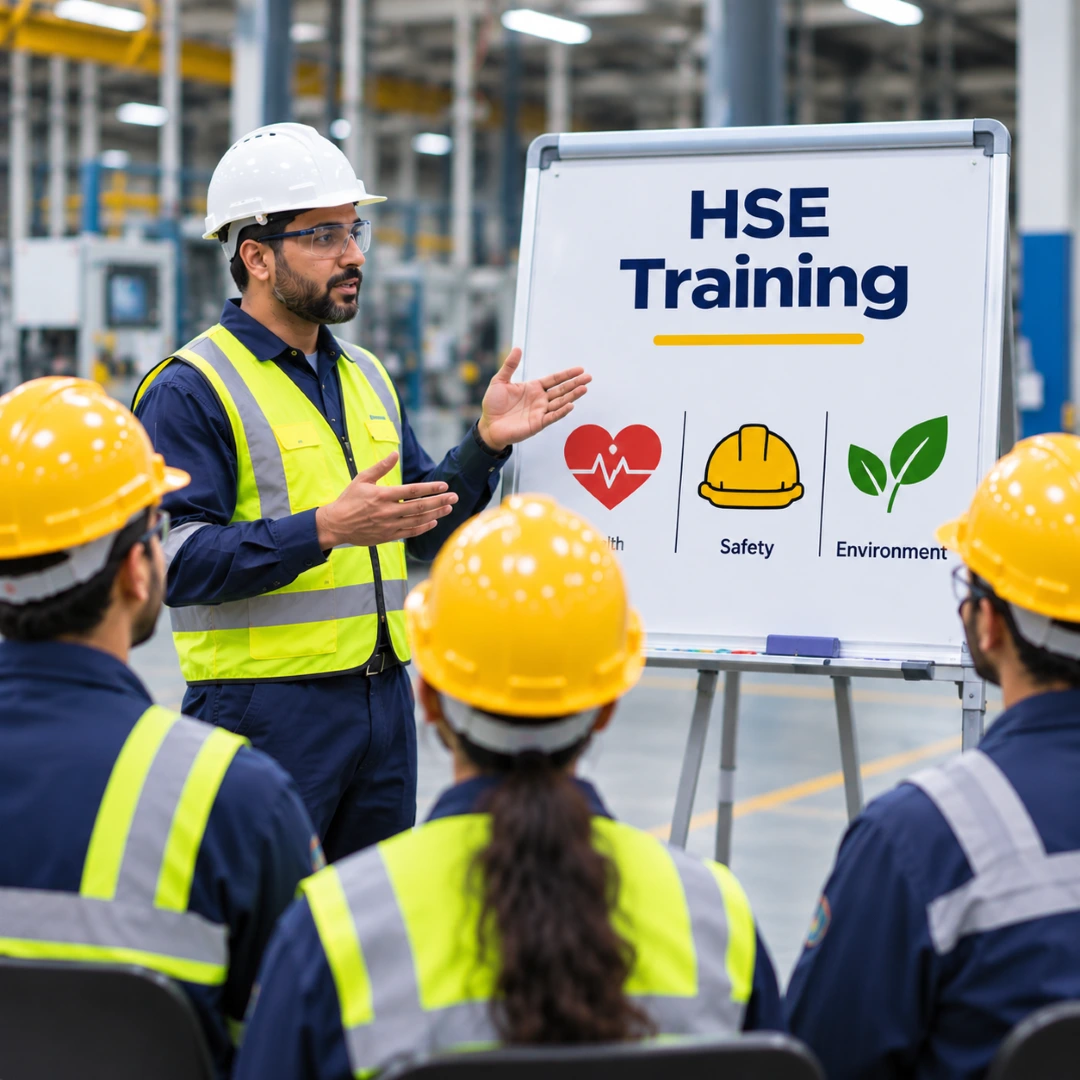
Every sector needs some HSE training, but the industry name only tells you where to start. What drives the content is the actual activity, equipment and exposure. A logistics company's office team and its forklift drivers sit in the same industry and need very different training.
Industry | Common hazards | Typical training topics |
|---|---|---|
Construction | Falls, falling objects, plant and vehicles, heat, excavations | Working at height, scaffold use, lifting operations, heat stress, permit-to-work |
Oil and gas | Fire and explosion, toxic gases, confined spaces, pressure systems | Hot work, gas testing, confined space entry, emergency response, process safety basics |
Manufacturing | Moving machinery, noise, chemicals, manual handling | Machine guarding, lockout/tagout, hearing protection, chemical handling |
Healthcare | Sharps, infection, patient handling, hazardous drugs | Infection control, sharps safety, safe patient handling, clinical waste |
Hospitality | Burns, cuts, slips, cleaning chemicals, gas appliances | Kitchen safety, chemical safety, fire evacuation, food hygiene |
Logistics and warehousing | Forklifts, racking, vehicle movement, manual handling | Traffic management, safe stacking, manual handling, loading bay safety |
Facilities management | Electrical work, ladders, chemicals, lone working | Electrical isolation, ladder safety, safe chemical use and storage, lone worker procedures |
Retail | Manual handling, slips, stock falls, customer emergencies | Safe lifting, housekeeping, evacuation, first response |
Offices | Workstation ergonomics, fire, electrical, stress | Display screen setup, fire wardens, evacuation, wellbeing awareness |
Who needs training within an organization
Think in groups, because each group carries a different responsibility:
New employees need an induction before starting work, which also reflects the federal duty to inform workers of occupational risks before employment begins.
General employees need awareness of hazards, reporting routes and emergency procedures, plus job-specific training for their tasks.
Supervisors need enough knowledge to spot unsafe conditions, stop work, run toolbox talks and check that controls are used.
Managers need to understand their legal duties, how to resource controls and how to read HSE performance data.
HSE officers need specialist, often certified, competence in risk assessment, investigation and auditing.
Contractors and temporary workers need a site-specific induction covering local hazards, rules and emergency arrangements, even when they hold training certificates from elsewhere.
Visitors need a short briefing on restricted areas, PPE and what to do if an alarm sounds.
Shared sites deserve particular care. When several contractors work side by side, a worker may follow their own employer's rules but not know the host site's evacuation route or permit system. Administrative Decision No. 19 of 2023 expects employers to set requirements for contracting with and monitoring long-term vendors and contractors, and a site induction is the simplest place to start.
Types of HSE Training: What is Awareness and What needs Practical Competence
HSE training topics fall into health, safety and environmental categories, but the more useful question is how deep each topic must go. Some topics only need awareness. Others need hands-on practice and a check that the person can actually do the task.
Three levels of learning help sort this out:
Basic awareness: understanding general hazards, rules and how to report a concern.
Job-specific training: learning the safe method for the tasks a person actually performs.
Specialist training: building the technical knowledge and practical competence needed for higher-risk or supervisory responsibilities, often leading to a recognised qualification.
The table shows how common topics typically map to these levels. Your own risk assessment decides the final answer.
Topic | Area | Usually sufficient for most staff | Needs practical or specialist training for |
|---|---|---|---|
Heat stress | Health | Recognising symptoms, hydration, reporting | Supervisors planning work-rest cycles; first aiders |
Ergonomics and manual handling | Health | Workstation setup, lifting principles | Warehouse and patient-handling staff (practised technique) |
Exposure to chemicals, dust and noise | Health | Reading labels and signs, using PPE | Workers handling hazardous substances; those doing exposure monitoring |
Fire safety | Safety | Alarm response, evacuation routes | Fire wardens; staff expected to use extinguishers (hands-on) |
First aid | Safety | Knowing who the first aiders are and how to call for help | Designated first aiders (certified course) |
Electrical safety | Safety | Reporting damaged cables and equipment | Electricians and maintenance teams (isolation, testing) |
Working at height | Safety | Staying out of exclusion zones | Anyone using ladders, scaffolds, harnesses or elevated platforms |
Machinery safety | Safety | Respecting guards and signs | Operators and maintenance staff (lockout/tagout) |
Confined spaces | Safety | Recognising a confined space and not entering | Entrants, standby persons, rescue teams |
Hazard identification and risk assessment | Safety | Spotting and reporting hazards | Supervisors, HSE officers, risk assessors |
Waste segregation | Environment | Using the right bins and containers | Waste handlers and stores staff |
Chemical storage and spill response | Environment | Raising the alarm, keeping clear | Stores staff and spill responders (kit use, containment drills) |
Environmental incident reporting | Environment | What counts as an incident and who to tell | Supervisors and HSE officers (investigation, regulator notification) |
Two points stand out. First, awareness of a topic is not permission to do the task. An office employee who completed fire awareness has not been trained to fight a fire. Second, some practical topics have a direct regulatory link. Administrative Decision No. 19 of 2023 requires employers to train selected workers in first aid and keep a register of them, so first aid is not optional for most establishments.
How to Identify HSE Training Needs and Build a Programme
Start with the work, not the course catalogue. A training needs analysis (TNA) compares what each role must know and be able to do against what people can do today. The gap is your training plan. Administrative Decision No. 19 of 2023 points the same way: it gives the OSH officer the task of selecting training for workers based on their responsibilities and risks.
A practical TNA in eight steps
List activities and processes. Walk the workplace and record what people actually do, including occasional tasks such as roof access or tank cleaning.
Identify hazards. Note physical, chemical, biological, ergonomic, psychosocial and environmental hazards for each activity.
Review existing risk assessments. Each control that depends on people (a procedure, a permit, PPE) implies a training need.
Examine incidents and near misses. Repeated issues often point to a knowledge or skill gap.
Map roles and exposure. Record who does each task, how often and in what conditions.
Check legal and competency requirements. Note licences, certifications or regulator-specific training that apply to your activities and emirate.
Assess current capability. Use records, observation and short assessments to see what people already know.
Prioritise by risk. Train first where the potential harm is highest and the gap is widest.
Illustrative example. A distribution company in Abu Dhabi runs a TNA across three teams. The office team's main exposures are workstation ergonomics and fire, so they need awareness training and an evacuation drill. Warehouse staff face forklift traffic, racking and manual handling, so they need job-specific training with practical assessment. The maintenance team works on electrical panels and rooftop units, so they need specialist training in electrical isolation and working at height, with competence verified on the job. One organisation, three very different plans.
The programme lifecycle
Once needs are clear, a programme moves through seven stages:
Analyse needs using the TNA above.
Set learning objectives that describe observable outcomes, such as "isolate and lock out a conveyor before clearing a jam", not "understand machine safety".
Develop content using your own equipment, procedures and site photos rather than generic material.
Choose delivery methods that suit each topic (covered in detail below).
Deliver across shifts, sites and languages, scheduling around operational peaks.
Assess understanding and competence through quizzes, scenarios, practical demonstrations or on-the-job sign-off.
Record and review results, follow up on gaps and schedule refreshers.
Illustrative example, continued. For warehouse staff, the objective is that every forklift operator can complete a pre-use check and a safe stacking sequence. An online module covers traffic rules and the pre-use checklist. A supervisor then observes each operator on the floor and signs off a practical checklist. Two operators miss steps in the pre-use check, receive coaching and are reassessed the following week. The records show both the completion and the competence evidence.
How to Identify, Assess and Control Workplace Risks
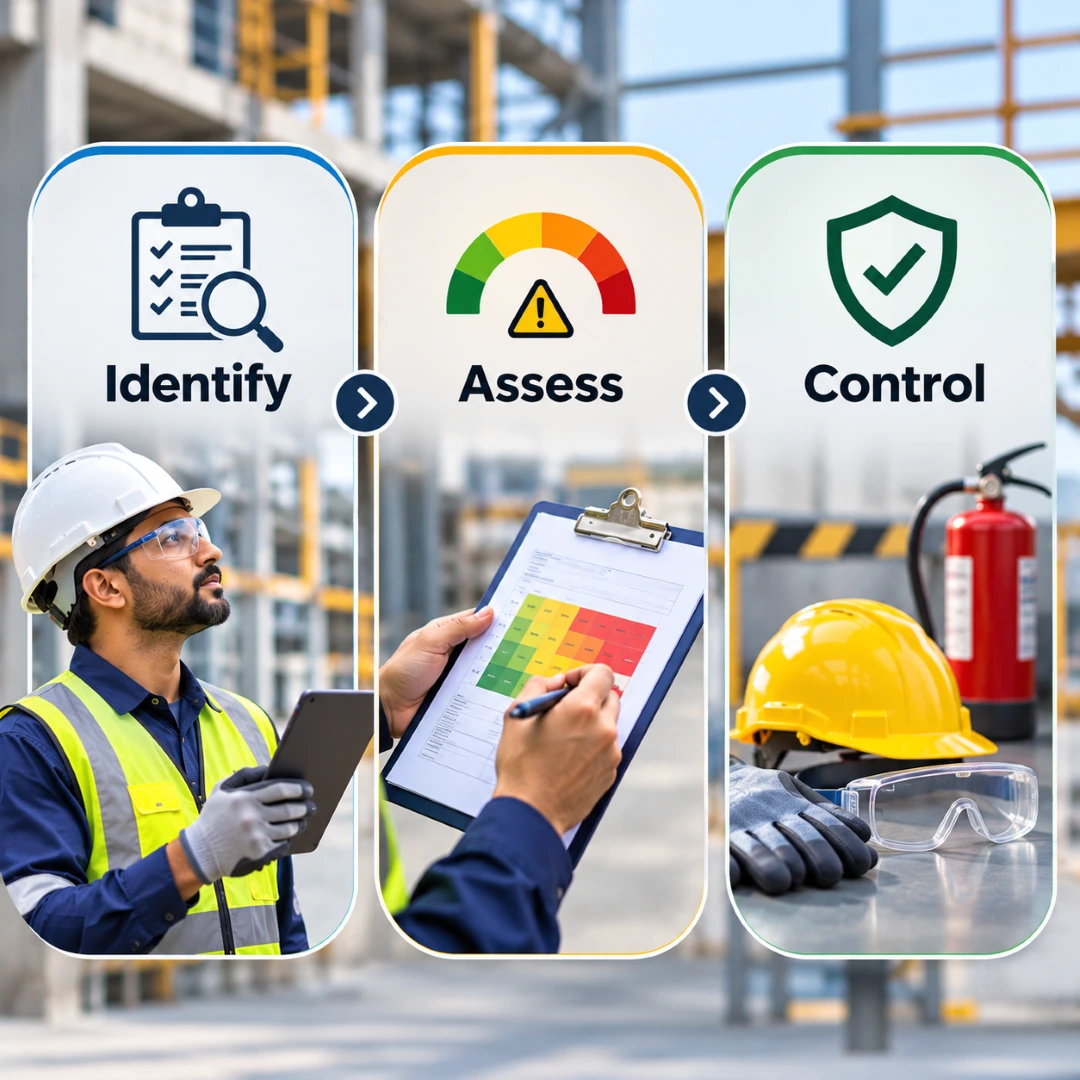
HSE risk assessment follows a simple loop: identify → assess → control → monitor. Training sits inside this loop. It helps people spot hazards and apply controls, but it is only one type of control, and rarely the strongest.
Identify. Hazards come to light through workplace inspections, task observations, employee reports, near-miss records and incident investigations. The most useful source is often the people doing the work, which is why reporting routes belong in every induction. Administrative Decision No. 19 of 2023 also expects workers to identify and report risks to themselves and others.
Assess. For each hazard, consider how likely harm is and how severe it could be. Many organisations use a simple likelihood × severity matrix (for example, 1–5 on each axis) to rank risks. The scoring method matters less than applying it consistently and acting on the highest scores first.
Control. Choose controls using the hierarchy of controls. The US National Institute for Occupational Safety and Health (NIOSH) sets out the preferred order as:
Elimination: remove the hazard entirely.
Substitution: replace it with something less hazardous.
Engineering controls: isolate people from the hazard through barriers, guards or ventilation.
Administrative controls: change how people work through procedures, permits, signage, scheduling and training.
Personal protective equipment (PPE): protect the individual worker.
NIOSH explains that the top three levels work with little reliance on human behaviour, while administrative controls and PPE need ongoing effort from workers and supervisors. ISO 45001 builds the same logic into its approach to controlling OH&S risks.
Hazard (from our scenario) | Higher-level control | Lower-level control | Role of training |
|---|---|---|---|
Loose rebar near a slab edge | Edge protection and toe boards; designated storage away from edges | Housekeeping checks; exclusion zone below | Recognise and report unsecured materials; know who can stop work |
Worker in full sun in July | Reschedule outdoor tasks; shaded work areas | Work-rest cycles; water and cooling points; buddy checks | Spot early heat illness symptoms; know how to respond |
Uncapped solvent drum near a drain | Substitute a lower-hazard product; bunded storage | Labelling; spill kits; storage procedure | Correct storage, spill response and reporting |
Monitor. Controls drift. Check them through inspections, audits, supervisor observations and incident trends, and close corrective actions promptly. A control that exists on paper but is not used on site is a training or supervision gap to fix.
The practical lesson: if your risk assessment lists "training" as the main control for a serious hazard, look again. Training makes a guardrail work; it cannot replace a missing one.
UAE Workplace Risks that Requires Specific Training
Some risks are shaped by the UAE's climate, its large construction and industrial sectors, and its diverse, multilingual workforce. Federal rules already address several of them directly, which makes them natural priorities for training.
Heat stress. Under the federal midday break, work under direct sunlight and in open places is not allowed between 12:30 pm and 3:00 pm from 15 June to 15 September each year, as stated on the UAE Government Portal. Limited exemptions exist for technical reasons, such as concrete pouring that cannot be postponed. Where exempt work continues, Administrative Decision No. 19 of 2023 requires employers to provide cold drinking water, approved hydration fluids, first aid materials, cooling and sun shades. Treat the midday break as a legal minimum, not the full answer. Heat risk also exists in the morning, in late September and indoors in poorly ventilated spaces.
Working at height. Administrative Decision No. 19 of 2023 requires scaffolds to be erected and dismantled by licensed, qualified people and inspected weekly, with guardrails on scaffolds and platforms 8 metres above the ground and harnesses worn to reduce fall risk. In Dubai, construction work must also follow the Code of Construction Safety Practice.
Language and literacy. The same decision requires warning labels on hazardous substance containers in Arabic and, where necessary, in other languages workers understand. The principle applies to training too. A course a worker cannot follow does not build competence, however professional it looks.
The table below turns these and other common risks into training responses.
Risk | Who is exposed | What employees should learn | What the organisation must do beyond training |
|---|---|---|---|
Heat stress | Outdoor and poorly ventilated indoor workers, delivery riders | Early symptoms, hydration, buddy checks, how to stop work and get help | Comply with the midday break; schedule heavy work for cooler hours; provide shade, water and rest areas |
Working at height | Construction, facilities and maintenance teams | Ladder and scaffold checks, harness use, exclusion zones | Edge protection, inspected scaffolds, rescue plans, competent supervision |
Contractor coordination | Contractors and host employees on shared sites | Site rules, permits, evacuation routes, who to report to | Contractor selection and monitoring; joint inductions; clear permit-to-work systems |
Chemical exposure | Cleaners, stores staff, workshop and lab workers | Reading labels and safety data sheets, PPE, spill response | Substitution where possible, ventilation, bunded storage, labelling in understood languages |
Machinery and electrical risks | Operators, technicians, maintenance staff | Lockout/tagout, guard use, reporting defects | Guarding, regular inspection, authorised-person systems |
Emergency response | Everyone, with extra depth for wardens and first aiders | Alarms, routes, assembly points, first response | Tested plans, drills, a register of first aiders, equipment checks |
Multilingual communication | Mixed-language teams | Key safety instructions in a language they understand | Translated materials, visual aids, interpreters for briefings, comprehension checks |
The common thread is that each risk needs a physical or organizational control first, with training making sure people use it.
Role-based Safety Training
HSE training should differ by role because exposure and decision-making authority differ. The matrix below is a starting template to adapt after your TNA.
Role | Main exposure | Relevant topics | Level | How to verify |
|---|---|---|---|---|
Construction workers | Falls, plant, heat, manual handling | Working at height, PPE, heat stress, site rules, emergency response | Job-specific | Practical demonstration; supervisor observation |
Office employees | Ergonomics, fire, electrical, stress | Workstation setup, evacuation, reporting, wellbeing | Awareness | Short quiz; drill participation |
Warehouse employees | Forklifts, racking, manual handling | Traffic rules, safe lifting, stacking, loading bays | Job-specific | Practical checklist sign-off |
Healthcare workers | Infection, sharps, patient handling | Infection control, sharps, safe handling, clinical waste | Job-specific | Skills check; audit of practice |
Maintenance teams | Electrical, height, confined spaces, machinery | Isolation and lockout, permits, height and confined space work | Specialist | Competence assessment; authorisation before work |
Supervisors | Responsible for others' safety | Hazard spotting, toolbox talks, stop-work authority, incident first response | Job-specific plus leadership | Observed toolbox talk; scenario exercise |
HSE officers | Organisation-wide risk | Risk assessment, investigation, auditing, legal requirements | Specialist (often certified) | Recognised qualification plus practical review |
Senior management | Accountability and resourcing | Legal duties, HSE governance, reading performance data | Awareness of duties | Review of decisions and actions taken |
A single hazard shows why depth matters. Take the uncapped solvent drum again. A general worker's job is to keep clear and report it. A stores employee should cap it, move it to bunded storage and check the drain. The supervisor decides whether work nearby must pause and records the near miss. The HSE officer asks why the drum was left there and whether the storage procedure, the product choice or the training needs to change. Same hazard, four different responsibilities, four different training needs.
How Should HSE Training be Delivered?
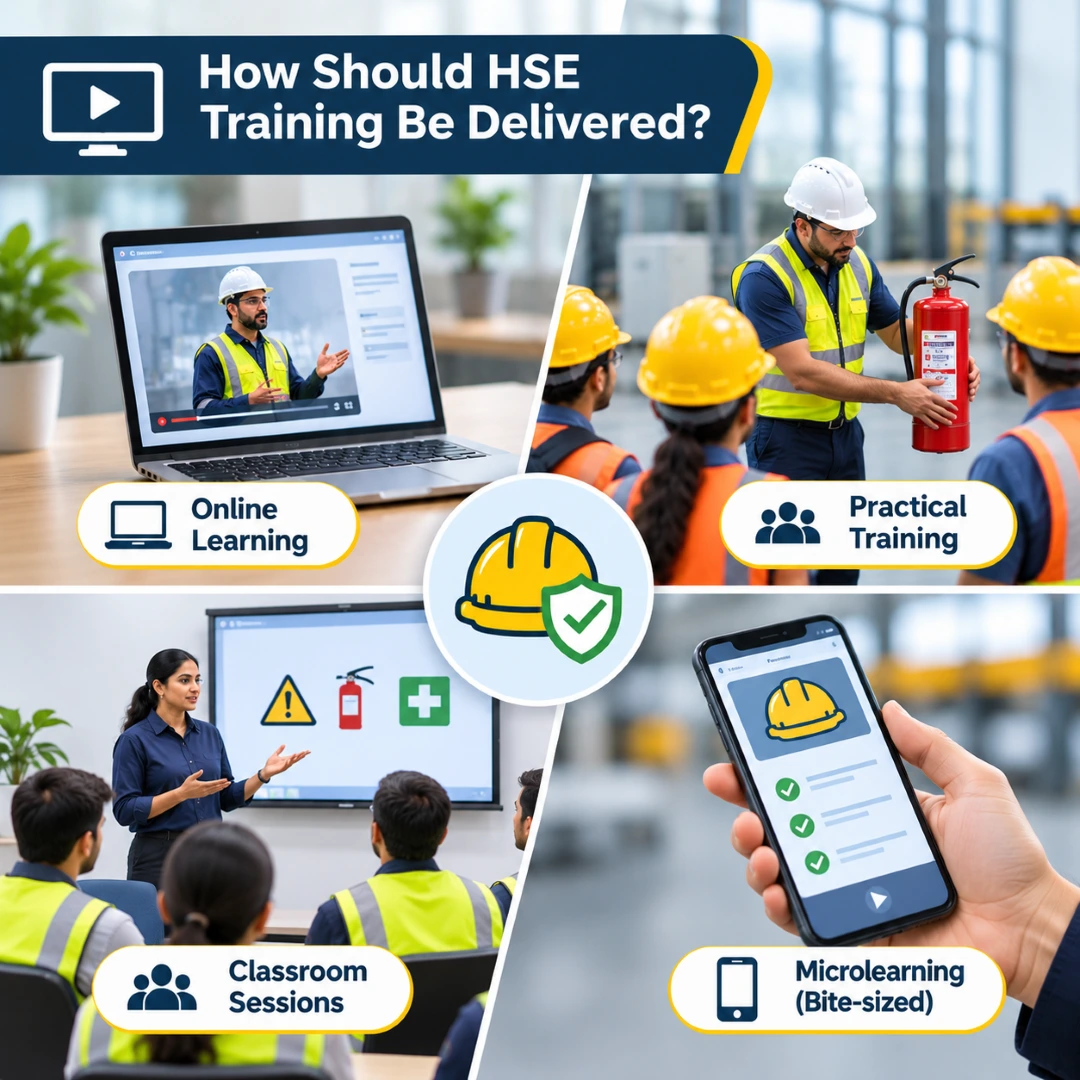
Match the method to what the learner must be able to do. If the outcome is knowledge, online or classroom learning can work well. If the outcome is a physical skill or a decision under pressure, people need to practice it.
Method | Strengths | Limitations | Best suited to |
|---|---|---|---|
Instructor-led sessions | Discussion, questions, adapting to the group | Hard to schedule across shifts; quality varies by trainer | Inductions, risk assessment, supervisor training |
Toolbox talks | Short, frequent, tied to the day's work | Shallow unless structured; rarely recorded well | Daily hazards, lessons from near misses, seasonal risks such as heat |
E-learning | Consistent, scalable, self-paced, easy to track | Cannot build physical skills; easy to click through | Awareness topics, policies, refreshers, pre-course theory |
Video-based learning | Shows real tasks and correct technique; works across literacy levels | Passive unless paired with questions | Demonstrating procedures, multilingual teams |
Scenario-based learning | Builds judgement; shows consequences safely | Takes effort to design well | Reporting decisions, hazard spotting, emergency choices |
Practical demonstrations | Builds and proves physical skill | Needs equipment, space and a competent assessor | Fire extinguisher use, harness fitting, spill kits, first aid |
Emergency drills | Tests the plan and people together | Disruptive; needs planning and debrief | Evacuation, spill response, rescue arrangements |
On-the-job coaching | Learning in the real environment with feedback | Depends on the coach's own competence | New starters, role changes, specialist tasks |
For example, fire extinguisher handling needs a practical demonstration with a real or training extinguisher. Introductory hazard awareness can be delivered well through an online module. Most organisations end up with a blended approach: online learning for theory and consistency, then practical sessions, drills and coaching for the skills that matter most. Blending also saves classroom time for the part of training that genuinely needs a trainer in the room.
How Often Should Employees Receive HSE Training?
There is no single federal refresher interval that applies to all HSE training in the UAE. The federal framework requires training that is appropriate to the risks, and informing workers of risks before they start work. Fixed intervals usually come from three other places: a specific emirate or sector rule, the validity period of a certification (first aid certificates, for example, typically carry an expiry date set by the issuing body), or your own risk-based policy.
So think in terms of triggers as well as calendars. Training should happen:
on joining, before the person starts hazardous work
on changing role, especially into higher-risk tasks or supervision
when equipment, processes or procedures change
when a new hazard appears, such as a new chemical, site or seasonal risk like summer heat
when requirements change, for example a new emirate code or client standard
after an incident, near miss or audit finding that reveals a gap
when an assessment shows knowledge has faded
On top of these triggers, many organisations set a recommended refresher cycle, often annual for awareness topics and more frequent for high-risk tasks. That is sensible practice, but describe it in your policy as your own risk-based choice, not as a universal legal rule.
How to Measure HSE Training Effectiveness
Completion rates tell you who sat the course. Effectiveness asks a harder question: are people now working more safely? Answering it needs a mix of indicators. ISO has published guidance on this topic in ISO 45004, which covers evaluating OH&S performance.
Indicator type | What it shows | Examples |
|---|---|---|
Leading (forward-looking) | Whether safe behaviour and controls are in place before harm occurs | Assessment scores, practical sign-offs, near-miss reports, inspection findings, toolbox talks held, corrective actions closed on time, overdue training |
Lagging (after the event) | Whether harm has occurred | Injuries, occupational illness cases, environmental incidents, lost time |
Read the two together. A fall in reported incidents can look like progress, but if near-miss reporting has also dropped, people may simply have stopped reporting. After good training, many organisations see near-miss reports rise for a while, because employees now recognise hazards and trust the process. That is usually a healthy sign.
Assessments should test decisions, not memory. Here is an illustrative scenario question:
HSE Training Records and Audit Readiness
UAE employers must keep OSH records available for inspection. Administrative Decision No. 19 of 2023 (Article 3) lists, among other items, OSH training for employees, the number of employees trained, training resources, and tests such as firefighting drills. Separately, establishments with 50 or more workers must keep a record of workers exposed to occupational hazards for at least five years after their service ends, according to the UAE Government Portal. Check emirate, free zone and client requirements for any additional retention rules.
A good record answers two different questions, and many organisations only answer the first.
Question | Evidence of completion | Evidence of competence |
|---|---|---|
Did they attend? | Name, date, course title, trainer, attendance sheet or system log | — |
Did they understand? | Quiz score | Scenario assessment results, with gaps followed up |
Can they do it? | — | Practical checklist signed by a competent assessor; on-the-job observation |
Are they still current? | Refresher dates; certificate expiry | Reassessment results; supervisor observations over time |
What happened with gaps? | — | Recorded follow-up actions, coaching and reassessment |
Also record the learning objectives and the version of the content used. If a procedure changes, you need to know who was trained on the old version. An auditor or investigator asking "was this worker competent for this task?" wants the right-hand column, not just a certificate.
How An LMS Supports HSE Training Management
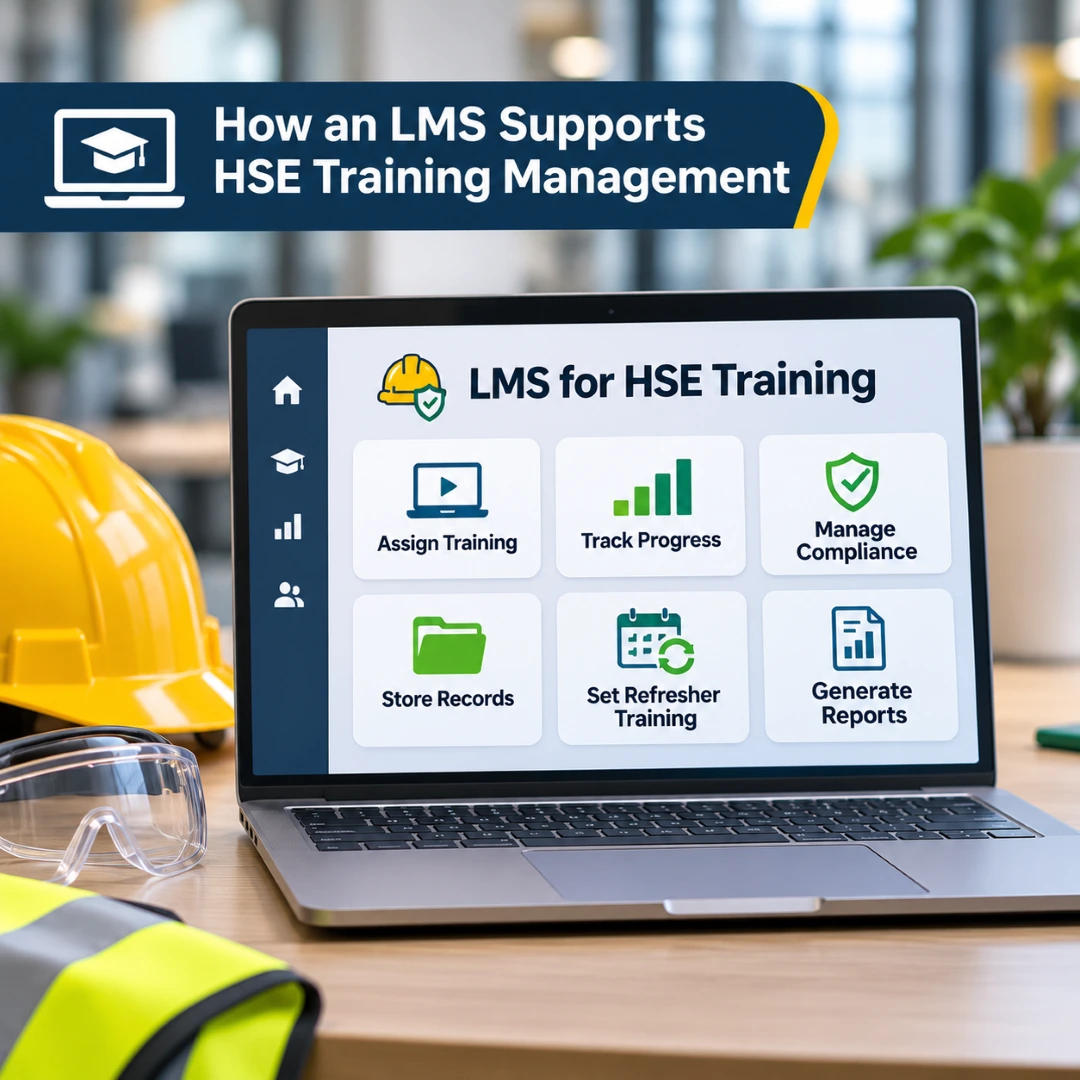
A learning management system (LMS) helps with the administrative side of HSE training: assigning the right courses, delivering theory consistently, tracking progress and keeping records. Those tasks become hard to manage on spreadsheets once you have multiple sites, shifts, languages and contractor groups.
Mapped to the programme lifecycle above, an LMS can support:
Centralised training management: one place for HSE courses, procedures and learning resources, so every site uses the current version.
Role-based learning paths: assigning courses automatically by role, site or exposure, following your TNA and role matrix.
Video-based and interactive learning: short videos, quizzes, flashcards and scenarios that suit awareness topics and mixed-literacy teams.
Assessments: knowledge checks and scenario questions that show understanding, not just attendance.
Records and reporting: completion, scores and overdue training by person, team or site, ready for internal review or inspection.
Refresher learning: reminders and scheduled re-enrolment when training is due or a trigger occurs.
Calibr is an LMS that supports these needs, helping organisations assign role-based HSE courses, deliver video-based and interactive learning, run assessments, send reminders and report on progress across teams.
Note: It is just as important to be clear about what an LMS does not do. It does not replace practical demonstrations, emergency drills, specialist certifications or on-the-job competence checks. A worker cannot learn to fit a harness from a screen. The most effective setup uses the LMS for theory, scheduling and records, and uses it to capture the outcome of practical assessments carried out by competent people on site. Responsibility for safe work stays with the employer, supervisors and workers.
Frequently Asked Questions (FAQs)
What is HSE training?
It is training that helps employees recognise and control risks to health, safety and the environment at work, and respond correctly to incidents and emergencies.
Is HSE training mandatory in the UAE?
Yes. Federal law requires private-sector employers to provide appropriate training to protect workers from occupational risks. The exact content, depth and any fixed intervals depend on your activities, emirate and sector.
What are the three components of HSE?
Health (preventing work-related illness), safety (preventing injuries and accidents) and environment (preventing pollution and environmental harm).
Who needs HSE training?
Everyone at the workplace needs some level, from awareness for office staff and visitors to specialist training for maintenance teams and HSE officers. Contractors need a site-specific induction.
What is the difference between HSE and occupational safety training?
Occupational safety and health training covers workers' health and safety. HSE training adds environmental responsibilities such as waste, spills and pollution prevention.
How often should employees receive HSE training?
At induction, on role or process changes, after incidents and when assessments show gaps, plus a risk-based refresher cycle. There is no single federal interval for all HSE topics, though certificates and some sector rules set their own.
Can HSE training be completed online?
Awareness and theory topics can be delivered online effectively. Practical skills such as extinguisher use, harness fitting or first aid need hands-on training and assessment.
Is an HSE certificate proof of competence?
Not on its own. A certificate shows a course was completed. Competence is shown when a person can perform the task safely in your workplace, verified by observation or practical assessment.
How can organisations evaluate HSE training effectiveness?
Combine assessment results and practical sign-offs with workplace indicators such as inspection findings, near-miss reporting and corrective action completion, rather than relying on completion rates or incident counts alone.
Conclusion: Back to the Site
Return to that construction site at 11:40. The difference between a near miss and an incident comes down to three quick decisions. The steel fixer moves the rebar back from the edge and tells the supervisor. A coworker recognises the new labourer's early heat symptoms, moves him into the shade and calls the first aider. The stores attendant caps the drum and moves it into bunded storage.
None of those actions comes from a certificate. Each comes from training built around the actual hazards, delivered in a way people understood, practised where it mattered and checked afterwards.
That is the core of effective HSE training: start with the risks, train each role to the depth its decisions require, verify competence rather than attendance, and keep improving. Technology such as an LMS can make the planning, delivery and record-keeping far easier to manage. The judgement on site still belongs to well-trained people.


Vivetha is a digital marketing professional specializing in content marketing and SEO. She focuses on developing optimized, high-quality content that improves search visibility, supports brand objectives, and drives measurable results. With a structured and analytical approach, she ensures content aligns with business and audience needs.