
HSE training teaches employees how to work safely and follow workplace procedures.
HSE certification provides a recognised qualification for people with specific safety responsibilities.
Not every employee needs a professional HSE qualification.
Training should match the employee's role, workplace and level of risk.
General employees need safety awareness, induction and job-specific training.
Supervisors and HSE professionals may benefit from qualifications such as IOSH and NEBOSH.
Practical skills like first aid and working at height require hands-on training.
Refresher training helps employees stay prepared for new risks and workplace changes.
An LMS helps companies assign courses, track progress and maintain training records.
Training or Certification: The Question Most Companies Get Stuck On
Here is an illustrative example. A logistics company in Sharjah has 150 employees across an office, a warehouse and a delivery fleet. After a client audit, the operations manager is asked to "get everyone HSE certified". Quotes for professional courses start arriving, and the budget looks alarming.
This is a common mix-up in the HSE training vs HSE certification debate. Both involve learning about health, safety and environment (HSE), and both often end with a certificate. But they serve different purposes, and most companies need each one for different people.
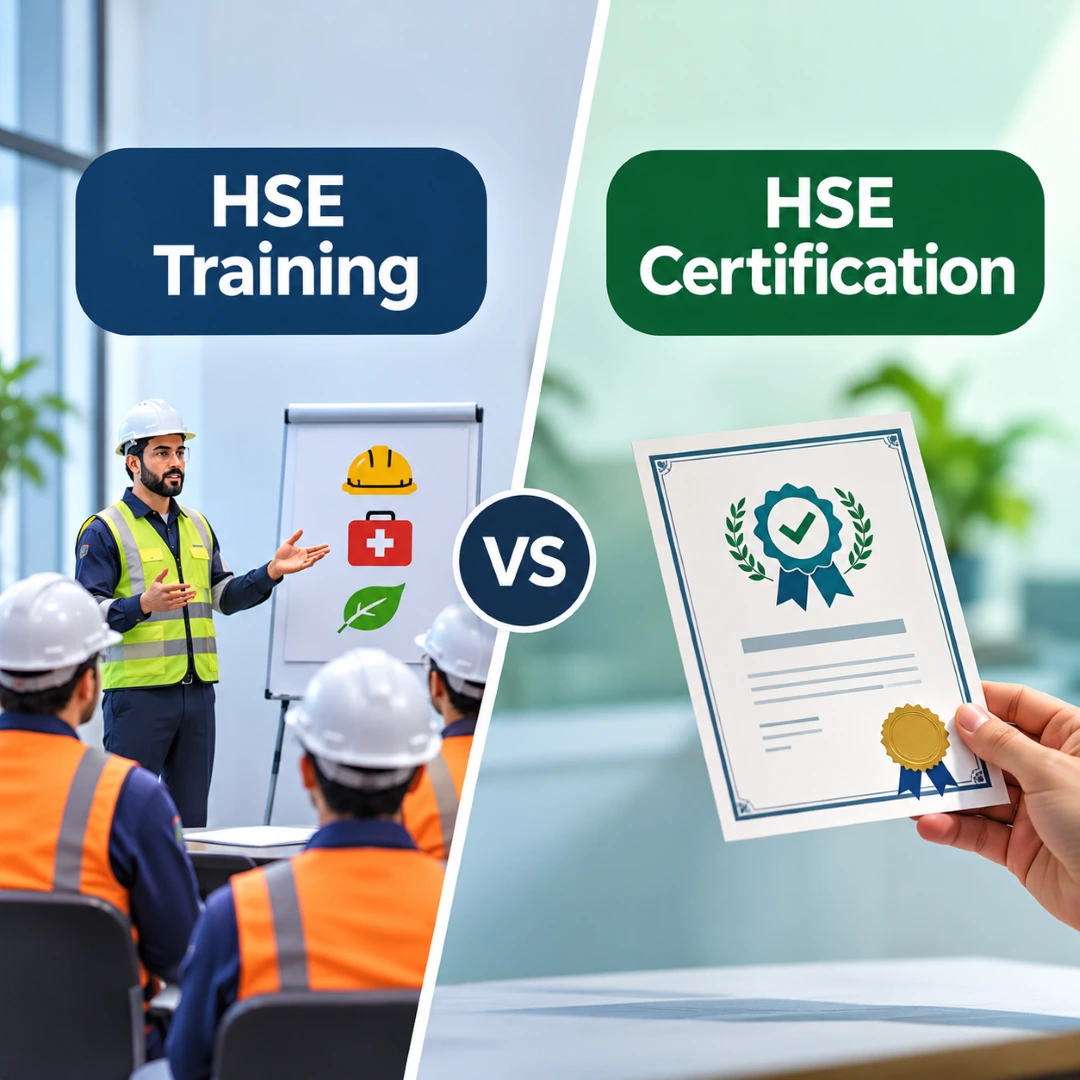
HSE Training vs HSE Certification: Purpose, Outcomes and Use
HSE training teaches employees to work safely in your workplace. HSE certification, in the sense of a recognized qualification, shows that a person has passed an independent assessment against a published standard. One is built around your risks; the other is built around a syllabus.
The table below compares the two from a business point of view.
What the company gets | HSE training | Recognised HSE qualification |
Purpose | Safe behaviour in specific roles and sites | Broad HSE knowledge for people who manage or advise on safety |
Content | Your hazards, procedures, PPE and emergency steps | Risk management, safety management systems and risk assessment |
Who designs it | The company or a training provider | An awarding body, such as NEBOSH or IOSH |
Typical outcome | An internal completion record | A qualification certificate from the awarding body |
Who receives it | Every employee, at the depth their role needs | Selected supervisors, managers and HSE staff |
One caution: not every certificate is a qualification. An attendance or completion certificate from a short course confirms participation, not independently assessed competence.
When Should a Company Choose HSE Training?
Choose HSE training whenever the goal is for employees to recognise hazards and follow your procedures. For most of your workforce, that is the whole requirement.
UAE federal rules point the same way. MoHRE's Administrative Decision No. 19 of 2023 requires employers to include OSH training programmes, designed around the nature of their activities, in their health and safety programme. It also requires employers to inform employees of the risks of their occupation before they start work (Administrative Decision No. 19 of 2023, English translation). The focus is training matched to risk, not a professional qualification for every employee.
In practice, HSE training covers four needs:
General safety awareness: hazard reporting, fire safety and emergency procedures for everyone, including office staff.
Workplace induction: site rules, assembly points and PPE requirements for new joiners and contractors.
Job-specific knowledge: manual handling for warehouse staff, safe loading for drivers, chemical handling for cleaning teams.
Practical safety skills: using a fire extinguisher, wearing a harness correctly or giving first aid. Administrative Decision No. 19 of 2023 also requires employers to train selected workers in first aid and keep a register of them.
In the Sharjah example, almost all 150 employees fall into this group.
When Should a Company Invest in HSE Certification?
Invest in recognised qualifications for the people who plan, lead or advise on safety for others. These roles need broad, transferable knowledge, not just familiarity with one site's rules.
Typical candidates are:
HSE officers and safety managers. Under MoHRE rules, every industrial establishment and every construction establishment with 100 or more workers must appoint a technically qualified occupational health and safety officer (UAE Government Portal). Administrative Decision No. 19 of 2023 specifies that this officer must be a licensed engineer or a graduate of an OSH institute.
Supervisors and team leaders. They carry out risk assessments and make daily safety calls. IOSH Managing Safely, assessed through a test and a workplace risk assessment project, is a common choice for this level.
Staff moving into an HSE role. The NEBOSH International General Certificate is designed for managers, supervisors and workers who need a broad understanding of health and safety, and is often a first step into an HSE career. It is assessed through an open book examination and a practical risk assessment (NEBOSH IGC learner guide).
Specialised responsibilities. Some activities need a specific licence or qualification. For example, crane operators must hold a valid licence from the relevant authority.
The decision does not say whether a NEBOSH or IOSH qualification alone meets the OSH officer requirement, so confirm this with MoHRE before appointing one. Requirements also vary by emirate, free zone, sector and client contract. Abu Dhabi, for example, has its own OSH framework with expectations for practitioners. Check with your licensing authority before you decide.
Why Ongoing HSE Training Matters
HSE training shouldn't stop once an employee completes a course. Think about it – new equipment gets introduced, safety procedures change and employees take on different responsibilities. They need to know how to handle these changes safely.
That's why regular refresher training is important. It helps employees remember what they've learned, understand new risks and stay prepared for situations they may face at work.
But how can companies manage this training across different teams? And where does an LMS fit in? Let's look at how ongoing HSE training works and how an LMS can make it easier to manage.
Conclusion: Most Companies Need Both, For Different People
Back in Sharjah, the operations manager does not need to certify all 150 employees. The workforce needs role-based HSE training with regular refreshers. The supervisors benefit from an assessed course, and the person leading safety needs the qualifications the role and regulator call for.
HSE training builds safe habits across the company. Recognised qualifications support specific professional responsibilities. An LMS keeps the training side running and recorded, so learning continues after the first course ends.
Frequently Asked Questions (FAQs)
Does every employee in the UAE need an HSE certificate?
No. UAE federal rules require employers to train employees on the risks of their work, not to give every employee a professional qualification. Specific roles, such as OSH officers in industrial and construction establishments, have additional requirements.
Is NEBOSH or IOSH the same as HSE training?
No. NEBOSH and IOSH are awarding bodies that offer assessed qualifications. Workplace HSE training is designed around your own hazards and procedures. Many HSE professionals need both.
Can online HSE training replace practical training?
No, not for physical skills. Online training suits awareness and knowledge, but skills such as first aid or working at height need hands-on practice and a practical check.
How often should employees receive HSE refresher training?
It depends on the task and its risks. Refresh training on a set cycle for higher-risk work, and whenever equipment, procedures, roles or regulations change, or after an incident.
How does an HSE training LMS help with inspections?
It keeps a central history of who was trained, on what and when, along with assessment results. This supports the OSH training records MoHRE requires employers to keep available for inspection.


Vivetha is a digital marketing professional specializing in content marketing and SEO. She focuses on developing optimized, high-quality content that improves search visibility, supports brand objectives, and drives measurable results. With a structured and analytical approach, she ensures content aligns with business and audience needs.