
Learning fatigue is becoming a hidden productivity and retention problem in modern workplaces.
Employees are expected to continuously absorb new tools, training, AI workflows, and upskilling demands — often without enough cognitive recovery time.
The article explores why traditional L&D models are contributing to cognitive overload and how learning fatigue impacts engagement, retention, and training ROI.
It introduces the R.E.S.T. framework — Reduce Overload, Embed Into Work, Shorten Learning Cycles, and Target Relevance — as a practical strategy for designing more sustainable workplace learning experiences.
The piece also explains how AI-powered learning platforms, workflow-integrated learning, and contextual microlearning can help organizations reduce friction and improve learning effectiveness in the flow of work.
Your employees are completing training. They're attending sessions. They're clicking through modules. And then they're forgetting almost everything. Here's why — and what to do about it.
Burnout has dominated workplace wellness conversations for years. But a quieter, less visible form of exhaustion is taking hold inside modern organizations — and most L&D dashboards can't detect it.
Call it learning fatigue: the cognitive exhaustion that sets in when employees are expected to continuously absorb new information, complete mandatory training, adopt new tools, and upskill — often on top of full workloads, back-to-back meetings, and constant digital noise.
According to LinkedIn's 2024 Workplace Learning Report, 90% of L&D professionals agree that proactively building employee skills is critical to business performance. Yet many organizations are simultaneously contributing to the very cognitive overload that makes learning ineffective. The result is a paradox: more training, less learning.
This piece explains what learning fatigue actually is, why it's getting worse, and what forward-thinking L&D leaders can do about it.
What Is Learning Fatigue
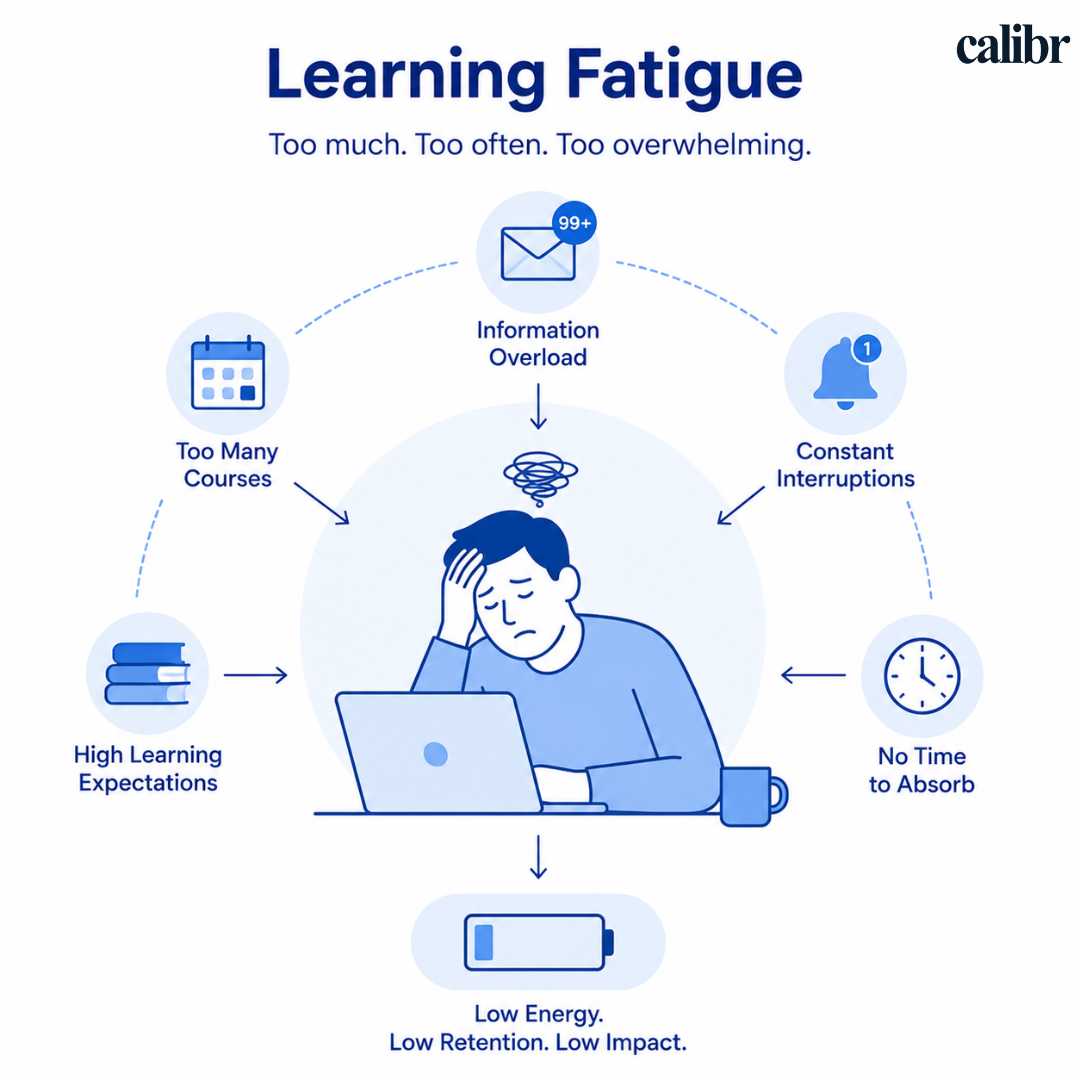
Learning fatigue is the mental exhaustion that occurs when employees are continuously expected to absorb, process, and retain large amounts of information — without adequate cognitive recovery time between learning demands.
It is distinct from general burnout, which stems from prolonged workplace stress across all domains. Learning fatigue is specifically tied to cognitive overload caused by excessive or poorly designed learning demands.
The brain has a finite capacity for information processing. When that capacity is exceeded consistently — through back-to-back training sessions, excessive course libraries, mandatory compliance modules, and continuous upskilling pressure — the brain starts to protect itself. Attention begins to drift. Information is processed more shallowly. Retention weakens. Engagement becomes increasingly passive.
Common signs of learning fatigue include employees rushing through training modules, disengaging from optional learning opportunities, multitasking during live sessions, and struggling to retain or apply information after training.
The employee may still complete the training. Very little actually sticks.
Why Learning Fatigue Is Growing — and Why the AI Era Is Accelerating It
A decade ago, formal workplace learning was episodic. Employees attended a training day once a quarter, completed a compliance module annually, and otherwise learned on the job.
Today, workplace learning is continuous — and increasingly mandatory. A typical employee is now expected to navigate:
AI literacy training and new tool adoption (often quarterly)
Compliance and regulatory modules
Role-specific upskilling programs
Onboarding updates as products and processes change
Optional but expected professional development
This is happening while employees are simultaneously managing full workloads, responding to messages across multiple platforms, attending virtual meetings, and navigating the cognitive demands of hybrid work.
The AI era is making this worse. Every few months, organizations are rolling out new platforms, workflow automation tools, and AI systems — each with its own onboarding curve. Employees are no longer learning in structured phases.
They are learning while simultaneously working, switching contexts, and managing digital distractions. The result is a compounding pressure that cognitive science would predict to be unsustainable.
Worth knowing:
Microsoft's 2023 Work Trend Index found that 68% of employees say they don't have enough uninterrupted focus time during the workday. When focus time is already fragmented, adding continuous learning demands accelerates cognitive depletion.
What Learning Fatigue Actually Looks Like (And Why It's Often Misread)
One of the most consequential things about learning fatigue is that it is almost invisible on a standard L&D dashboard. Completion rates look fine. Session attendance is normal. Assessment scores are passable.
But the warning signs show up elsewhere — and they are frequently misattributed to motivation, attitude, or engagement problems when the root cause is cognitive overload.
In many organizations, completion metrics still create the illusion of effective learning. But completion does not necessarily indicate comprehension, retention, or behavioral change — especially in cognitively overloaded environments.
What leaders observe | Common misreading | What it often actually indicates |
Employees rushing through modules | "They're not taking learning seriously" | Training has become checkbox behavior due to overload |
Low voluntary course enrollment | "Low motivation to develop" | Cognitive bandwidth is already exhausted |
Multitasking during live sessions | "Disrespectful or disengaged" | Attention fatigue from excessive screen time |
Poor knowledge retention after training | "Training wasn't sticky enough" | Information overload — retention requires recovery time |
Repeated mistakes despite training completion | "Skill issue or attitude problem" | Knowledge never transferred because processing was shallow |
This misdiagnosis matters because the typical response — more training, more mandates, more content — directly worsens the underlying problem.
The Real Business Cost of Getting This Wrong
Learning fatigue is not just an employee wellness issue. Left unaddressed, it quietly erodes the return on every rupee your organization invests in L&D.
When employees are cognitively overloaded, training completion does not translate into capability. Skills don't transfer. New tools get underused. Compliance knowledge doesn't stick. The organization has paid for learning that didn't happen.
Beyond the direct training ROI problem, the downstream effects include slower onboarding (because new joiners can't absorb the information firehose), lower AI and tool adoption rates, weaker innovation (because curiosity and experimentation require cognitive energy), and, over time, disengagement and attrition among the employees who feel most overwhelmed.
This is what makes learning fatigue a leadership issue, not just an L&D issue.
The uncomfortable reality is that many organizations are unintentionally creating the very conditions that produce learning fatigue. Not because they don't value learning — but because most workplace training systems were designed for a very different era of work.
Why Traditional L&D Design Makes This Worse
Most corporate learning is still designed on an industrial model: long courses, information-dense slides, passive consumption, scheduled delivery, and a completion metric as the proxy for learning.
That model was built for a world where employees had protected learning time and encountered new information infrequently. It does not fit the cognitive environment of a modern workplace.
Modern employees are not information starved. They are information-saturated. The challenge is not access to learning — it is designing learning experiences that are short enough to fit into fragmented attention windows, relevant enough to feel worth the cognitive cost, and practical enough to be applied immediately.
Much of this aligns with principles from Cognitive Load Theory, which suggests that working memory has a limited capacity for processing new information at any given time.
When training programs overload employees with excessive content, dense interfaces, or continuous context-switching, learning effectiveness drops sharply. In many organizations, the issue is no longer lack of learning opportunities — it is exceeding the brain's ability to meaningfully absorb and apply information.
Several specific design failures consistently contribute to learning fatigue:
Content bloat: Courses contain far more information than employees need to do their jobs. The 10% that matter is buried in the 90% that isn't.
Poor timing: Training is delivered at a set time rather than in the moment of need, reducing relevance and retention.
Lack of personalization: Everyone receives the same content regardless of what they already know, creating redundancy that feels like wasted time.
No cognitive recovery built in: Learning schedules stack sessions without spacing — which is the opposite of what the science of spaced repetition recommends.
The good news is that learning fatigue is not an unavoidable side effect of modern work. In many cases, it is a design problem — which means it can also be redesigned.
A Practical Framework: The R.E.S.T. Model for Sustainable Learning
Addressing learning fatigue does not mean reducing the importance of L&D. It means rethinking how learning is designed, delivered, and experienced within the flow of modern work.
Many organizations assume low engagement is a motivation problem. In reality, employees are often overwhelmed by excessive content, constant notifications, mandatory modules, and learning experiences disconnected from their day-to-day responsibilities. Sustainable learning requires a shift from volume-driven training to relevance-driven learning.
The R.E.S.T. framework gives L&D teams a practical model for auditing and redesigning learning programs in a way that supports retention, engagement, and long-term performance — without contributing to cognitive overload.
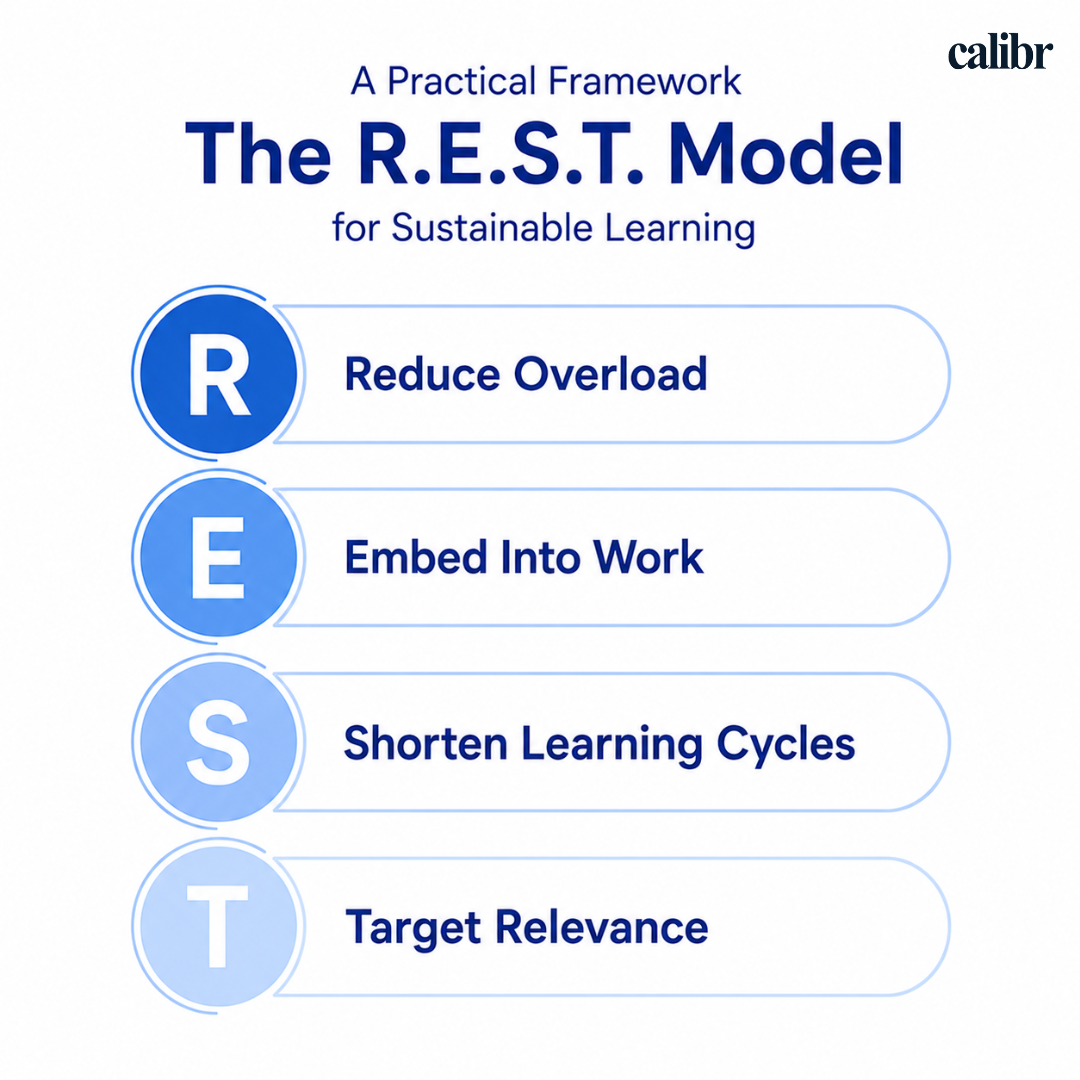
R — Reduce Overload
Most organizations have accumulated years of learning content across LMS platforms, SharePoint folders, recorded webinars, PDFs, compliance modules, and duplicated training paths. More content does not automatically create better learning outcomes.
L&D teams should regularly audit their learning ecosystems to identify:
Duplicate or outdated content
Training with low completion or application rates
Courses that are rarely revisited after completion
Content that overwhelms employees without driving measurable performance improvement
Reducing overload means prioritizing clarity over quantity. A smaller, focused learning ecosystem is easier to navigate, easier to retain, and more likely to be used consistently by employees.
The goal is not to remove learning opportunities — it is to eliminate unnecessary friction and noise.
E — Embed Into Work
Employees rarely stop working to learn. More often, they learn while trying to solve a problem, complete a task, or make a decision.
That is why modern L&D strategies increasingly focus on embedding learning directly into workplace workflows rather than separating learning from work itself.
This can include:
Workflow-integrated guidance
Searchable knowledge bases
AI assistants
In-app prompts and nudges
Embedded SOPs and job aids
Contextual onboarding support
When knowledge is accessible at the moment of need, employees spend less time searching for answers and more time applying what they learn immediately. This improves both productivity and knowledge retention.
S — Shorten Learning Cycles
Long-form training sessions often create information overload, especially in fast-paced work environments where employees already manage constant context switching.
Breaking learning into shorter, focused experiences helps reduce cognitive fatigue and improves behavioral transfer.
Instead of:
90-minute webinars
hour-long compliance modules
lengthy onboarding sessions
Organizations can use:
5–10 minute microlearning modules
scenario-based learning moments
short explainer videos
spaced reinforcement
role-specific refreshers
Shorter learning cycles align more naturally with how people consume information at work today — in quick, actionable bursts rather than extended periods of passive consumption.
T — Target Relevance
One of the biggest causes of learning fatigue is irrelevant training.
Employees disengage quickly when they are asked to complete learning that does not connect to their role, responsibilities, or current skill needs.
Modern learning strategies should prioritize personalization by tailoring:
Learning paths by role
Skill-based recommendations
Experience-level content
Manager-guided development
AI-powered content suggestions
Contextual learning journeys
Not every employee needs every course. Relevance improves engagement because employees can immediately see how learning supports their daily work and long-term growth.
The underlying principle behind the R.E.S.T. framework is simple: sustainable learning is not about maximizing content consumption — it is about improving learning effectiveness.
A workforce that completes fewer but highly relevant, well-timed, and easily applicable learning experiences will often outperform teams overwhelmed by excessive training volume and constant learning interruptions.
How Modern Learning Platforms Are Responding
As organizations look for ways to reduce cognitive overload, technology is increasingly becoming part of the solution.
But technology alone does not solve learning fatigue. Poor learning design delivered through AI is still poor learning design. The real value of modern learning platforms comes from reducing unnecessary cognitive effort — helping employees find, consume, and apply only the information that matters most in the moment.
The good news is that the technology available to L&D teams has genuinely evolved to address many of these challenges. Modern AI-powered learning platforms can now help organizations:
Identify early signs of learner disengagement before it impacts performance
Surface relevant learning content at the moment employees actually need it
Personalize learning paths based on skill gaps, roles, and learner behavior
Reduce unnecessary content overload by prioritizing relevance over volume
Flag when learning demands are too high relative to employee workload and available time
This shift allows L&D teams to move beyond one-size-fits-all training models and create learning experiences that are more adaptive, contextual, and sustainable for modern employees.
Platforms like Calibr are built specifically around this challenge — using AI to reduce cognitive overhead by surfacing only what's relevant to each learner, delivering microlearning within workflows, and giving L&D leaders the real-time analytics to see where engagement is dropping before it becomes a retention or performance problem.
Practical Next Steps for L&D Leaders
If you suspect learning fatigue is affecting your workforce, here are five places to start:
Audit completion speed, not just completion rate: Courses completed significantly faster than expected average time are a reliable proxy for checkbox behavior.
Survey for cognitive load, not just satisfaction: Add questions to your post-training surveys about whether employees felt the training was appropriately scoped and whether they feel they can apply it.
Map your training volume against your operational calendar: Heavy learning periods that coincide with peak business periods (quarter-end, product launches) will reliably produce fatigue.
Identify your most overloaded learner segments: New joiners, managers, and employees in rapidly changing roles typically carry the heaviest cognitive loads.
Review your mandatory training list: Ask honestly: what on this list is mandatory because it's genuinely compliance-critical, and what is mandatory because no one has revisited the policy in three years?
Frequently Asked Questions (FAQs)
What is learning fatigue in the workplace?
Learning fatigue is the mental exhaustion employees experience when they are continuously expected to absorb, process, and retain large amounts of information — without adequate recovery time between learning demands. It leads to shallow processing, poor retention, and passive engagement with training.
What causes learning fatigue?
The most common causes include excessive mandatory training, poorly timed or irrelevant course content, long virtual learning sessions, continuous upskilling pressure from tool adoption and AI transitions, lack of personalization in learning programs, and no cognitive recovery time built into the learning schedule.
How is learning fatigue different from employee burnout?
Burnout is broad workplace exhaustion caused by prolonged stress across all job demands. Learning fatigue is specifically cognitive exhaustion caused by excessive or poorly designed learning demands. An employee can experience learning fatigue without being broadly burned out — and vice versa.
What are the warning signs of learning fatigue?
Warning signs include employees completing courses significantly faster than expected, low voluntary course enrollment, multitasking during live training sessions, poor retention and knowledge application after training, and declining participation in optional learning programs.
How can organizations reduce learning fatigue?
Organizations can reduce learning fatigue by auditing and trimming course libraries, shifting from long-form courses to microlearning, personalizing learning paths so employees only see relevant content, embedding learning into workflows rather than scheduling separate training blocks, and building spaced repetition and cognitive recovery into the learning design.
Does learning fatigue affect training ROI?
Yes, directly. When employees are cognitively overloaded, training completion does not translate into skill transfer or behavioral change. Organizations end up paying for learning that doesn't stick, which reduces the measurable business return on L&D investment.
What is the R.E.S.T. framework for learning fatigue?
R.E.S.T. is a practical framework for redesigning learning programs to reduce cognitive overload. It stands for: Reduce overload (cut unnecessary content), Embed learning into work (move learning to the moment of need), Shorten learning cycles (use microlearning), and Target relevance (personalize learning paths by role and skill gap).
Final Thoughts
For years, organizations treated workplace learning as something employees paused work to complete.
That assumption no longer reflects reality.
Modern employees are learning while navigating meetings, notifications, AI tools, deadlines, and constant information flow — all at the same time.
The challenge for L&D teams is no longer simply creating more learning opportunities.
It is reducing the friction between work and knowledge.
The organizations that succeed in the coming years will not necessarily be the ones with the largest course libraries or the highest completion rates.
They will be the ones that make learning feel natural, useful, and sustainable inside the flow of everyday work.
Because in modern workplaces, the most valuable learning experiences are often the ones employees barely notice — but consistently use.
Reduce learning overload with smarter workplace learning.
Explore how Calibr helps teams build more effective learning experiences.
Contact our team for more details or queries
Schedule a Demo to get started


Vivetha is a digital marketing professional specializing in content marketing and SEO. She focuses on developing optimized, high-quality content that improves search visibility, supports brand objectives, and drives measurable results. With a structured and analytical approach, she ensures content aligns with business and audience needs.