Learning in the flow of work is changing how modern employees access and apply knowledge on the job.
The A.C.C.E.S.S framework highlights the key elements of effective workflow learning: Accessible, Contextual, Continuous, Embedded, Search-first, and Short.
Organizations are moving away from long, disconnected training programs toward embedded, AI-powered, and searchable learning experiences.
The article explores real workplace examples, common implementation challenges, and practical strategies for building more effective workflow learning systems.
It also explains why reducing friction, improving knowledge access, and supporting learning in the moment of need are becoming critical priorities for modern L&D teams.
A manager is in the middle of a meeting. A process question comes up. Nobody opens a training course.
Instead, one person searches Slack. Another checks Notion. Someone asks for an AI tool. Within minutes, the problem is solved — without anyone formally sitting down to learn.
This is what workplace learning increasingly looks like in practice. And it's fundamentally changing how forward-thinking organizations think about employee development, training effectiveness, and knowledge accessibility.
Learning in the flow of work isn't a buzzword. It's a shift in how employees actually consume knowledge on the job — and understanding it is quickly becoming one of the most important priorities for L&D leaders.
What Is Learning in the Flow of Work
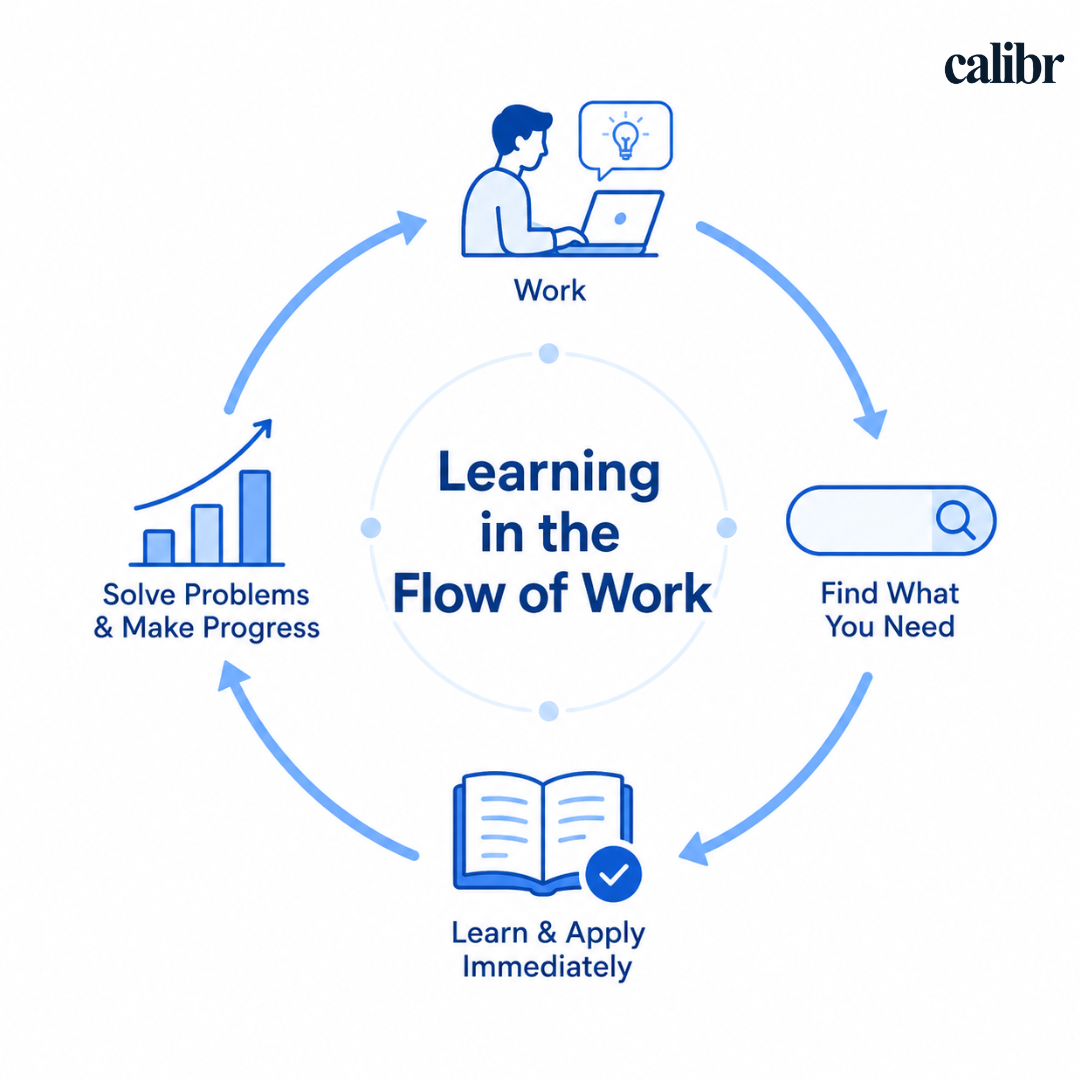
Learning in the flow of work refers to learning that happens naturally during work rather than through separate, scheduled training sessions. Instead of pulling employees away from their tasks to complete a course, knowledge becomes embedded into the work itself.
The concept was popularized by analyst Josh Bersin, who observed that employees have, on average, only 24 minutes a week to dedicate to formal learning. The rest happens contextually — through doing, searching, and problem-solving in the moment.
In practice, this means employees learn while:
• Solving real problems as they arise
• Using internal tools and workflow guidance
• Collaborating with colleagues
• Accessing AI assistants or searchable knowledge systems
• Consuming short, relevant content directly inside their workflows
The goal isn't to create more learning content. It's to make the right knowledge available at exactly the moment employees need it.
Why This Matters More Than Ever
The modern employee's work environment has changed dramatically. People now operate inside ecosystems full of notifications, collaboration tools, AI assistants, real-time dashboards, and constant context-switching. The expectation of speed has risen across every function.
At the same time, organizations expect employees to continuously upskill, adapt to change, and apply new knowledge faster than ever. That combination creates a serious tension — more to learn, far less time to learn it in.
The result? Traditional workplace training is losing the battle for attention.
Long courses, slide-heavy modules, and scheduled sessions assume that employees can step away from their work, absorb large amounts of information, and then successfully apply it later. That model worked when workplaces moved at a slower pace. In most organizations today, it doesn't.
Ebbinghaus's Forgetting Curve research shows people can lose up to 70% of new information within 24 hours without reinforcement.
When workplace learning is disconnected from real moments of application, the gap between training and performance widens — making learning retention and training ROI increasingly difficult for organizations to improve.
How Learning in the Flow of Work Differs from Traditional Training
Traditional workplace learning was designed for a slower, more structured work environment — one where employees could step away from daily responsibilities to complete training separately from their actual work.
Modern workplaces operate differently. Employees now need faster access to knowledge, quicker decision-making support, and learning that fits naturally into the pace of work itself.
The difference between traditional training and learning in the flow of work is not just about format. It reflects a broader shift in how employees' access, apply, and retain knowledge in modern workplace environments.
Traditional Workplace Learning | Learning in the Flow of Work |
Scheduled, time-bound courses | Real-time, on-demand access |
Separate LMS systems | Knowledge embedded in workflows |
Information-heavy modules | Short, contextual learning moments |
Generic content libraries | Relevant guidance at point of need |
Learn first, apply later | Learn and apply simultaneously |
Measured by course completions | Measured by performance impact |
Passive consumption | Active problem-solving |
This shift does not mean formal learning is no longer important. Compliance training, leadership development, certifications, and deep skill-building programs still require structured learning experiences.
However, many day-to-day performance challenges are solved more effectively through embedded, searchable, and contextual learning support delivered directly within the workflow. Increasingly, organizations are realizing that employees do not always need more courses — they need faster access to the right knowledge at the moment work happens.
What This Looks Like in Real Workplaces
Learning in the flow of work shows up differently across functions, but the pattern is consistent: knowledge meets employees where they are, when they need it.
Customer Support
A support agent dealing with an unusual customer complaint doesn't pause to open a training module. They search the internal knowledge base, surface the relevant policy, and resolve the issue — all within the same workflow. The learning happened; it just looked like a search.
Sales
Sales representatives increasingly access AI-generated battle cards, objection-handling guides, or product comparison summaries mid-conversation — either in a CRM sidebar or a chat tool.
The best-performing reps aren't necessarily attending more training; they're accessing better information faster.
HR and Onboarding
HR managers walk through onboarding workflows with contextual prompts embedded directly in the process — "What should you send to a new hire on Day 1?" answered inside the tool they're already using, not in a separate onboarding course completed six weeks prior.
Operations and Manufacturing
Frontline workers learn updated procedures through short video clips or visual guides embedded in the tools they use to log tasks — not through a classroom refresher scheduled for the following month.
The A.C.C.E.S.S Framework: What Makes Workflow Learning Actually Work
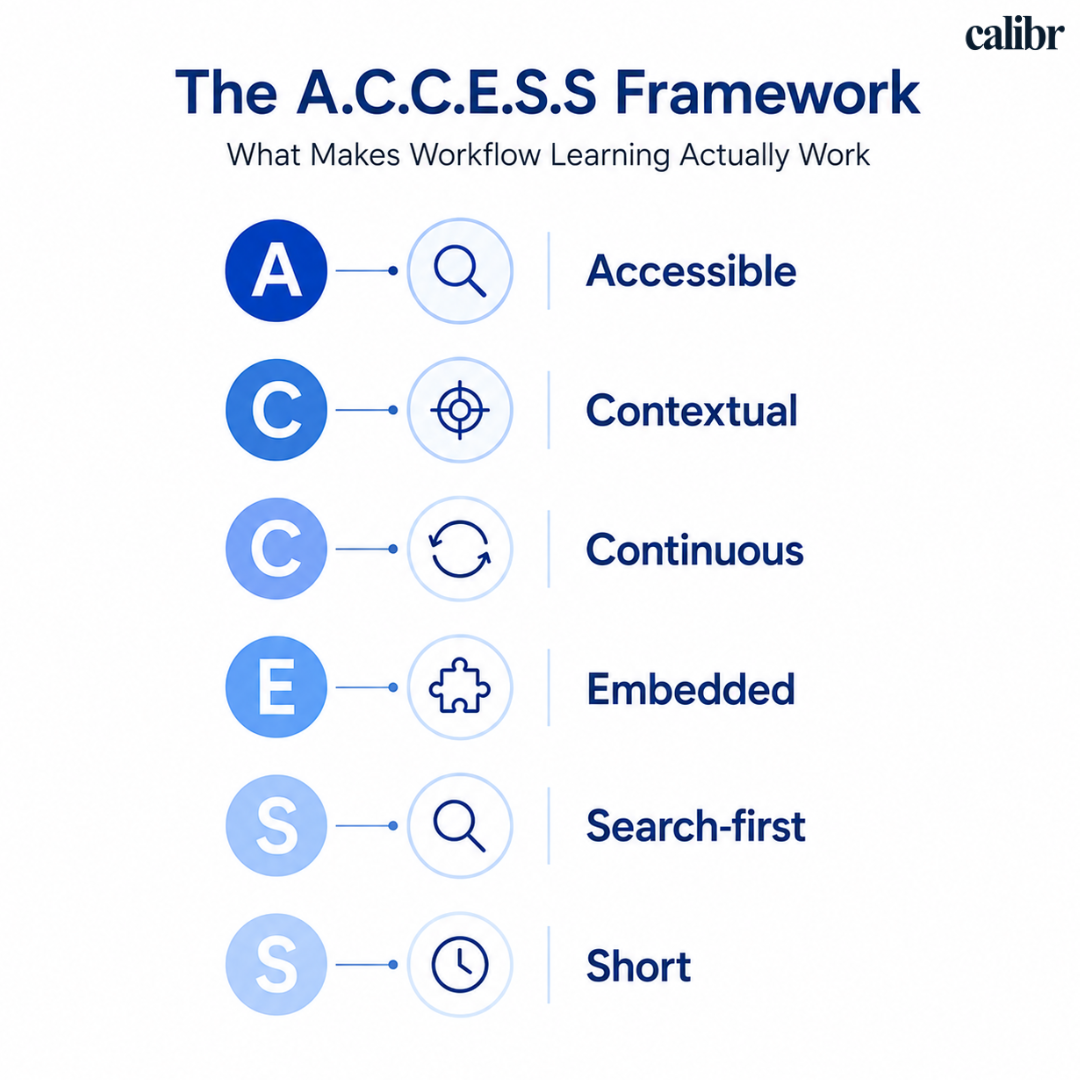
Not all workflow-integrated learning is effective. The difference between knowledge that gets used and knowledge that gets ignored often comes down to how well it's designed. High-performing organizations tend to get six things right:
Element | What It Means | Example in Practice |
Accessible | Knowledge is findable, not buried in an LMS | Internal search, AI assistants, pinned documentation |
Contextual | Learning is tied to the task at hand | Workflow prompts, role-specific guidance |
Continuous | Support is available throughout — not just during onboarding | Always-on knowledge bases, peer networks |
Embedded | Learning lives inside the tools employees already use | In-app guidance, CRM tooltips, helpdesk integrations |
Search-first | Employees can retrieve answers instantly | Enterprise search, AI-powered knowledge retrieval |
Short | Learning moments are brief and immediately applicable | Microlearning modules, 2-minute explainer videos |
The most common mistake organizations make is investing heavily in learning content while neglecting the infrastructure that makes content findable, contextual, and short enough to consume in the moment.
Both matter — but infrastructure often has the greater impact on daily performance.
Why Most Learning in the Flow of Work Initiatives Fail
Many organizations understand the value of learning in the flow of work — but far fewer implement it effectively.
The problem usually is not a lack of learning content. Most organizations already have extensive course libraries, documentation, onboarding materials, and internal knowledge resources. The real challenge is making that knowledge accessible, relevant, and usable within the pace of everyday work.
One of the most common mistakes is treating workflow learning as simply another content distribution strategy. Organizations add more microlearning modules or upload more resources into an LMS, but employees still struggle to find the right information when they actually need it.
In many workplaces, knowledge remains:
Buried inside disconnected systems
Difficult to search
Outdated or poorly maintained
Separated from the tools employees use daily
As a result, employees often spend more time searching for information than applying it.
Workflow learning also fails when organizations continue measuring learning success through completion rates rather than operational outcomes. Completing courses does not automatically improve performance. What matters is whether employees can solve problems faster, make better decisions, reduce errors, and apply knowledge effectively during work.
Manager support is another overlooked factor. Employees are far more likely to engage with workflow learning when managers reinforce learning behaviors, encourage knowledge sharing, and normalize learning as part of daily work rather than as a separate activity.
There is also a growing issue of content overload. Many employees already experience constant notifications, meetings, dashboards, and communication fatigue throughout the day. Adding excessive learning requirements on top of that can increase disengagement rather than improve development.
Successful learning in the flow of work strategies focus less on maximizing content volume and more on reducing friction. The goal is not to create more learning moments — it is to make knowledge easier to access, easier to apply, and easier to retain within the natural rhythm of work itself.
How Modern Learning Technology Enables the Flow of Work
The right technology infrastructure is what makes learning in the flow of work scalable across an organization. Several capabilities matter here:
AI-Powered Recommendations
Modern learning platforms use AI to surface relevant content based on an employee's role, recent activity, and stated learning goals — reducing the effort required to find the right resource at the right time. Rather than browsing a content library, employees receive proactive suggestions contextualized to what they're working on.
Microlearning
Breaking content into short focused modules (typically 3–7 minutes) makes it far easier to consume learning during natural workflow pauses — without requiring employees to carve out dedicated learning time.
Mobile-First Access
For frontline and distributed teams, mobile access to learning content is table stakes. Knowledge that lives only on a desktop LMS won't reach the people who need it most.
Searchable Knowledge Systems
The ability to search for specific answers — rather than navigating a course catalog — is one of the highest-leverage changes an L&D team can make. Enterprise search, well-structured knowledge bases, and AI assistants all contribute to this.
Platforms like Calibr Learn are built to support exactly this kind of learning model —combining AI-powered personalized paths, microlearning to real-time analytics in a single LXP designed for the realities of how employees actually work.
The Business Case: Why This Approach Delivers Better ROI
Learning in the flow of work isn't just better for employees — it produces measurable outcomes that matter to the business.
• Faster onboarding: Embedding guidance directly into onboarding workflows reduces time-to-productivity for new hires, often by weeks.
• Reduced performance gaps: When employees can access the right knowledge exactly when they need it, skill gaps translate less directly into performance failures.
• Higher engagement: Employees who find learning relevant and immediately applicable are significantly more likely to use it voluntarily — without being pushed.
• Stronger L&D ROI: Learning that connects directly to performance outcomes is far easier to measure and justify to leadership than course completion rates.
For L&D teams trying to reposition learning from a support function to a strategic business driver, this shift is becoming increasingly important.
The value of L&D is increasingly measured by business impact rather than training activity alone.
Learning in the flow of work strengthens that connection by tying knowledge directly to the moments where performance, decision-making, and business outcomes actually happen.
How to Get Started: Practical Steps for L&D Leaders
You don't need to rebuild your entire learning infrastructure to begin. Most organizations can start making meaningful progress with these steps:
• Audit your current content for searchability: Can employees actually find what they need, or is content buried in course catalogs and SharePoint folders? Start there.
• Identify the top 5 performance moments: Where do employees most frequently get stuck or make errors? These are your highest-priority use cases for workflow-integrated learning.
• Break long courses into shorter assets: A 45-minute compliance course can often be restructured into a 5-question scenario + a searchable reference guide. The learning outcome is the same; the accessibility is dramatically better.
• Evaluate your LMS/LXP for workflow integration: Does your current platform support mobile access, AI recommendations, and searchable content? If not, this is worth revisiting.
• Measure differently: Move beyond course completion. Track time-to-competency, error rates, and manager-assessed performance improvement instead.
Frequently Asked Questions
What is learning in the flow of work?
Learning in the flow of work refers to the practice of embedding learning opportunities directly into daily work activities rather than through separate, scheduled training sessions. Employees access knowledge, guidance, and support at the moment they need it — within the tools and workflows they already use.
Why is learning in the flow of work important for organizations?
Most employees have very limited time for formal training — research suggests as little as 24 minutes per week. Learning in the flow of work makes knowledge accessible without requiring employees to step away from their roles, which improves knowledge retention, reduces performance gaps, and makes L&D spend easier to justify with measurable outcomes.
What are learning in the flow of work examples?
Common examples include: a support agent searching an internal knowledge base during a live customer call; a sales rep accessing a battle card from a CRM sidebar mid-conversation; an onboarding manager using embedded process prompts during Day 1 tasks; and a frontline worker watching a 3-minute procedure video before beginning a task. In each case, learning happens during work — not before it.
How is learning in the flow of work different from traditional eLearning?
Traditional eLearning typically involves scheduled, self-contained courses that employees complete separately from their work. Learning in the flow of work is contextual, shorter, and designed for the moment of need — it lives inside workflows, search systems, and AI tools rather than inside a separate LMS library.
What technology supports learning in the flow of work?
Key enablers include AI-powered learning experience platforms (LXPs) that deliver personalized recommendations, enterprise search tools, microlearning content, mobile learning apps, and AI assistants. The common thread is making knowledge findable and accessible within — or immediately adjacent to — the tools employees already use for their work.
How can L&D teams measure the effectiveness of flow-of-work learning?
Rather than tracking course completions, L&D teams should focus on performance-linked metrics: time-to-competency for new hires, error rates before and after knowledge interventions, manager-assessed skill improvement, and employee self-sufficiency on common tasks. These metrics connect learning directly to business outcomes and make the ROI case much stronger.
Is learning in the flow of work suitable for compliance training?
Compliance training typically still requires formal documentation and completion tracking, so a fully workflow-embedded approach may not be sufficient on its own. However, flow-of-work elements — such as searchable policy references, brief scenario-based reminders, and just-in-time guidance — can significantly reinforce compliance knowledge between formal certification cycles.
Final Thoughts
Learning in the flow of work isn't about doing away with structured training. It's about recognizing that the majority of workplace learning happens informally — during work, not before it — and designing for that reality rather than fighting it.
The L&D teams making the biggest impact right now are those who have stopped asking "How do we get employees to complete more courses?" and started asking "How do we get the right knowledge to the right person at the moment it matters?"
That shift in question leads to a very different set of decisions — about content design, technology, measurement, and where L&D invests its time.
Ready to build learning experiences that fit the way modern employees actually work?
See how Calibr supports learning directly within everyday workflows
Contact our team for more details or queries
Schedule a Demo to get started


Vivetha is a digital marketing professional specializing in content marketing and SEO. She focuses on developing optimized, high-quality content that improves search visibility, supports brand objectives, and drives measurable results. With a structured and analytical approach, she ensures content aligns with business and audience needs.