PIC (Person in Charge) training in Dubai prepares food business managers and supervisors to oversee food safety, guide employees and maintain safe food operations.
It covers hygiene, temperature control, food storage, cross-contamination, allergen management, HACCP and corrective actions.
From restaurant managers and head chefs to hotel and catering supervisors, PICs must apply this knowledge through daily checks, staff supervision and accurate record-keeping.
An LMS can further support PIC training through structured courses, assessments, progress tracking and refresher learning.
PIC Training in Dubai: Watch the Quick Overview
Want to understand PIC training at a glance? Watch this short video to explore what Person in Charge training covers, who needs it, the key food safety responsibilities across different roles, and how an LMS can support structured training and continuous learning.
Introduction: Why Every Food Business Needs a Competent Person in Charge
It is 8 pm on a Thursday in a busy Dubai restaurant. A chilled delivery is waiting at the back door, two commis chefs are prepping salads next to the grill, and a server is relaying an allergy question from table nine. Everyone is working hard. But who is making sure the delivery is checked before it goes into the chiller, that raw chicken and salad leaves stay apart, and that the allergy question gets an accurate answer rather than a guess?
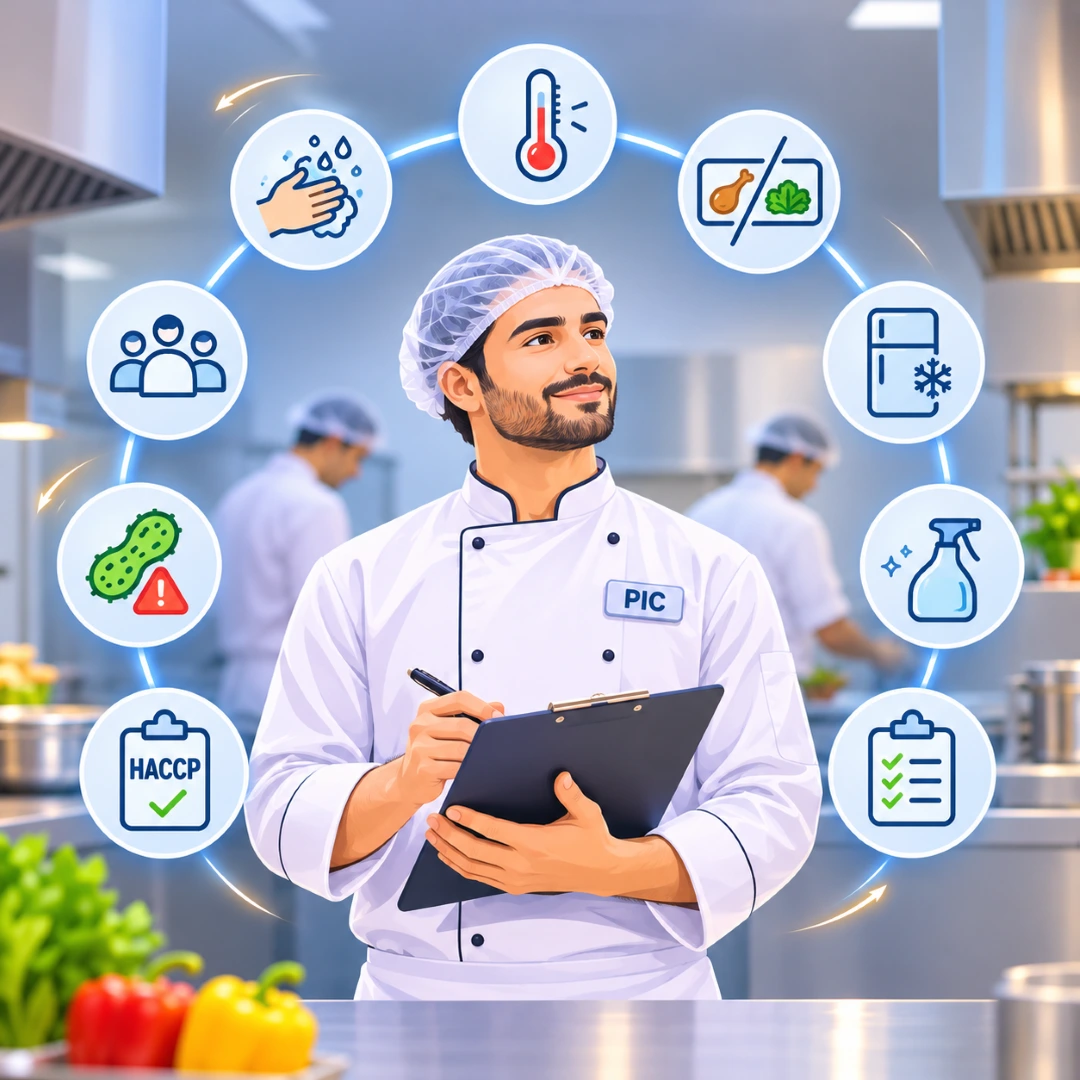
In Dubai, that responsibility has a formal title: the Person in Charge, or PIC. The PIC is the person on shift who supervises food safety, guides the team and decides what to do when something goes wrong.
This article explains what PIC training in Dubai involves, who needs it, what a PIC actually does during a shift, and which knowledge and skills turn a certificate holder into a genuinely competent supervisor.
1. What Is PIC (Person in Charge) Training?
PIC stands for Person in Charge. In food safety, it means the person directly responsible for food operations in an establishment, with authority over the staff who store, prepare, display or serve food. That is how Dubai Municipality's Food Code defines the role.
PIC training is the formal food safety programme that prepares supervisors and managers for that responsibility. In Dubai, it leads to a PIC certification that is awarded only after passing an examination, and it is recorded on Dubai Municipality's Foodwatch platform.
How is PIC training different from food handler training?
The key difference between food handler training and PIC training is the scope of responsibility. A food handler learns how to perform their own duties safely, such as washing hands properly, maintaining correct food temperatures and reporting illness. A PIC, on the other hand, learns how to ensure that the entire team follows these practices consistently across every shift. The training guideline makes a similar distinction: basic training provides food handlers with essential knowledge, while PIC training prepares supervisors and managers to put that knowledge into practice by resourcing and supporting their staff.
In short, PIC training moves the question from "What is the correct temperature?" to "How do I know it is being achieved, and what do I do when it isn't?"
2. Who Needs PIC Training in Dubai?
Under Dubai Municipality's Food Code, every food establishment must employ at least one full-time, on-site PIC certified in food safety. Food service establishments that prepare high-risk, ready-to-eat or raw foods must have a certified PIC present during every shift.
Who fills the role depends on how the business is run. It is usually the person directing food operations on a given shift, such as:
Restaurant or café managers and shift supervisors
Head chefs, sous chefs and kitchen supervisors
Hotel food and beverage managers, and the chefs running each hotel kitchen
Catering and central kitchen supervisors
Owners who run their outlet day to day
Food safety or hygiene supervisors in larger operations
The level of certification also varies. Dubai Municipality's 2023 guideline links PIC requirements to business type: restaurants, cafés, hotels and catering companies generally need an Advanced PIC Certification holder on each shift, while a grocery selling only pre-packed food needs one PIC per establishment with the standard certification.
Not every employee needs PIC certification. Other food handlers in Dubai complete basic food safety training suited to their work. The rules also differ by emirate: Abu Dhabi, for example, regulates training through the Abu Dhabi Agriculture and Food Safety Authority (ADAFSA) and its mandatory Essential Food Safety Training programme. Businesses outside Dubai should check their own emirate's authority rather than assume Dubai's PIC rules apply.
3. What Are the Roles and Responsibilities of a PIC?
A PIC supervises food safety while it is happening: watching practices, checking conditions, correcting problems and keeping evidence that it was done. The Food Code expects the PIC to supervise safe practices, inspect the premises regularly, address risks and take corrective action, and to make sure staff are trained before they start and remain competent afterwards. Dubai Municipality also expects PICs to carry out and record their food safety checks on Foodwatch.
Here is how those duties translate into a working shift:
Responsibility | What it looks like on shift |
Opening and closing checks | Walking the kitchen before service: handwash stations stocked, chillers in range, surfaces clean, no signs of pests |
Receiving deliveries | Checking temperature, packaging, labels and approved supplier before accepting stock, and rejecting and recording anything unsuitable |
Temperature control | Reviewing chiller, cooking and hot-holding readings, probing high-risk food and acting on deviations |
Personal hygiene and health | Checking handwashing and uniforms, asking about illness at the start of a shift, and keeping unwell staff away from food |
Cross-contamination and allergens | Confirming separate boards and storage for raw and ready-to-eat food, and that allergen-free orders are handled correctly |
Cleaning and pest control | Verifying the cleaning schedule is followed, chemicals are used correctly, and pest control findings are acted on |
Supervising staff | Coaching in the moment, briefing new joiners and identifying who needs retraining |
Records and inspections | Keeping checks, corrective actions and supplier records current, and accompanying inspectors |
Customer complaints | Handling food safety complaints and knowing when to report them to Dubai Municipality |
What do these responsibilities look like in practice? Consider two situations a PIC might encounter during a normal working day.
Illustrative scenario 1: Temperature control
During the morning check, the PIC finds the walk-in chiller reading 9°C, above the 5°C limit for chilled high-risk food. Rather than simply noting it, they probe the food, work out how long it may have been out of range, move high-risk items to a working unit, decide what cannot be kept, call maintenance and record each step.
Illustrative scenario 2: Preventing cross-contamination
During an inspection, the PIC finds ready-to-eat desserts stored below raw meat. They correct the shelving immediately and investigate why it happened. If the cause was a new storekeeper and unlabelled shelves, the solution is to brief the employee and introduce clear shelf labels, rather than simply rearranging the items.
4. What Food Safety Knowledge and Skills Should Every PIC Have?
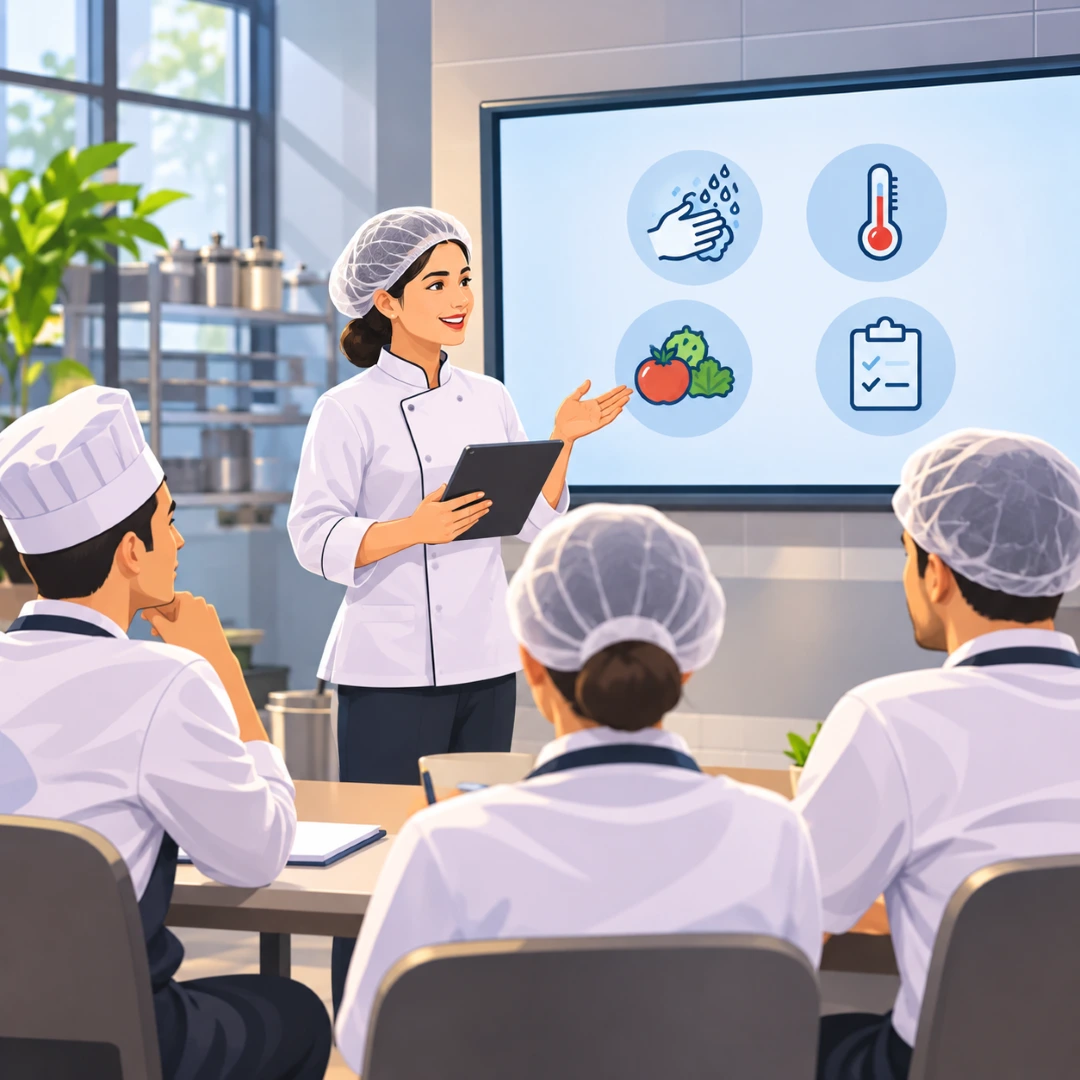
A PIC needs two kinds of competence: technical knowledge of how food becomes unsafe, and the supervisory skill to act on that knowledge through other people.
Dubai Municipality's competency framework for certified PICs covers both, from recognising illness symptoms to managing records and staff training needs. Here is how each area shapes better decisions.
Food Safety Competency | Key Knowledge and Skills | Workplace Application |
|---|---|---|
Personal Hygiene and Illness | Knowing the hygiene rules is the starting point. A PIC also needs to recognise the symptoms of foodborne illness and know when to exclude someone from food handling. | A cook arrives saying they had diarrhoea overnight but now feel fine. A PIC who understands how infection spreads knows that "feeling fine" is not the test, keeps them away from food and follows the establishment's exclusion and reporting procedure. |
Temperature Control | A PIC should know the limits that apply to their operation, such as chilled high-risk food at 5°C or below, hot holding at 60°C or above, and cooking to a core of at least 75°C, as set out in the Food Code. Understanding why cooling is a frequent failure point helps them plan ahead, for example by portioning large batches into shallow trays. | A PIC finds that a large batch of cooked food is taking too long to cool. They divide it into smaller portions and use shallow trays to support faster cooling. |
Cross-Contamination Prevention | Contamination travels on hands, boards, cloths, knives and drips. | A team member trims raw chicken, then starts slicing cucumbers on the same board. The PIC stops the task, has the cucumbers discarded, the board cleaned and disinfected and hands washed, then asks why a separate board wasn't to hand. |
Food Storage and Handling | Segregating raw and ready-to-eat food, first-in-first-out rotation, and relabelling food with its original dates when packaging is removed. | A PIC finds raw meat stored above ready-to-eat food in a chiller. They rearrange the storage, ensure proper segregation and remind staff about correct food storage practices. |
Cleaning and Disinfection | Knowing that cleaning and disinfection are separate steps, and that chemicals only work at the right concentration and contact time, lets a PIC verify a surface rather than just tick a schedule. | During a kitchen inspection, the PIC notices that a work surface has been cleaned but not disinfected. They ensure the correct disinfectant is used at the required concentration and contact time. |
Allergen Management | The Food Code lists allergens that must be declared and expects allergen-free food to be protected from cross-contact. | A guest worries a dish contains nuts. The PIC checks the recipe and ingredient labels before answering, never guesses, and if the guest shows signs of a reaction, gets medical help first and reviews the cause afterwards. |
HACCP and the Food Safety Programme | A PIC should understand where hazards are controlled in their own menu, what is monitored and what corrective action looks like. | A PIC identifies a critical control point in the cooking process, checks that the required temperature is achieved and takes corrective action if the limit is not met. |
Records and Inspections | Records should show what actually happened, including problems and the actions taken, so an inspector can see that controls are working. | During an inspection, the PIC presents temperature logs, cleaning schedules and corrective action records to demonstrate that food safety checks are being carried out. |
Supervision and Communication | UAE kitchens often bring together staff with different first languages. Demonstrating rather than only telling, explaining the reason behind a rule and correcting calmly in the moment usually change behaviour more than a reprimand. | A new kitchen employee is unsure how to separate raw and ready-to-eat food. The PIC demonstrates the correct storage method, explains why it matters and checks that the employee follows it. |
[Note: The illustrative scenarios added to the points without an original scenario are examples to help explain how a PIC might apply the knowledge at work]
5. How Can Someone Develop the Skills Required for the PIC Role?
The first step is the formal one. In Dubai, PIC certification comes through a training centre approved by Dubai Municipality, followed by an assessment run under the ISO/IEC 17024 personnel certification standard. The certificate is valid for five years, and Dubai Municipality's guideline notes it can be withdrawn if the establishment's food safety performance is poor.
Passing the exam shows knowledge. Competence is shown on the kitchen floor, and it builds through practice:
Learn your own establishment's system. Read the food safety programme, know which steps are critical for your menu and what corrective actions are agreed.
Shadow an experienced PIC. Watch how they run opening checks, receive deliveries and handle problems mid-service.
Practise the routines. Carry out and record daily checks until spotting a deviation becomes second nature.
Rehearse scenarios. Talk through what you would do if a chiller fails or a guest reports a reaction, before it happens.
Learn from findings. Treat inspection and audit findings as lessons. Dubai Municipality expects PICs to use the e-learning on Foodwatch to understand the corrective actions for any violations found.
Stay current. Refresh your knowledge when the menu, equipment, procedures or regulations change.
6. How an LMS Helps Food Businesses Train and Develop PICs
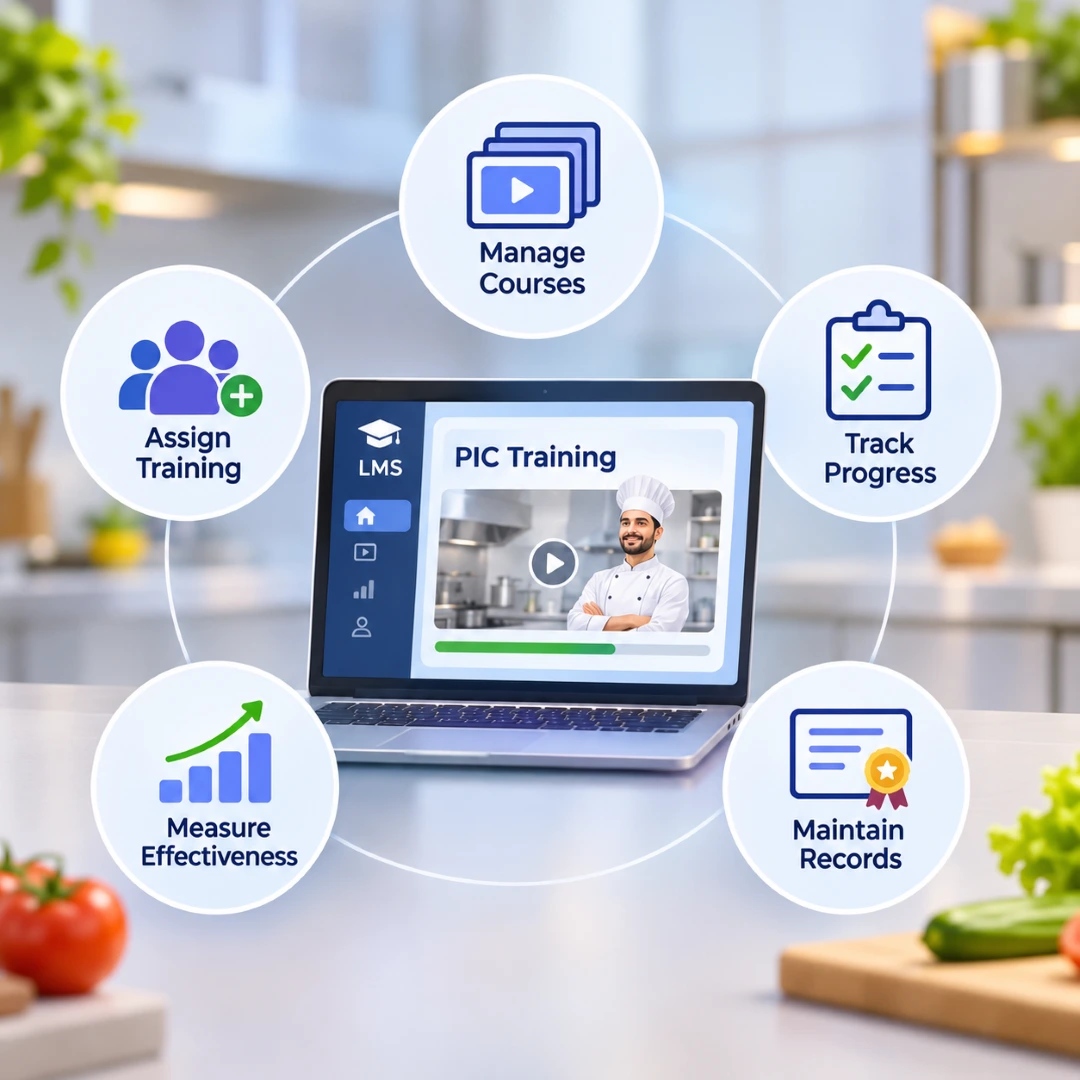
A Learning Management System (LMS) helps food businesses organize, deliver and track ongoing employee learning. Dubai Municipality's training guideline recognizes LMS-based delivery for approved food safety training programmes, including online and blended learning through systems approved by its Food Safety Department. These systems can support structured course delivery, assessments, trainee records and integration with Foodwatch.
Beyond formal PIC certification, food businesses can also use an LMS to reinforce food safety knowledge through refresher courses, practical learning materials, scenario-based assessments and progress tracking. This helps organisations monitor learning gaps and support PICs as they supervise everyday food operations.
Organize PIC learning into clear modules such as hygiene, temperature control, storage, allergens and HACCP.
Assign different content to a new shift supervisor, a head chef or a hotel F&B manager.
Show correct probing, board color-coding or delivery checks in your own kitchen.
Test how PICs would respond to a chiller failure, a cross-contamination incident or an unwell employee.
See completion rates, assessment scores and recurring knowledge gaps across outlets.
Plan short refreshers before certifications lapse or after procedures change.
Keep learning history in one place, which supports internal audits.
An LMS manages learning; it does not replace the official PIC certification, the daily supervision a PIC must provide or regulatory inspection.
7. Frequently Asked Questions (FAQs) About PIC Training in Dubai
What does PIC stand for in food safety?
PIC stands for Person in Charge: the person directly responsible for food operations who has authority over staff handling, storing, preparing or serving food.
What is the purpose of PIC training?
PIC training prepares supervisors and managers to oversee food safety in practice: monitoring staff, checking controls, correcting problems and keeping records.
Who needs PIC training in Dubai?
The person or people designated to supervise food safety, usually managers, head chefs, kitchen and catering supervisors or owner-operators. The number and level of PICs depend on the type of establishment and its shifts.
Is PIC training mandatory in Dubai?
Yes. Dubai Municipality's Food Code requires every food establishment to employ at least one certified PIC, and food service outlets handling high-risk, ready-to-eat or raw food need one present on every shift. Other emirates have their own authorities and requirements.
What topics are covered in PIC training?
Typically Dubai's regulatory framework, hazards and controls, personal hygiene, cleaning, pest control, supplier and stock control, inspections and Foodwatch. Advanced levels add monitoring, corrective action and record-keeping for food service. Exact content varies by level and provider.
What is the difference between a PIC and a food handler?
A food handler is responsible for their own safe practices. A PIC is responsible for making sure the whole team follows them, and for acting when they don't.
What skills should a Person in Charge have?
Sound food safety knowledge, plus the ability to observe, coach, communicate clearly, keep accurate records and make calm decisions under pressure.
Does completing PIC training automatically make someone competent?
No. Certification confirms knowledge at the time of the exam. Competence is shown through consistent supervision, good decisions and continued learning on the job.
Conclusion: Building Stronger Food Safety Supervision
Back to that busy Thursday service. The delivery gets checked, the salads stay clear of raw chicken and table nine gets a straight answer, not because everyone is certified, but because one person is watching, guiding and ready to step in.
That is what a competent PIC brings. The certificate is the entry point. The real value comes from applying that knowledge every shift, supporting the team and responding calmly when something goes wrong. Food businesses that invest in that ongoing development get supervisors, not just certificate holders.
[ Note: Regulatory details can change. Confirm current requirements with Dubai Municipality or the relevant emirate's food safety authority]


Vivetha is a digital marketing professional specializing in content marketing and SEO. She focuses on developing optimized, high-quality content that improves search visibility, supports brand objectives, and drives measurable results. With a structured and analytical approach, she ensures content aligns with business and audience needs.