
Structured interviews use standardized questions and scoring criteria, making hiring decisions more consistent, objective, and fair.
Unstructured interviews are more conversational and flexible, allowing deeper exploration of a candidate's experiences, leadership style, and strategic thinking.
Structured interviews work best for high-volume hiring, campus recruitment, customer service, and operational roles where candidate comparison is critical.
Unstructured interviews are often better suited for executive, leadership, and specialized roles that require deeper assessment of judgment, adaptability, and interpersonal skills.
Many organizations now use a hybrid interview approach, combining structured assessments with open-ended discussions to balance consistency and deeper insights.
The most effective interview format depends on the role, hiring objectives, candidate volume, and decision-making requirements, rather than one method being universally superior
Quick Answer: Structured vs Unstructured Interviews:
If you're deciding between structured and unstructured interviews, the right choice depends on your hiring goals.
Structured Interviews | Unstructured Interviews |
Same questions for every candidate | Questions vary based on conversation |
Uses standardized scoring criteria | Relies more on interviewer judgment |
Easier candidate comparison | Allows deeper exploration |
Reduces bias and improves consistency | Builds stronger rapport |
Best for high-volume hiring | Best for leadership hiring |
In general, structured interviews are better for consistency, fairness, and objective hiring decisions, while unstructured interviews are better for exploring leadership potential, career journeys, critical thinking, and strategic thinking.
Introduction
Hiring decisions can shape the future of a team, department, or entire organization. Yet despite advances in recruitment technology, interviews remain one of the most commonly used methods for evaluating candidates.
The challenge is that not all interviews are conducted the same way. Some organizations rely on structured interviews with standardized questions and scoring criteria, while others prefer unstructured conversations that allow interviewers to explore a candidate's background more freely.
Choosing the right interview format has a direct impact on hiring quality, candidate experience, fairness, and decision-making accuracy. While both approaches have advantages, limitations, and specific use cases, understanding when to use each can significantly improve hiring outcomes.
This guide explores the differences between structured and unstructured interviews, their strengths and weaknesses, and how recruiters can determine the best approach for different hiring scenarios.
Why This Decision Matters More Than Most Recruiters Think
Interview structure has a direct impact on hiring quality, candidate experience, fairness, and decision-making. When candidates are assessed using different questions or inconsistent criteria, comparisons become difficult and decisions often rely on personal impressions rather than job-related skills.
The consequences can be significant. According to SHRM Labs, 48% of HR managers admit bias affects their hiring decisions, while companies lose an average of $17,000 for every bad hire. Managers also spend 26% of their time coaching underperforming employees, further increasing the cost of poor hiring decisions.
The challenge is not that one interview format is always better than the other. Structured interviews improve consistency, fairness, and objective evaluation, while unstructured interviews provide deeper insights into communication style, leadership potential, and career experiences.
Choosing the wrong approach can result in missed talent, inconsistent assessments, and less confident hiring decisions.
Understanding the strengths and limitations of each method helps recruiters select the most effective approach for the role, hiring goals, and business context.
Understanding Structured Interviews
What Is a Structured Interview?
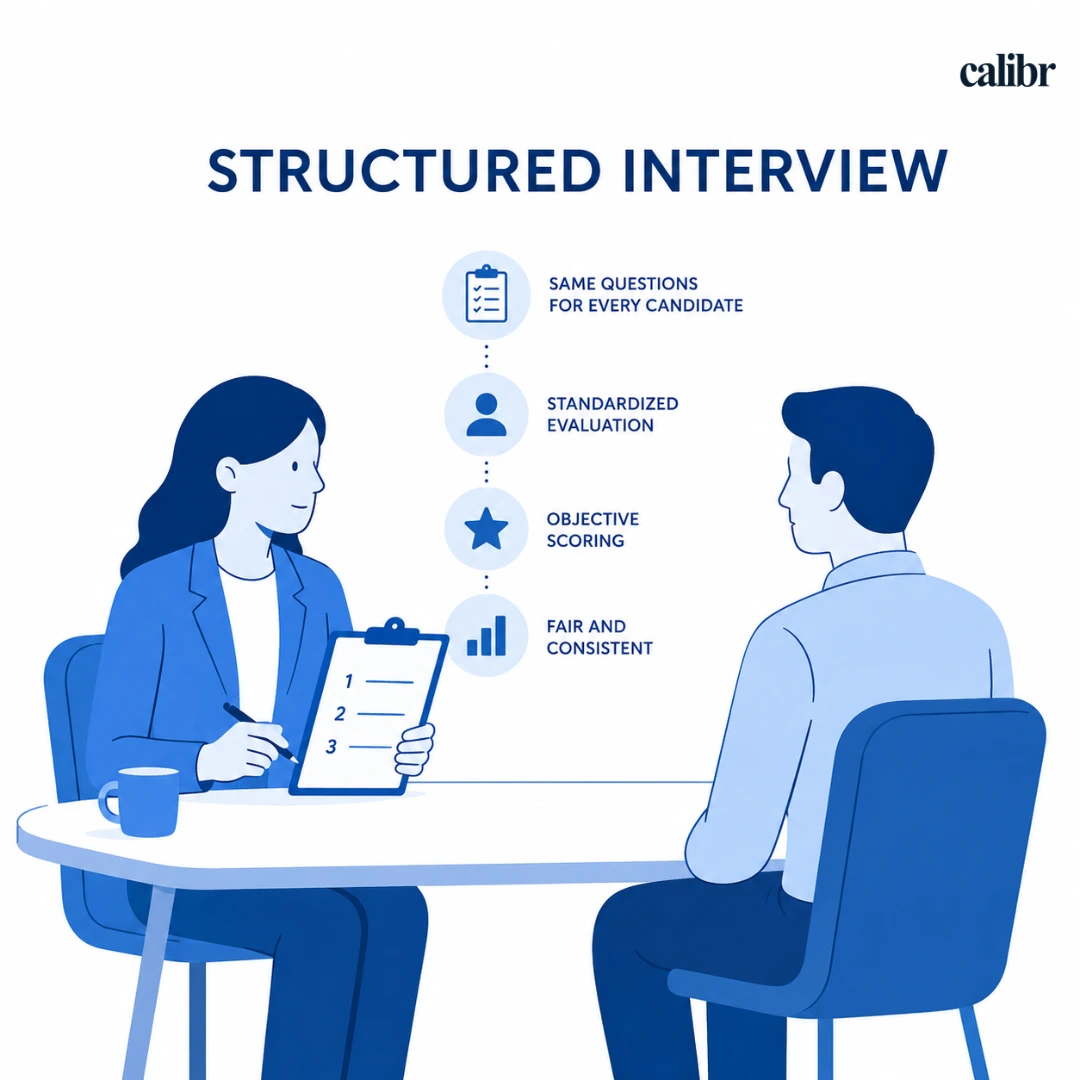
A structured interview is a standardized interview method where every candidate is asked the same set of questions in the same order. Interviewers use predefined evaluation criteria and scoring systems to assess responses objectively. This approach helps organizations compare candidates fairly and make more consistent hiring decisions.
Key Characteristics of Structured Interviews
Given below are the characteristics of structured interview:
Predefined Questions – All candidates answer the same questions, ensuring consistency throughout the hiring process.
Standardized Process – The interview follows a fixed format and sequence.
Objective Scoring System – Responses are evaluated using predefined rating scales.
Consistent Candidate Evaluation – Every applicant is assessed against the same competencies.
Documented Decision-Making – Hiring decisions are supported by recorded scores and evidence.
Structured Interviews: Pros and Cons
Given below are the pros and cons of structured interview:
Pros | Cons |
Improves fairness and consistency | Can feel rigid and formal |
Reduces unconscious bias | Less flexibility during discussions |
Makes candidate comparison easier | Requires significant preparation |
Improves hiring accuracy | May limit rapport-building |
Supports data-driven decisions | Not ideal for exploring unexpected insights |
How Structured Interviews Work in Practice
Before interviews begin, recruiters identify the key competencies required for the role. They then develop standardized questions and scoring guidelines.
For example, when hiring Customer Support Executives, every candidate might be asked:
Tell us about a time you handled a difficult customer.
How would you prioritize multiple customer requests?
Describe a situation where you solved a problem under pressure.
Each response is scored against predefined criteria such as communication skills, problem solving ability, and customer focus. At the end of the process, candidates are ranked based on their scores, making comparisons more objective and reliable.
Why Structured Interviews Work Best
Structured interviews are most effective when organizations need consistency, fairness, and scalability. They are particularly valuable for high-volume recruitment, campus hiring, customer service roles, sales positions, and other situations where multiple candidates must be evaluated against the same requirements.
Because every applicant is assessed using the same framework, hiring decisions are based more on evidence and less on personal impressions. This not only improves hiring accuracy but also strengthens compliance, reduces bias, and creates a more transparent recruitment process.
Research also suggests that structured interviews help create a more level playing field for candidates by reducing the influence of subjective judgments.
Their standardized format makes it easier for interview panels to compare candidates fairly using objective criteria, which can support more inclusive and equitable hiring decisions.
Understanding Unstructured Interviews
What Is an Unstructured Interview?
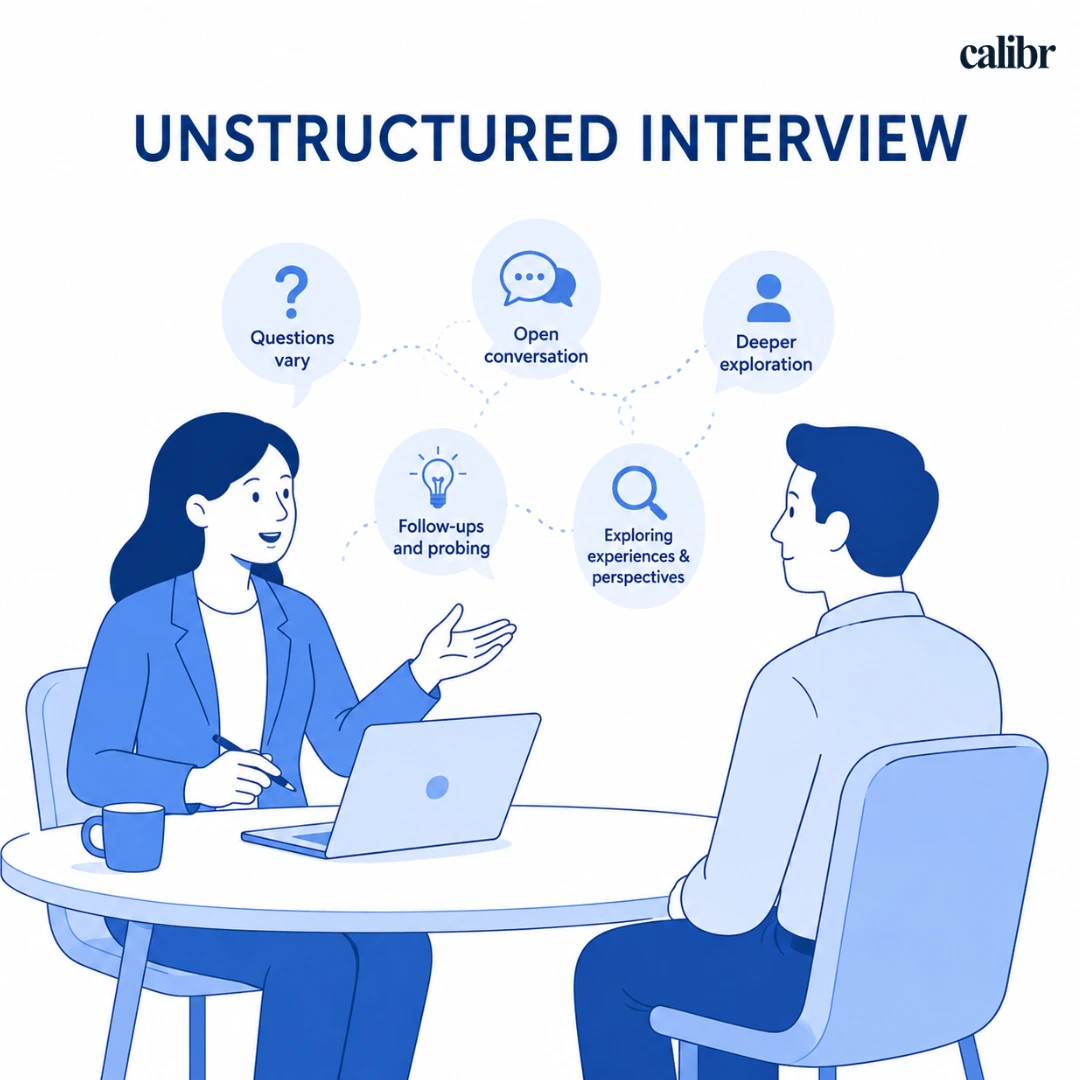
An unstructured interview is a flexible interview method that resembles a professional conversation rather than a formal assessment. Instead of following a fixed set of questions, interviewers adapt their questions based on the candidate's background, experiences, and responses. This approach allows deeper exploration of a candidate's career journey, leadership style, and unique achievements.
Key Characteristics of Unstructured Interviews
Given below are the characteristics of unstructured interview:
Flexible Discussion – The conversation flows naturally, allowing interviewers to change direction based on the candidate's responses.
Open-Ended Questions – Questions are broad and designed to encourage detailed answers rather than short responses.
Minimal Standardization – Different candidates may be asked different questions depending on their experience and background.
Interviewer-Led Exploration – Interviewers can probe deeper into specific topics that emerge during the discussion.
Relationship-Focused Interaction – The interview often feels more personal and conversational, helping build rapport with candidates.
Unstructured Interviews: Pros and Cons
Given below are the pros and cons of unstructured interview:
Pros | Cons |
Allow deeper exploration of a candidate's experiences and achievements | Personal opinions can influence hiring decisions |
Create a more natural and comfortable conversation | Comparing candidates fairly can be challenging |
Give interviewers the flexibility to ask follow-up questions | Evaluation standards may vary between interviews |
Help assess leadership, strategic thinking, and complex skills | Decisions may rely heavily on subjective judgment |
Build stronger relationships with candidates | Interviews can take longer and be harder to scale |
How Unstructured Interviews Work in Practice
An unstructured interview usually begins with a broad question such as:
"Tell me about your career journey and what led you to where you are today."
From there, the interviewer follows the candidate's responses and asks follow-up questions based on areas of interest.
For example, if a candidate mentions leading a major business transformation project, the interviewer may explore:
How the change was implemented
Challenges encountered during execution
Stakeholder management strategies
Lessons learned from the experience
Unlike structured interviews, there is no fixed path. The discussion evolves naturally and focuses on uncovering deeper insights rather than collecting standardized responses.
Why Unstructured Interviews Work Best
Unstructured interviews work best when organizations need to understand the person behind the resume, not just evaluate specific skills.
They are particularly effective for executive, leadership, and specialized roles where qualities such as vision, adaptability, strategic thinking, and leadership style are critical.
Their flexible nature allows interviewers to explore unique experiences, assess interpersonal skills, and gain deeper insights into how candidates think and approach complex challenges—insights that may not emerge through standardized questions alone.
Although unstructured interviews provide valuable qualitative insights, research suggests they are generally less reliable than structured interviews for predicting job performance.
As a result, many organizations adopt a hybrid approach that combines the consistency of structured interviews with the flexibility of open-ended discussions.
Key Differences Between Structured and Unstructured Interviews
While both structured and unstructured interviews aim to evaluate candidates, they differ significantly in how questions are asked, how responses are assessed, and how hiring decisions are made.
Understanding the differences between structured and unstructured interview helps recruiters choose the most effective approach for each hiring situation.
Factor | Structured Interview | Unstructured Interview |
Interview Format | Follows a predefined format with standardized questions. | Follows a flexible, conversational format with no fixed structure. |
Question Design | All candidates receive the same questions in the same order. | Questions vary depending on the candidate and discussion flow. |
Preparation Required | Requires extensive planning, competency mapping, and scorecard creation. | Requires minimal preparation and relies heavily on interviewer experience. |
Evaluation Method | Responses are scored using predefined criteria and rating scales. | Evaluation is primarily based on interviewer judgment and observations. |
Consistency | High consistency across all candidates and interviewers. | Consistency varies significantly between interviews. |
Candidate Comparison | Easy to compare candidates objectively because everyone answers identical questions. | Difficult to compare candidates since discussions may cover different topics. |
Bias Risk | Lower risk of unconscious bias due to standardization. | Higher risk of personal bias influencing decisions. |
Flexibility | Limited flexibility to explore unexpected topics. | High flexibility to pursue interesting responses and unique experiences. |
Candidate Experience | Can feel formal, structured, and assessment-focused. | Usually feels more natural, relaxed, and conversational. |
Decision-Making | Data-driven and evidence-based. | More dependent on intuition and subjective impressions. |
Scalability | Easily scalable for large recruitment drives. | Difficult to scale across large candidate pools. |
Documentation | Strong documentation through scorecards and interview records. | Documentation often varies by interviewer. |
Interviewer Skill Requirement | Easier for new interviewers to conduct effectively. | Requires highly skilled interviewers to avoid bias and gather meaningful insights. |
Hiring Speed | Faster decision-making due to standardized evaluations. | Decision-making may take longer because responses are harder to compare. |
Best Suited For | High-volume hiring, graduate recruitment, customer service, sales, and operational roles. | Executive hiring, leadership positions, niche roles, and strategic recruitment. |
Real-World Hiring Scenarios: Which Approach Would You Choose?
Scenario 1: Campus Recruitment Drive
Recommendation: Structured Interview
Hundreds of graduates must be assessed fairly and efficiently.
Why?
Easier comparison
Consistent evaluation
Reduced bias
Faster decision-making
Scenario 2: Customer Support Hiring
Recommendation: Structured Interview
High-volume recruitment requires standardized assessment of communication skills, customer focus, and problem-solving abilities.
Scenario 3: Startup Hiring a COO
Recommendation: Unstructured Interview
The role demands leadership, adaptability, and strategic thinking.
Deep conversations often reveal qualities that standardized questions cannot fully capture.
Scenario 4: Hiring a Chief Marketing Officer
Recommendation: Mostly Unstructured
Marketing leadership requires creativity, vision, stakeholder management, and strategic influence.
Exploratory discussions are often more valuable.
Scenario 5: Internal Leadership Promotion
Recommendation: Hybrid Approach
Organizations already possess performance data. Combining structured competency assessment with open discussion often provides the best outcome.
The Recruiter's Decision Framework
If Your Goal Is... | Best Choice |
Reduce bias | Structured |
Improve consistency | Structured |
Compare candidates fairly | Structured |
Explore career stories | Unstructured |
Assess culture fit | Unstructured |
Hire senior executives | Unstructured |
Handle high-volume recruitment | Structured |
Improve hiring accuracy | Structured |
Recruiters should align interview design with business objectives rather than applying a single approach to every role.
Structured vs Unstructured Interview Scorecard
Choose Structured Interviews If Most Answers Are "Yes"
Are you interviewing many candidates?
Do multiple interviewers need consistency?
Is reducing bias important?
Do you need objective scoring?
Must candidates be compared fairly?
Scoring
If you answered "Yes" to four or more questions, structured interviews are likely the best option.
Choose Unstructured Interviews If Most Answers Are "Yes"
Are you hiring senior leaders?
Do you need to understand a unique career journey?
Is relationship-building important?
Does the role require deep exploration?
Is flexibility critical?
Scoring
Four or more "Yes" responses suggest an unstructured approach may be more appropriate.
Consider a Hybrid Approach If Most Answers Are "Yes"
Do you need both consistency and flexibility?
Is this a business-critical role?
Are skills and culture fit equally important?
Is the hiring decision high-risk?
Scoring
A hybrid model combines the strengths of both methods and is increasingly used by leading employers.
Common Interview Mistakes Recruiters Make
Common Interview Mistake | How to Avoid It |
Relying on gut feeling | Use structured evaluation criteria |
Asking different questions to each candidate | Standardize core interview questions |
Lack of scoring guidelines | Define evaluation criteria beforehand |
Confusing confidence with competence | Assess evidence, not charisma |
Poor interviewer preparation | Review resumes and role requirements |
Ignoring bias | Use scorecards and interviewer training |
Key takeaway:
Interview quality often depends less on the interview format and more on how consistently interviewers evaluate candidates. Even the best interview structure can fail without preparation, objective scoring, and clear hiring criteria.
Quick Insight: Can AI Improve Interview Quality?
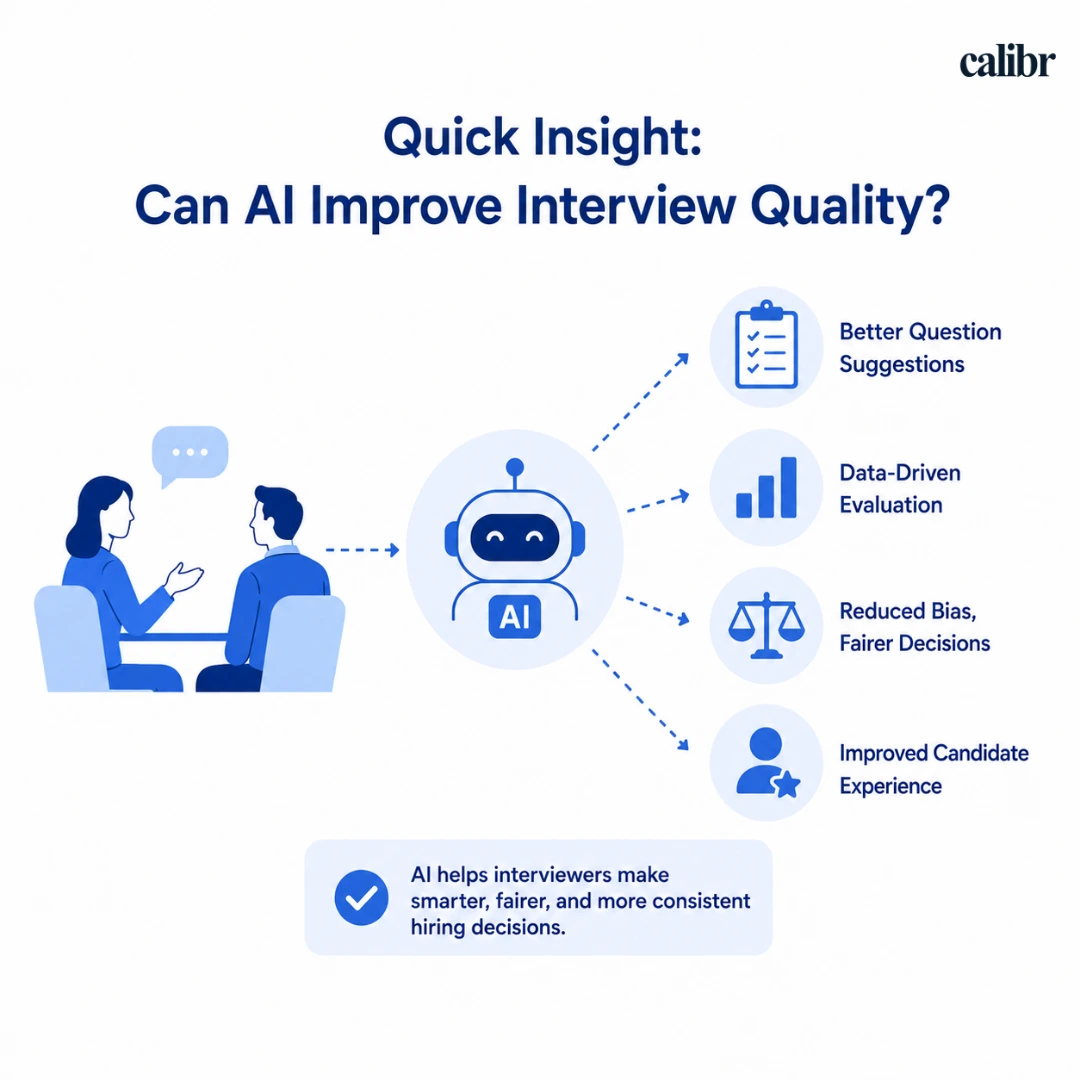
AI can improve interview quality by generating interview questions, summarizing conversations, creating scorecards, and assisting with candidate screening. It also helps standardize evaluations and can reduce certain forms of unconscious bias.
The adoption of AI in recruitment continues to accelerate. According to LinkedIn's Future of Recruiting report, 37% of organizations are actively integrating or experimenting with generative AI tools in recruiting, up from 27% the previous year.
As a result, recruiters are increasingly shifting their focus from routine administrative tasks to higher-value activities such as improving candidate experience and supporting hiring decisions.
However, AI cannot fully replace human judgment. It may miss context, interpersonal nuances, and leadership qualities. The best hiring decisions combine AI-driven insights with human expertise
Frequently Asked Questions (FAQs)
Which interview type is more reliable?
Structured interviews are generally considered more reliable because every candidate is assessed using the same questions, evaluation criteria, and scoring system. This creates greater consistency and reduces subjective decision-making.
Are structured interviews less biased?
Yes. Structured interviews help reduce unconscious bias by ensuring candidates are evaluated against standardized job-related criteria rather than personal impressions or preferences.
Do unstructured interviews improve candidate experience?
Often, yes. Unstructured interviews feel more conversational and natural, allowing candidates to discuss their experiences more freely and build stronger rapport with interviewers.
Which interview format is best for leadership hiring?
Unstructured or hybrid interviews are often preferred for leadership roles because they allow deeper exploration of leadership style, strategic thinking, decision-making, and cultural fit.
Can organizations combine both approaches?
Absolutely. Many organizations use a hybrid interview approach that combines structured questions for consistency with open-ended discussions for deeper insights.
Are structured interviews better for high-volume hiring?
Yes. Structured interviews are ideal for high-volume recruitment because they make candidate evaluation faster, more consistent, and easier to compare across large applicant pools.
Do unstructured interviews take longer?
Typically, yes. Since discussions evolve naturally and often involve follow-up questions, unstructured interviews usually require more time than structured interviews.
Which approach improves candidate comparison?
Structured interviews make candidate comparison much easier because all applicants are assessed using the same questions and evaluation standards.
Are structured interviews difficult to design?
They require more upfront planning, including competency mapping, question development, and scoring criteria. However, this preparation often leads to more accurate hiring decisions.
Which is better: structured or unstructured interviews?
Many organizations use a hybrid approach that balances the consistency of structured interviews with the flexibility of unstructured conversations, providing the benefits of both methods.
Key Takeaways
Structured interviews improve consistency, fairness, and hiring accuracy.
Unstructured interviews provide flexibility and deeper exploration.
High-volume hiring usually benefits from structured interviews.
Executive hiring often benefits from unstructured discussions.
Hybrid interviews combine the strengths of both approaches.
Reducing bias requires standardized evaluation criteria.
Interview quality directly influences quality of hire.
AI can support interviews but should not replace human judgment.
Final Thought: Structured vs Unstructured Interviews
There is no universally superior interview format.
The best choice depends on the hiring objective, role complexity, candidate volume, organizational priorities, and decision-making requirements.
Structured interviews excel when fairness, consistency, and objective evaluation are critical. Unstructured interviews shine when recruiters need deeper insights into leadership capability, career stories, and strategic thinking.
The most successful organizations do not ask:
"Which interview type is better?"
Instead, they ask:
"Which interview approach will help us make the best hiring decision for this role?"
That shift in thinking is what ultimately leads to stronger hiring outcomes, better talent decisions, and long-term business success.
Equally important is ensuring that interviewers have the skills and knowledge needed to apply these approaches effectively.
The right interview framework can improve hiring outcomes, but developing strong communication, evaluation, leadership, and decision-making skills is what enables organizations to consistently identify and hire the best talent.
Ready to build better hiring skills?
Great interviews depend on more than just the right format. They require capable interviewers, consistent evaluation practices, and continuous skill development.
Platforms like Calibr helps organizations build critical workplace skills, support leadership development, and create personalized learning experiences that drive better business outcomes.


Vivetha is a digital marketing professional specializing in content marketing and SEO. She focuses on developing optimized, high-quality content that improves search visibility, supports brand objectives, and drives measurable results. With a structured and analytical approach, she ensures content aligns with business and audience needs.