
Looking for the best TalentLMS alternatives in 2026? Here are the top platforms that go beyond basic LMS capabilities.
TL;DR / Quick Summary
This guide compares the top TalentLMS alternatives in 2026, covering key features, strengths, limitations, and real use cases across leading platforms.
You’ll also learn how to evaluate each option using the SCALE framework — focusing on personalization, analytics, scalability, user experience, and integrations.
By the end, you’ll have a clear understanding of which LMS fits your organization based on your goals, team size, and long-term learning strategy.
Before comparing platforms, let’s quickly understand what an LMS is:
What is an LMS (Learning Management System)
An Learning Management System is a platform used to create, deliver, and track employee training programs.
It acts as a central hub where companies can onboard employees, run compliance training, and upskill teams at scale.
Modern LMS platforms increasingly incorporate AI to personalize learning paths, automate administrative tasks, and measure training ROI through advanced analytics. This helps organizations improve employee performance, ensure compliance, and make data-driven learning decisions.
Why Look for TalentLMS Alternatives?
Understanding TalentLMS
TalentLMS is a user-friendly, cloud-based LMS suited for small to mid-sized businesses. It offers quick setup, basic course creation, and standard reporting for simple training needs.
Where TalentLMS Falls Short
Limited analytics: Basic reporting lacks deep insights for tracking ROI and performance.
Higher cost for advanced features: Key capabilities often come at additional cost.
Limited AI capabilities: Personalization and predictive learning features are minimal.
Scalability challenges: May not suit large or fast-growing organizations with complex needs.
Overall: While TalentLMS covers essential training needs, growing organizations often require deeper insights and scalability.
Quick Comparison Table: Top 7 TalentLMS Alternatives
Before diving deeper, here’s a quick comparison to help you evaluate the top platforms at a glance:
LMS | Key Features | Pricing | User Rating | Why It’s Better |
|---|---|---|---|---|
Calibr | AI-powered personalization, advanced analytics, mobile-first design, seamless integrations | Custom (scalable) | 4.8/5 | Stronger AI capabilities, deeper analytics, and enterprise-ready customization |
Docebo | AI-driven learning, social learning, multi-domain support | Starting at $25,000/year | 4.4/5 | Better suited for enterprise training with automation and scalability |
Absorb LMS | Intuitive interface, e-commerce capabilities, advanced reporting | Custom pricing | 4.6/5 | Better user experience and built-in e-commerce functionality |
LearnUpon | White-labeling, portal customization, training marketplace | Starting at $599/month | 4.6/5 | Strong branding options and effective multi-portal training support |
Moodle | Open-source flexibility, extensive plugins, global community | Free (hosting costs apply) | 4.1/5 | High customization flexibility and cost-effective for tech-driven teams |
360Learning | Collaborative learning, peer-to-peer training, rapid course creation | Custom pricing | 4.6/5 | Strong collaborative learning and knowledge-sharing capabilities |
Litmos | Quick deployment, content library, mobile accessibility | Starting at $3/user/month | 4.2/5 | Fast implementation with ready-to-use training content |
Beyond features, choosing the right LMS depends on how well it supports your long-term learning goals.
Now that you’ve seen a high-level comparison, let’s explore each platform in more detail below.
Selecting the Right LMS in 2026: Make a Smart, Future-Ready Decision
Choosing the right corporate learning platform is more than a technology decision — it directly impacts training effectiveness, compliance success, and overall employee engagement. Today, 83% of organizations rely on an LMS to manage their learning programs, showing how essential the right platform has become.
And with the global LMS market projected to reach $70.83 billion by 2030, the demand for scalable, intuitive, and future-ready learning solutions continues to accelerate.
As you evaluate your options for 2026, focus on platforms that deliver simplicity, scalability, robust analytics, seamless system integrations, and transparent pricing — the core pillars of a modern, future-proof learning ecosystem.
1. Calibr
Calibr is an AI-native corporate learning platform built for organizations that need more than basic training — it delivers measurable business outcomes.
What Capabilities does Calibr Offer?
AI-powered personalization: Automatically adapts learning paths based on performance, behavior, and skill gaps.
Advanced analytics: Tracks skill development, identifies gaps, and measures training ROI with actionable insights.
Mobile-first learning: Seamless experience across devices with offline access for on-the-go training.
Enterprise integrations: Connects with HRIS, CRM, and communication tools for a unified learning ecosystem.
Advanced Customization Tools: White-label the entire platform to match your brand identity perfectly. Companies may use tools like AI logo creator for logo design and branding. Customize everything from color schemes and logos using AI logo creator to learning pathways and certification workflows.
Compliance-ready: Built-in tracking and reporting to meet regulatory requirements.
What Are the Practical Pros and Cons of Calibr?
Pros:
Delivers personalized learning experiences with deep analytics that improve engagement and enable data-driven decisions.
Intuitive interface with scalable architecture that supports growth from small teams to large enterprises.
Strong customer support, regular feature updates, and robust mobile functionality including offline learning.
Cons:
Calibr is relatively new compared to some legacy LMS platforms, which means the ecosystem is still growing.
Some advanced customization features are continuously evolving as we enhance the platform.
When Do Teams Usually Explore Calibr?
Organizations choose Calibr for its AI-powered analytics, personalization, and advanced white-labeling that enable a fully branded, high-impact learning experience.
Many organizations switch to Calibr because TalentLMS doesn’t offer a native content marketplace, while Calibr’s Content Hub provides access to courses from Udemy, Go1, and Packt.
2. Docebo
Docebo positions itself as an enterprise learning suite with artificial intelligence at its core, designed for large organizations managing complex training requirements across global teams.
What Capabilities does Docebo Offer?
AI-powered content recommendations
Social learning capabilities including discussion forums and peer collaboration
Multi-domain architecture for managing separate learning environments
Enterprise functionality for customer and partner training
Third-party integrations
What Are the Practical Pros and Cons of Docebo?
Pros
Docebo offers strong AI-driven recommendations and automation features that help personalize learning at scale, especially for large organizations.
It also provides robust integrations with enterprise tools, making it suitable for companies with complex tech ecosystems.
Cons
The platform can feel complex to set up and manage, often requiring dedicated admin support and onboarding time.
Pricing tends to be on the higher side, which may not be ideal for mid-sized companies with limited budgets.
When Do Teams Usually Explore Docebo?
Organizations often consider Docebo when they need to manage multiple learning environments or extend training beyond employees.
Its social learning features support knowledge sharing and collaboration, making it suitable for companies that prioritize colloborative learning culture.
3. Absorb LMS
Absorb LMS is designed with a user-friendly interface ,making it suitable for administrators managing learning programs without deep technical expertise.
What Capabilities does Absorb LMS Offer?
Modern User interface for both admins and learners
Native e-commerce functionality for monetizing training content
Reporting with dashboards
Automated enrollment and assignment rules
Built-in course authoring tools
What Are the Practical Pros and Cons of Absorb LMS?
Pros
Absorb LMS is known for its clean interface and strong learner experience, making adoption easier across teams.
It also offers solid reporting features and supports a wide range of content formats.
Cons
While reporting is strong, it lacks deeper predictive analytics and AI-driven insights found in newer platforms.
Customization beyond standard configurations can be limited without additional support or cost.
When Do Teams Usually Explore Absorb LMS?
For organizations seeking a user-friendly platform that supports both internal training and external content delivery, Absorb offers a well-rounded solution that combines ease of use with standard functionality.
4. LearnUpon
LearnUpon specializes in helping organizations deliver branded training experiences to multiple audiences, particularly excelling in client training and partner enablement scenarios.
What Capabilities Does LearnUpon Offer?
Separate learning portals for different audiences
Training marketplace for content distribution
Reporting by portal and audience type
Automated certification management
What Are the Practical Pros and Cons of LearnUpon?
Pros
LearnUpon is easy to deploy and offers a straightforward interface that reduces onboarding time for admins and learners.
It supports multi-portal training, which is useful for customer and partner education.
Cons
The platform focuses more on simplicity than depth, which can limit scalability for enterprises needing advanced analytics and automation.
AI personalization and advanced skill tracking capabilities are relatively limited.
When Do Teams Usually Explore LearnUpon?
Organizations looking to provide branded training experiences to multiple audiences often explore LearnUpon for its multi-portal architecture and white-labeling capabilities, which help deliver tailored learning for different customer segments.
5. Moodle
Moodle is an open-source LMS that allows customization through plugins and configuration options, but it requires technical resources to handle development, setup, and ongoing maintenance.
What Capabilities does Moodle Offer?
Plugin ecosystem with thousands of extensions
Active global community providing support and resources
No per-user licensing fees
Customizable to specific organizational needs
What Are the Practical Pros and Cons of Moodle?
Pros
Moodle is open-source, offering high flexibility and customization for organizations with technical expertise.
It has a large global community, which means access to plugins, extensions, and support resources.
Cons
The open-source model means your IT team is responsible for hosting, security patches, and upgrades — costs that aren't visible upfront but add up quickly.
The user interface can feel outdated compared to modern LMS platforms, impacting user experience and adoption.
When Do Teams Usually Explore Moodle?
Organizations with in-house IT capabilities often choose Moodle for its customization options, cost efficiency, and flexibility to meet unique organizational needs. It is ideal for institutions or non-profits seeking full control over their learning environment.
6. 360Learning
360Learning reimagines corporate learning through collaborative, bottom-up approaches where employees create and share knowledge rather than passively consuming top-down content.
What Capabilities Does 360 Learning Offer?
Collaborative course creation tools
Peer-to-peer learning and knowledge sharing
Social learning features and discussion boards
Real-time feedback and iteration capabilities
What Are the Practical Pros and Cons of 360Learning?
Pros
360Learning focuses on collaborative learning, allowing teams to create and share content internally.
It supports peer-driven learning models, which can increase engagement and knowledge sharing.
Cons
The platform leans heavily on user-generated content, which may not work well for organizations needing structured, compliance-driven training.
Advanced analytics and enterprise-grade reporting are less comprehensive compared to more robust LMS platforms.
When Do Teams Usually Explore 360Learning?
Organizations that want to empower subject matter experts and accelerate internal knowledge sharing often find 360Learning valuable. Its collaborative model supports a culture of continuous learning and innovation, making it suitable for teams seeking fast, participatory training methods.
7. Litmos
Litmos focuses on getting organizations up and running quickly with training programs, offering streamlined implementation and a substantial content library that eliminates the need to build everything from scratch.
What Capabilities Does Litmos Offer?
Built-in course library
Mobile-optimized learning experience
Integration with platforms
Video assessments and interactive content
What Are the Practical Pros and Cons of Litmos?
Pros
SAP Litmos offers a strong library of pre-built courses and is quick to deploy, making it useful for rapid training rollouts.
It supports compliance training and has a relatively intuitive interface.
Cons
Customization options can be limited, especially for organizations with complex learning workflows.
Reporting and analytics capabilities are not as advanced as newer AI-driven platforms.
When Do Teams usually prefer Litmos?
Teams looking for speed and ease of implementation often choose Litmos. Its ready-made content library reduces development time, and mobile-friendly design ensures learners can access training anywhere. It is particularly useful for organizations that need to get programs running quickly with minimal setup.
Before making a final decision, it’s important to avoid common LMS selection mistakes
Common Mistakes to Avoid When Choosing an LMS
Mistake | Why It’s a Problem | What to Do Instead |
|---|---|---|
Focusing only on pricing | Low upfront cost can hide limitations, upgrade fees, and long-term inefficiencies | Evaluate total value, including scalability, features, and long-term ROI |
Ignoring scalability | A platform that works today may fail as teams, users, and content grow | Choose an LMS that supports future expansion and complex use cases |
Overlooking analytics | Limited insights make it difficult to track performance and improve learning outcomes | Prioritize platforms with clear, actionable reporting and performance tracking |
Poor integration capabilities | Disconnected tools create manual work and data silos | Select an LMS that integrates with HR, performance, and communication systems |
Prioritizing features over usability | Complex platforms reduce adoption and learner engagement | Ensure the LMS is intuitive for both learners and administrators |
Not considering mobile experience | Learners may struggle to access content on the go | Choose a platform with a seamless, mobile-friendly experience |
Once you know what to avoid, here’s a framework to guide your decision
The SCALE Framework: How to Choose the Right LMS
When evaluating a corporate learning platform, don’t just compare features — evaluate how well it drives business outcomes.
The SCALE Framework helps you assess what truly matters.
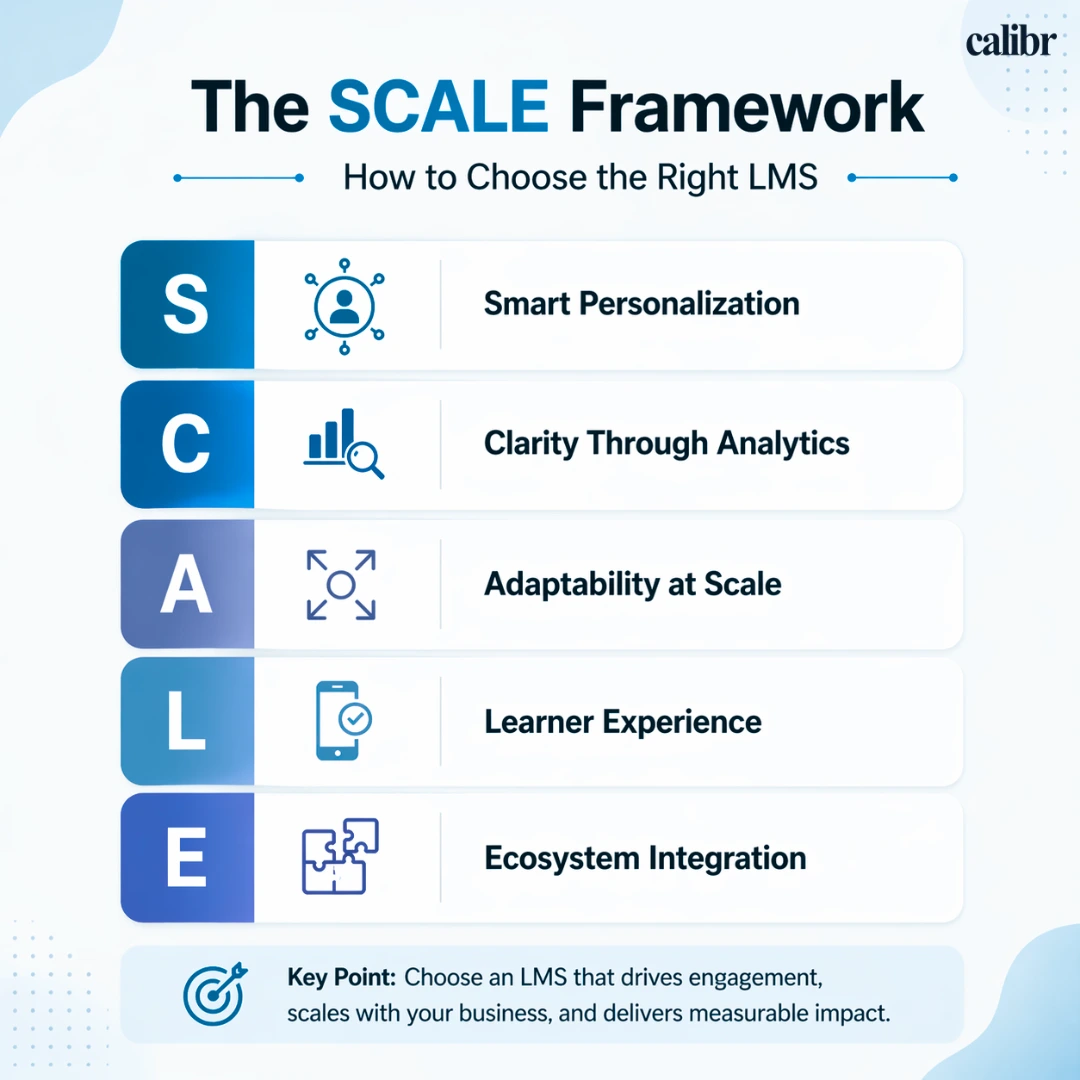
S — Smart Personalization
An LMS should go beyond static courses.
Look for an LMS with AI personalization that adapts learning paths based on employee roles, performance, and skill gaps.
Why it matters
Personalized learning increases engagement, completion rates, and real skill development.
C — Clarity Through Analytics
Data should drive decisions, not just reporting.
Choose an LMS with advanced analytics that provides insights into learner behavior, skill gaps, and training ROI.
Why it matters
Without actionable insights, training becomes a cost — not an investment.
A — Adaptability at Scale
Your learning platform should grow with your organization.
If you're evaluating the best LMS, ensure it supports multiple teams, geographies, and evolving training needs.
Why it matters
What works for 50 employees often fails at 5,000.
L — Learner Experience
Adoption determines success.
Your employee training software must be intuitive, mobile-friendly, and easy to navigate for both learners and admins.
Why it matters
Even the most powerful LMS fails if employees don’t use it.
E — Ecosystem Integration
A platform should not operate in isolation. It should integrate seamlessly with HRMS, performance tools, and content providers.
Why it matters
Integration reduces manual work and creates a unified learning ecosystem.
Quick Decision Guide: Which LMS Should You Choose?
LMS | Choose This If You… |
|---|---|
Calibr | Want AI-powered personalization, an LMS with advanced analytics, and a scalable all-in-one platform |
Docebo | Need enterprise-grade automation and multi-domain training at scale |
Absorb LMS | Want a user-friendly platform with strong reporting and e-commerce features |
LearnUpon | Need multi-portal training for customers and partners |
Moodle | Want full customization and have technical resources to manage it |
360Learning | Prefer collaborative, peer-driven learning environments |
SAP Litmos | Need quick deployment with ready-made content and simple setup |
Frequently Asked Questions (FAQ's)
What are the main limitations of TalentLMS?
TalentLMS is limited in advanced analytics, AI-driven personalization, and enterprise scalability. While it works well for basic training, growing organizations often need deeper insights, automation, and performance tracking.
How does TalentLMS compare to enterprise LMS platforms?
TalentLMS is designed for simplicity, whereas enterprise LMS platforms offer advanced features like AI personalization, compliance automation, and detailed analytics. This makes enterprise LMS solutions more suitable for large or scaling organizations.
Which LMS is best for compliance training in India?
The best LMS for compliance training in India is one that supports automation, certification tracking, and audit-ready reporting.
What features should I look for when switching from TalentLMS?
You should look for AI-driven personalization, advanced analytics, integrations, and scalability. A modern LMS should also provide measurable outcomes, not just course delivery.
Is TalentLMS suitable for large enterprises?
TalentLMS is generally better suited for small to mid-sized teams. Large enterprises often require more advanced customization, automation, and analytics capabilities.
How long does it take to migrate from TalentLMS to another LMS?
Migration timelines vary, but most organizations can transition within a few weeks to a few months depending on data complexity, integrations, and customization requirements.
Which LMS offers the best AI-powered learning features?
LMS platforms with AI capabilities provide personalized learning paths, predictive insights, and automation. Solutions like Calibr combine these features to deliver more adaptive and data-driven learning experiences.
Choosing the Best LMS for 2026: Final Thoughts
While TalentLMS provides a solid foundation for standard employee training needs, organizations looking to turn learning into a strategic advantage need more advanced capabilities. The alternatives in this guide address these gaps with features that support scalability, engagement, and measurable outcomes.
As you evaluate your options for 2026, focus on platforms that offer deeper insights, flexibility, and the ability to grow with your organization. The right employee training software should not only deliver content but also enable measurable learning impact.
Choosing the right LMS ultimately depends on your business goals, team size, and long-term learning strategy — but the right platform will go beyond course delivery to drive real performance and impact.
Ready to Experience the Calibr Difference?
Calibr helps organizations move beyond basic training to drive real performance. It enables smarter learning with deeper insights and flexible customization, while supporting growing teams with a seamless, scalable experience.
Start your 14-day free trial and experience AI-powered learning in action.
Book a personalized demo to see how your training can drive real outcomes.


Vivetha is a digital marketing professional specializing in content marketing and SEO. She focuses on developing optimized, high-quality content that improves search visibility, supports brand objectives, and drives measurable results. With a structured and analytical approach, she ensures content aligns with business and audience needs.