
Most LMS decisions fail because they’re driven by compliance, not strategy — and that’s why they underdeliver.
The right LMS is not a content platform — it’s a performance engine that improves productivity, engagement, and business outcomes.
US enterprises face unique challenges: strict compliance (HIPAA, OSHA), distributed teams, and heavy reliance on HR systems.
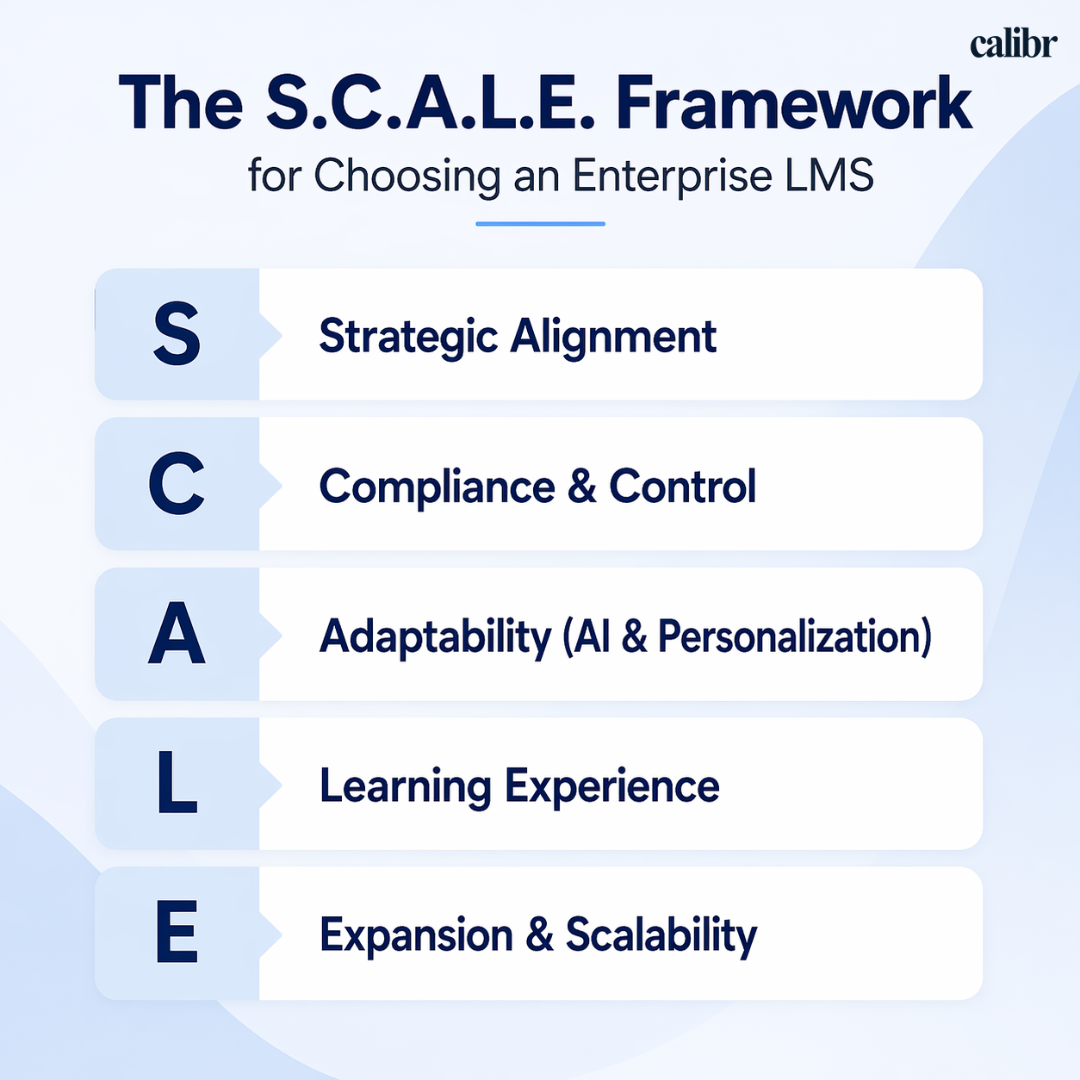
The S.C.A.L.E. framework helps cut through noise by focusing on strategy, compliance, adaptability, experience, and scalability.
Common mistakes kill ROI — like choosing feature-heavy tools over fit-for-purpose platforms or ignoring adoption and change management.
Not all LMS platforms are equal — some excel in compliance, others in simplicity or multi-audience training.
AI-driven personalization and analytics are no longer optional — they’re key to modern learning effectiveness.
The best LMS decisions connect learning to business impact, not just course completion.
Empower Your Workforce with the Right Enterprise Learning Platform
Most enterprise LMS buying decisions in the US are driven by compliance deadlines or IT mandates—not L&D strategy. That’s exactly why many implementations fail to deliver meaningful business impact.
When learning is treated as a checkbox activity, it rarely translates into performance improvement. However, organizations that take a strategic approach see measurable results. According to Deloitte, companies investing in learning technologies achieve up to 24% higher profit margins, while Gallup reports that well-trained employees are 21% more productive.
Choosing the right enterprise LMS for L&D managers in the USA move beyond compliance-driven training and build scalable, personalized learning programs. This enables faster onboarding, reduces skill gaps, and provides clear visibility into workforce performance.
What is an LMS?
A Learning Management System (LMS) is a platform used to create, deliver, and track employee training. It helps organizations manage onboarding, compliance training, and skill development while providing visibility into learner progress and performance.
Modern learning platforms often combine LMS capabilities with a Learning Experience Platform (LXP). While an LMS focuses on structured training and administration, an LXP emphasizes personalized, user-driven learning through recommendations, microlearning, and content discovery.
Together, LMS + LXP create a more engaging, data-driven learning ecosystem that supports both compliance and continuous development.
Why L&D Managers Need the Best Enterprise LMS Software
L&D managers in mid-market and large US enterprises face challenges that directly impact performance, compliance, and growth. Choosing the right enterprise LMS is critical to solving these issues while aligning with the unique demands of the US market.
Skill Gaps: Employees need continuous, role-based learning to stay productive. An enterprise LMS ensures the right training reaches the right people at the right time.
Compliance Requirements: US organizations must meet strict regulations such as HIPAA, OSHA, and industry-specific standards. An LMS automates certification tracking, maintains audit-ready records, and reduces compliance risk.
Low Engagement: Traditional training methods often fail to drive participation. Modern LMS platforms use AI, gamification, and interactive learning to improve engagement and retention.
Scalability & Distributed Workforce: With remote and hybrid teams spread across multiple states, enterprises need scalable, mobile-first learning platforms that deliver consistent training across locations.
System Integration Needs: US enterprises rely heavily on HR and business systems like Workday, ADP, and Rippling. A strong LMS must integrate seamlessly to ensure centralized data, accurate reporting, and efficient workforce management.
The best enterprise LMS software goes beyond content delivery—it enables personalized learning, real-time performance tracking, and measurable business outcomes while supporting compliance, scalability, and ecosystem connectivity.
The S.C.A.L.E. Framework for Choosing an Enterprise LMS
A practical model for L&D managers to evaluate and select the right enterprise LMS.
S — Strategic Alignment
Does the LMS align with business goals?
Supports business KPIs (productivity, retention, revenue)
Aligns with workforce development strategy
Enables role-based learning paths
If learning isn’t tied to business outcomes, it won’t deliver ROI.
C — Compliance & Control
Can it handle regulatory and operational requirements?
Automated certification tracking
Audit-ready reporting (HIPAA, OSHA, etc.)
Role-based access and governance
Critical for regulated industries and enterprise risk management.
A — Adaptability (AI & Personalization)
How well does it adapt to learners?
AI-driven recommendations
Personalized learning journeys
Adaptive content delivery
This is what separates modern LMS from traditional ones.
L — Learning Experience
Is it engaging and user-friendly?
Mobile-first learning
Gamification and microlearning
Intuitive UI/UX
Engagement = completion = actual learning impact.
E — Expansion & Scalability
Can it grow with your organization?
Multi-location / global support
Multi-tenant capability (partners, vendors)
Integrations with HRMS, CRM, etc.
Your LMS should scale without friction.
While the S.C.A.L.E framework helps evaluate platforms effectively, it’s equally important to avoid common mistakes that can impact long-term success.
Common Decision Pitfalls When Choosing an Enterprise LMS
Even with the right framework, many L&D teams make subtle mistakes that reduce long-term impact. Avoid these less obvious but critical pitfalls:
Over-indexing on demos, underestimating adoption: A platform may look powerful during demos but fail in real-world usage if employees don’t actively engage with it over time.
Treating LMS as a content library, not a performance system: Many organizations focus on hosting courses instead of driving measurable outcomes like skill development, productivity, and business impact.
Choosing “feature-rich” over “fit-for-purpose”: More features don’t guarantee better results. The right LMS should solve your specific L&D challenges rather than just offering a long list of capabilities.
Ignoring learning behavior data early on: Without actionable insights from the beginning, optimizing training programs becomes reactive instead of data-driven and strategic.
Underestimating change management: Even the best LMS can fail without proper onboarding, internal communication, and employee buy-in.
Avoiding these pitfalls ensures your LMS investment translates into real business impact—not just another system in your tech stack.
Top Enterprise LMS Options for L&D Managers (USA)
Selecting the right Learning Management System (LMS) is essential for L&D managers to improve training effectiveness and support workforce development. Below are leading enterprise LMS platforms for mid-market and large organizations:

1. Calibr LMS
Calibr is an AI-powered enterprise LMS designed to deliver personalized learning experiences, streamline compliance tracking, and foster employee engagement. Its modular approach ensures scalability and adaptability to various organizational needs.
Key Features:
AI-Powered Course Authoring: Intelligent content creation and design tailored to individual learning paths.
Collaborative Learning: Facilitates team-based learning and social engagement to enhance knowledge sharing.
Mobile Learning: Provides access to training anytime, anywhere, with mobile-optimized content and offline capabilities.
Real-Time Analytics: Tracks progress, measures engagement, and demonstrates ROI with comprehensive reporting.
SCORM Compliance: Ensures compatibility with existing Learning Management Systems and training standards.
Limitations:
Platform ecosystem is still maturing compared to long-established vendors
May require further evaluation for highly specialized enterprise use cases
Ideal For:
Organizations seeking a scalable, AI-driven LMS that offers personalized learning journeys, robust compliance tracking, and real-time analytics.
2. Docebo
Docebo is a widely used enterprise LMS that supports blended learning across large organizations.
Key Features:
Blended learning (online + instructor-led training)
Scalable training for global teams
Centralized learning management
Strong enterprise adoption
Limitations:
More general-purpose, less AI-specialized
Can feel complex for smaller teams
Ideal For:
Large enterprises needing scalable, blended learning across multiple locations
3. Cornerstone OnDemand
Cornerstone OnDemand is a full-suite talent management platform combining learning, performance, and compliance.
Key Features:
Integrated learning + performance management
Strong compliance tracking
Structured learning paths
Enterprise-wide workforce development
Limitations:
Can be heavy and complex
Less focused on modern AI-driven personalization
Ideal For:
Large organizations needing an all-in-one talent and compliance solution
4. TalentLMS
TalentLMS is a cloud-based LMS known for simplicity, flexibility, and quick deployment.
Key Features:
Easy course creation and setup
Supports remote and hybrid teams
Scalable for growing businesses
User-friendly interface
Limitations:
Limited advanced AI capabilities
Not ideal for highly complex enterprise needs
Ideal For:
Mid-sized companies looking for a simple, scalable LMS
5. LearnUpon
LearnUpon is a multi-tenant LMS designed to manage training across employees, partners, and external stakeholders.
Key Features:
Multi-portal training management
Centralized reporting
Consistent onboarding across audiences
Scalable for extended enterprise learning
Limitations:
General LMS capabilities (less AI-focused)
Limited advanced personalization
Ideal For:
Enterprises training multiple audiences (employees, partners, vendors)
Quick Comparison: Top Enterprise LMS Software (USA)
Feature | Calibr LMS | Docebo | Cornerstone OnDemand | TalentLMS | LearnUpon |
|---|---|---|---|---|---|
AI-Powered Learning | ✔ Advanced | ✔ Moderate | ✔ Moderate | ✖ | ✖ |
Personalization | ✔ High | ✔ High | ✔ High | ✔ Basic | ✔ Basic |
Mobile Learning | ✔ Strong | ✔ Strong | ✔ Strong | ✔ Strong | ✔ Strong |
Analytics & ROI Tracking | ✔ Advanced (real-time) | ✔ Good | ✔ Advanced | ✖ Limited | ✔ Good |
Compliance Management | ✔ Strong | ✔ Strong | ✔ Enterprise-grade | ✔ Basic | ✔ Strong |
Ease of Use | ✔ High | ⚠ Moderate | ⚠ Complex | ✔ Very Easy | ✔ Easy |
Scalability | ✔ High | ✔ High | ✔ High | ⚠ Medium | ✔ High |
Multi-Audience Training | ✔ Yes | ✔ Yes | ✔ Yes | ✖ Limited | ✔ Strong |
Best For | AI-driven enterprises | Large enterprises | Compliance-heavy orgs | Mid-sized teams | Multi-audience training |
Quick Decision Matrix: Which Enterprise LMS Should You Choose?
Choose Calibr LMS if:
You want AI-driven personalization + modern learning experience
You need real-time analytics and scalability
You want a future-ready LMS (not legacy-heavy)
Choose Docebo if:
You need a well-known, enterprise-grade platform
Blended learning is your priority
Choose Cornerstone OnDemand if:
You require strong compliance + full talent suite
You operate in a highly regulated industry
Choose TalentLMS if:
You want simplicity and quick setup
You’re a mid-sized company with standard needs
Choose LearnUpon if:
You train partners, vendors, or external audiences
You need multi-portal training environments
Frequently Asked Question ( FAQ)
How do L&D managers in the USA choose the right enterprise LMS?
L&D managers in the USA should evaluate an LMS based on compliance readiness, scalability, integrations with HR and business systems, and the ability to deliver role-specific training. The platform should align with both workforce development goals and regulatory requirements.
What features are essential in enterprise LMS software for US Organizations?
Essential features include compliance tracking (HIPAA, OSHA), AI-driven personalization, real-time analytics, mobile learning, and seamless integration with HRMS and CRM systems. These features help ensure both performance improvement and regulatory adherence.
How does an enterprise LMS improve employee performance in US Companies?
An enterprise LMS improves performance by delivering role-specific training, tracking progress in real time, identifying skill gaps, and enabling continuous learning. This leads to higher productivity and better business outcomes.
Can an enterprise LMS support compliance and regulatory training in the USA?
Yes, enterprise LMS platforms help US organizations manage compliance by automating certification tracking, sending renewal alerts, and generating audit-ready reports. This ensures adherence to regulations like HIPAA, OSHA, and internal corporate policies.
What is the best enterprise LMS for L&D managers in the USA?
The best enterprise LMS for L&D managers in the USA is one that supports regulatory compliance (such as HIPAA and OSHA), delivers measurable training outcomes, and scales across distributed teams. It should enable role-based learning, provide clear visibility into performance, and integrate seamlessly with existing enterprise systems to support data-driven decision-making.
Empower Enterprise Learning That Drives Real Impact
Choosing the right enterprise LMS is no longer just about delivering training—it’s about driving measurable business outcomes. For L&D managers, the right platform enables scalable learning, ensures compliance, and directly improves workforce performance.
With growing demands for personalization, analytics, and global scalability, modern enterprises need an LMS that goes beyond basic course delivery and acts as a strategic learning engine.
Key Takeaways
The right enterprise LMS should align with business goals, not just training needs
AI-driven personalization and analytics are critical for improving engagement and ROI
Scalability and integration capabilities ensure long-term success as organizations grow
Why Calibr LMS Stands Out
Calibr combines AI-powered personalization, real-time analytics, and a flexible, scalable architecture to help L&D teams move from training delivery to performance impact.
It’s designed for enterprises that want to modernize learning, improve engagement, and make training measurable.
Ready to Elevate Your Learning Strategy?
Start building a smarter, more effective learning ecosystem with Calibr LMS.
Start your 14-day free trial | Contact our team | Schedule a Demo


Vivetha is a digital marketing professional specializing in content marketing and SEO. She focuses on developing optimized, high-quality content that improves search visibility, supports brand objectives, and drives measurable results. With a structured and analytical approach, she ensures content aligns with business and audience needs.