
TL;DR — Key Takeaways
• Clear types of hr policies give organizations the legal footing and cultural consistency they need to function fairly.
• Every HR team should maintain core policies covering employment, leave, conduct, harassment prevention, data protection, and discipline.
• What is hr policy goes beyond paperwork — it is the documented agreement between an organization and its people.
• HR policies and procedures should be reviewed at least annually and updated whenever laws or business structures change.
Introduction: Why Getting This Right Matters
Most organizations know they need HR policies. Fewer take the time to think carefully about which ones they actually need, how those policies should be structured, and what happens when they go out of date.
Understanding why are hr policies important starts with a practical reality: without documented policies, decisions get made inconsistently. One manager approves a leave request that another denies. One department enforces a code of conduct that others quietly ignore. Over time, inconsistency erodes trust — and trust is very difficult to rebuild.
This blog covers the core types of hr policies every organization should have, why each one matters, and how to approach policy development in a way that actually sticks. If you're building your HR policy library from scratch or auditing an existing one, this is your starting point.
To understand the broader role of HR policies and why they are essential in organizations, explore our complete guide on: HR Policies: A Practical Global Guide for HR Leaders
What Is an HR Policy?
An HR policy is a formal document that defines an organization’s rules, expectations, and guidelines for managing employees. It outlines how common workplace situations — such as leave, conduct, performance, and data handling — should be handled, ensuring consistency, fairness, and legal compliance across the organization.
Why HR policy is important?
HR policies are important because they create consistency, fairness, and legal protection in the workplace. They set clear expectations for employees, guide managers in decision-making, and reduce the risk of disputes or compliance issues. Without policies, organizations rely on individual judgment — leading to inconsistency, confusion, and potential legal exposure.
Workplace Policy and Compliance: Key Statistics
The importance of HR policies is reinforced by real-world data. According to Gallup State of the Global Workplace report, only about 21% of employees globally are engaged at work, highlighting significant gaps in clarity, structure, and workplace consistency.
Similarly, insights from SHRM employee engagement research show that 80% of employees report higher loyalty when organizations implement supportive workplace policies such as flexibility and clear guidelines.
In addition, research summarized in employee engagement statistics by Gallup shows that engaged employees drive better productivity, profitability, and retention — all of which are directly influenced by clear expectations and structured policies.
These findings make one thing clear: without well-defined HR policies and consistent implementation, organizations struggle with engagement, retention, and long-term performance.
Types of HR Policies Every Organization Needs

While the specific language and scope of each policy will vary by industry, size, and location, the following categories represent the baseline every organization should cover. These are the 7 most common HR Policies that come up most often, carry the most legal weight, and have the greatest impact on day-to-day employee experience.
1. Employment Policies
Employment policies establish the foundational terms of the working relationship. They cover hiring practices, employment classifications (full-time, part-time, contract), probation periods, and the conditions under which employment can be terminated.
These policies answer the questions employees have from day one: What are my working hours? What is my notice period? What does my probation look like? Having clear employment policies reduces ambiguity during onboarding and sets expectations before they become points of conflict.
Key elements to include:
• Employment types and classification criteria
• Probation period duration and evaluation process
• Notice periods for resignation and termination
• Equal employment opportunity and non-discrimination guidelines
• Rehire eligibility and reference check procedures
2. Leave and Attendance Policies
Leave policies are among the most frequently referenced hr policies and procedures — and among the most common sources of employee grievances when they're vague or inconsistently applied.
A well-written leave policy covers all leave types: annual leave, sick leave, maternity and paternity leave, bereavement leave, and public holidays. It should also specify the process for requesting leave, the approval chain, how unused leave is handled, and what happens during extended absences.
Attendance policies sit alongside leave policies and define expectations around punctuality, unplanned absences, and how patterns of absenteeism are addressed. Both policies need to comply with local labor law, which can vary significantly across states and countries.
Key elements to include:
• Leave types and entitlements by employee category
• Request and approval process
• Leave carry-over and encashment rules
• Attendance tracking and escalation procedures
3. Code of Conduct
The code of conduct is arguably the most culturally significant of all types of hr policies. It defines the behavioral standards the organization expects from every employee, regardless of level or function.
A strong code of conduct covers professional behavior in the workplace and in external settings, conflict of interest disclosures, standards for communication (internal and external), and expectations around company property and resources. It sets the tone for what kind of workplace the organization is trying to build.
The code of conduct works best when it's written in accessible language, actively communicated during onboarding, and reinforced through regular training rather than filed away and forgotten. Calibr's employee training features make it straightforward to deliver code of conduct training at scale and track completion across the organization.
Key elements to include:
• Professional behavior standards
• Conflict of interest declaration requirements
• Acceptable use of company resources
• Consequences for violations
4. Anti-Harassment and POSH Policy
No HR policy library is complete without a robust anti-harassment policy. In many jurisdictions, this is not optional — it is a legal requirement. The Prevention of Sexual Harassment (POSH) framework, for example, mandates specific policies, complaints committees, and training requirements for organizations operating in India.
An effective harassment policy defines what constitutes harassment (sexual, verbal, physical, and digital), establishes a clear and confidential reporting mechanism, outlines the investigation process, and specifies protections against retaliation for those who report in good faith.
Importantly, this policy needs to be communicated — not just distributed. Employees must understand what it covers, how to use it, and that leadership takes it seriously. Annual awareness training is considered best practice in most jurisdictions.
Key elements to include:
• Definition of harassment with examples
• Reporting channels and confidentiality assurances
• Investigation process and timelines
• Anti-retaliation protections
• Training and awareness requirements
5. Remote Work Policy
Remote and hybrid work has become a standard employment arrangement across industries, and organizations without a formal policy governing it are operating in ambiguous territory. A remote work policy clarifies eligibility, expectations, equipment responsibilities, data security standards, and how performance is measured for employees working outside the office.
This policy also protects the organization. Without it, questions about working hours, liability for home-office injuries, or data breaches in unsecured environments can quickly become complicated. A clear policy sets boundaries while giving employees the flexibility they increasingly expect.
Key elements to include:
• Eligibility criteria for remote or hybrid arrangements
• Working hour expectations and availability requirements
• Equipment and connectivity responsibilities
• Data security and confidentiality requirements for remote settings
• Performance management expectations
6. Data Protection and IT Acceptable Use Policy
With data breaches and privacy regulations becoming increasingly prominent, data protection policies have moved from a nice-to-have to a compliance necessity. The data protection policy governs how employees handle company data, customer information, and personal data — and defines acceptable use of company IT systems, devices, and networks.
It should align with applicable regulations such as GDPR (in Europe), PDPA (in India and Southeast Asia), or CCPA (in California), and be updated whenever those regulations change. Employees need to know what they can and cannot do with data — and what the consequences are for misuse.
Key elements to include:
• Data classification and handling standards
• Acceptable use of company devices, email, and internet
• Password and access management requirements
• Incident reporting obligations
• Consequences of data misuse or breach
7. Disciplinary and Grievance Policy
Disciplinary policies define the process the organization follows when an employee's behavior or performance falls below expected standards. Grievance policies give employees a structured way to raise concerns about their treatment or working conditions.
Both policies serve a protective function — for employees and for the organization. A clear disciplinary process ensures that corrective action is applied consistently and fairly, reducing the risk of wrongful termination claims. A functioning grievance procedure gives employees a legitimate outlet rather than letting issues escalate.
These are among the most legally sensitive of all hr policies and procedures, and they should be reviewed by legal counsel before implementation.
Key elements to include:
• Stages of disciplinary action (verbal warning, written warning, suspension, termination)
• Employee rights during the process
• Grievance submission process and timelines
• Escalation procedures and appeals
The C.L.E.A.R. Framework for Managing HR Policies
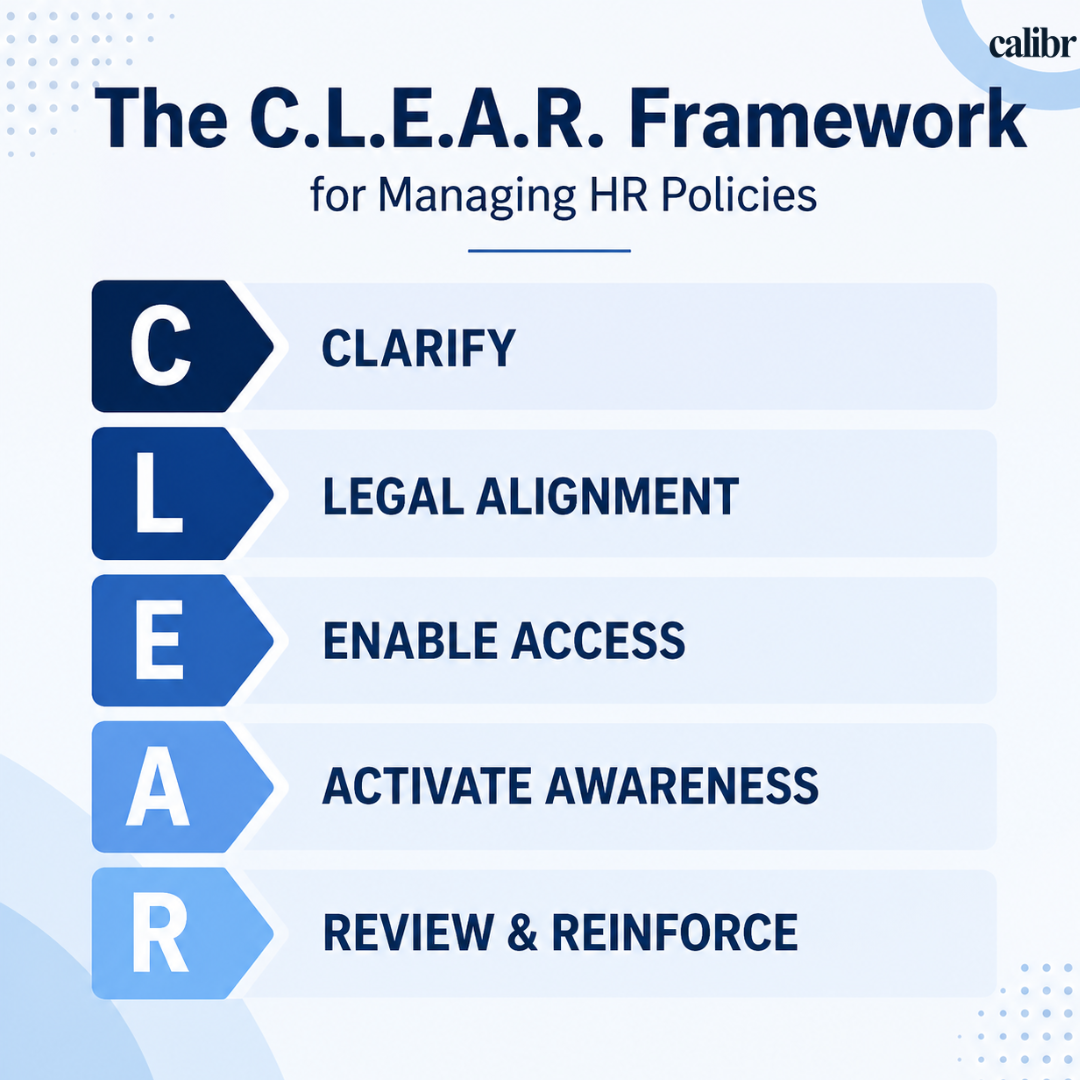
A practical model to ensure HR policies are not just written — but actually used.
C — Clarify
Policies must be easy to understand.
Use plain, human language
Avoid unnecessary legal jargon
Define key terms clearly
Keep sentences short and direct
If employees don’t understand a policy, they won’t follow it.
L — Legal Alignment
Every policy must stand up legally.
Align with applicable labor laws (POSH, data protection, etc.)
Conduct legal review before publishing
Update policies when regulations change
A policy is only effective if it protects both the organization and employees.
E — Enable Access
Policies should be easy to find — anytime.
Centralize all policies in one platform
Ensure mobile accessibility
Keep navigation simple (ideally within two clicks)
If policies are hard to access, they won’t be used.
A — Activate Awareness
Don’t just share policies — ensure they are understood.
Include policies in onboarding programs
Conduct regular training (especially for compliance areas)
Track employee acknowledgment and completion
Awareness drives real compliance.
R — Review & Reinforce
Policies must evolve with the organization.
Review policies at least annually
Update based on legal or business changes
Reinforce through regular communication
A policy that isn’t updated becomes a risk.
The C.L.E.A.R. framework ensures HR policies are clear, compliant, accessible, actively used, and continuously updated.
How to Build and Manage HR Policies That Actually Work
Having the right HR policies and best practices in place is essential. But the real challenge begins after policies are created — ensuring they are consistently implemented, accessible, and followed across the organization.
Many organizations invest time in drafting policies but struggle with what comes next. Policies get stored in shared drives, overlooked after onboarding, and rarely revisited. Over time, this creates a gap between what is written and what actually happens in the workplace.
Effective HR policy management requires a structured approach — not just documentation.
It involves:
Creating policies that are clear, practical, and legally aligned
Distributing them to the right employees at the right time
Tracking acknowledgment to ensure employees have read and understood them
Maintaining version control for audit readiness
Regularly updating policies as laws and business needs evolve
Without this system, even well-written policies fail to deliver real impact.
Organizations that manage policies effectively treat them as active tools — not static documents. They ensure policies are easy to access, consistently communicated, and integrated into everyday workflows
Platforms like Calibr help streamline this process by centralizing policy management, automating distribution, tracking employee acknowledgment, and generating compliance-ready reports — ensuring policies are not just created, but actively managed and followed across the organization.
Great policies don’t just exist — they are actively managed, consistently applied, and continuously improved.
Frequently Asked Questions (FAQ's)
What are the main types of HR policies every organization needs?
The main types of HR policies include employment policies, leave and attendance policies, code of conduct, anti-harassment (POSH), remote work policies, data protection policies, and disciplinary procedures.
These cover the most common workplace situations and ensure consistency and compliance.
What policies should HR have as a starting point?
Every company should start with core HR policies such as employment terms, leave policies, code of conduct, anti-harassment, data protection, and disciplinary procedures.
These form the foundation for managing employees fairly and legally.
Why are HR policies important for organizations?
HR policies are important because they ensure consistency, fairness, and legal compliance in the workplace.
They help managers make decisions and reduce the risk of disputes or legal issues.
How often should HR policies be reviewed?
HR policies should be reviewed at least once a year.
High-risk policies like harassment and data protection should be reviewed more frequently, especially when laws change.
How do HR policy improve employee engagement?
HR policies improve employee engagement by creating clarity, fairness, and trust in the workplace.
When employees understand expectations and feel policies are applied consistently, they are more confident, satisfied, and motivated to perform.
What happens if a company does not have HR policies?
Without HR policies, companies face inconsistency, confusion, and higher legal risk.
Decisions may vary between managers, leading to employee dissatisfaction, disputes, and potential compliance issues.
Final Thoughts
Getting the right types of HR Policies is one of the most foundational things an HR team can do for their organization. Policies are not bureaucratic overhead — they are the documented commitments that make fair, consistent, and legally compliant management possible.
The organizations that invest in building clear, accessible, and regularly updated HR policies aren't just protecting themselves from legal risk. They're building a culture where employees understand what's expected of them, trust that the rules apply equally to everyone, and feel confident raising concerns when something goes wrong.
Whether you're building your HR policy library from scratch, auditing an existing one, or looking for a better way to manage distribution and compliance tracking, Calibr is built to support every step of the process.
Next Steps


Vivetha is a digital marketing professional specializing in content marketing and SEO. She focuses on developing optimized, high-quality content that improves search visibility, supports brand objectives, and drives measurable results. With a structured and analytical approach, she ensures content aligns with business and audience needs.