
Coaching helps employees improve specific skills, solve challenges, and achieve measurable goals. It is structured, goal-focused, and typically short-term.
Mentoring supports long-term career growth through guidance, advice, and experience sharing from a more experienced professional.
Use coaching when the goal is performance improvement, behavior change, or skill development.
Use mentoring when the goal is career development, leadership growth, or professional guidance.
Many organizations achieve the best results by combining both approaches.
The right choice depends on whether the employee needs to perform better today, grow for tomorrow, or both.
Every organization wants its people to grow — but growth needs the right kind of support at the right time.
Two of the most effective tools for employee development are coaching and mentoring. The problem? Most organizations use these words as if they mean the same thing. They don't.
Using the wrong approach — even with good intentions — wastes time and leaves real needs unmet. Understanding the difference directly affects how well your people develop, how fast they progress, and how long they stay.
Quick Answer: Coaching vs Mentoring
Coaching helps someone improve a specific skill or work through a particular challenge. It is structured, short-term, and goal focused. A coach does not need to be an expert in your field — they ask good questions and guide your thinking.
Mentoring is a longer relationship where a more experienced person shares their knowledge, experience, and advice to help someone grow in their career. A mentor has "been there" and guides based on lived experience.
Feature | Coaching | Mentoring |
Focus | Specific skill or goal | Career and personal growth |
Duration | Short-term (weeks to months) | Long-term (months to years) |
Direction | Coach leads the process | Mentor shares experience |
Who does it | Trained coach (internal or external) | Senior colleague or leader |
Outcome | Solve a problem, build a skill | Grow as a professional |
What Is Coaching?
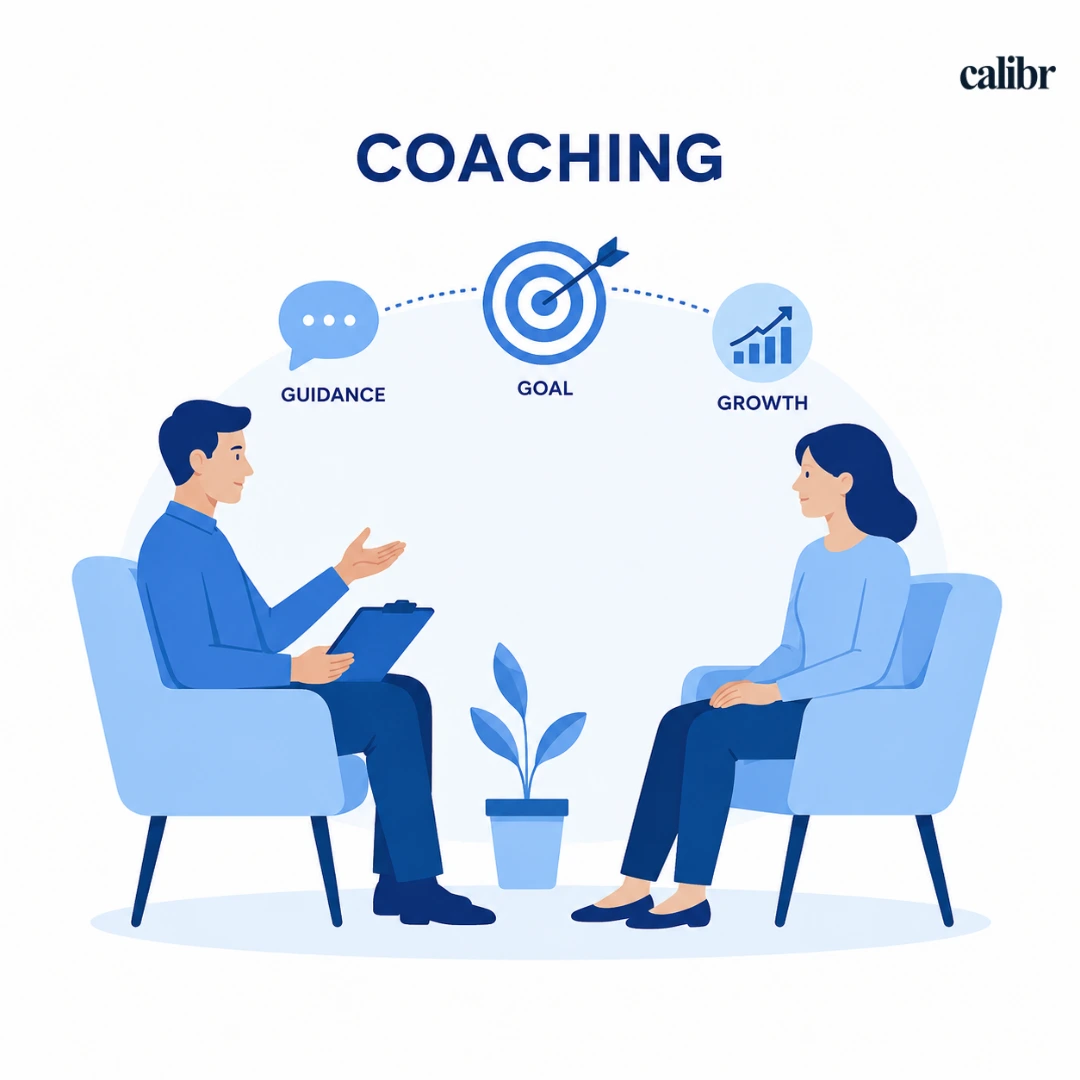
Coaching is a structured conversation process where a trained person helps someone think through challenges, set goals, and take action to improve.
A good coach does not give you the answer. They ask the right questions so you can find it yourself. This approach builds deeper understanding and longer-lasting change.
How coaching works in practice:
Imagine a newly promoted manager who struggles to speak confidently during team meetings. During coaching sessions, they identify what's holding them back, set specific improvement goals, and practice new communication techniques. Over the next few months, regular feedback and action plans help them become a more confident and effective leader.
Where Coaching Excels vs Where It Falls Short
Where Coaching Excels | Where Coaching Falls Short |
Developing specific skills | Providing long-term career guidance |
Improving workplace performance | Expanding professional networks |
Building self-awareness | Offering industry-specific experience |
Creating accountability | Sponsoring career advancement |
Driving measurable results | Sharing personal career lessons |
Solving immediate challenges | Supporting broad career development |
Common types of coaching include:
Organizations use different types of coaching depending on the development goal:
Performance Coaching – Helps employees improve specific skills, behaviors, or workplace performance.
Executive Coaching – Supports senior leaders in strategic thinking, influence, and organizational leadership.
Career Coaching – Helps individuals identify career goals and create a plan for professional growth.
Team Coaching – Focuses on improving collaboration, communication, and overall team effectiveness.
Leadership Coaching – Develops leadership capabilities such as decision-making, communication, and team management.
What Is Mentoring?

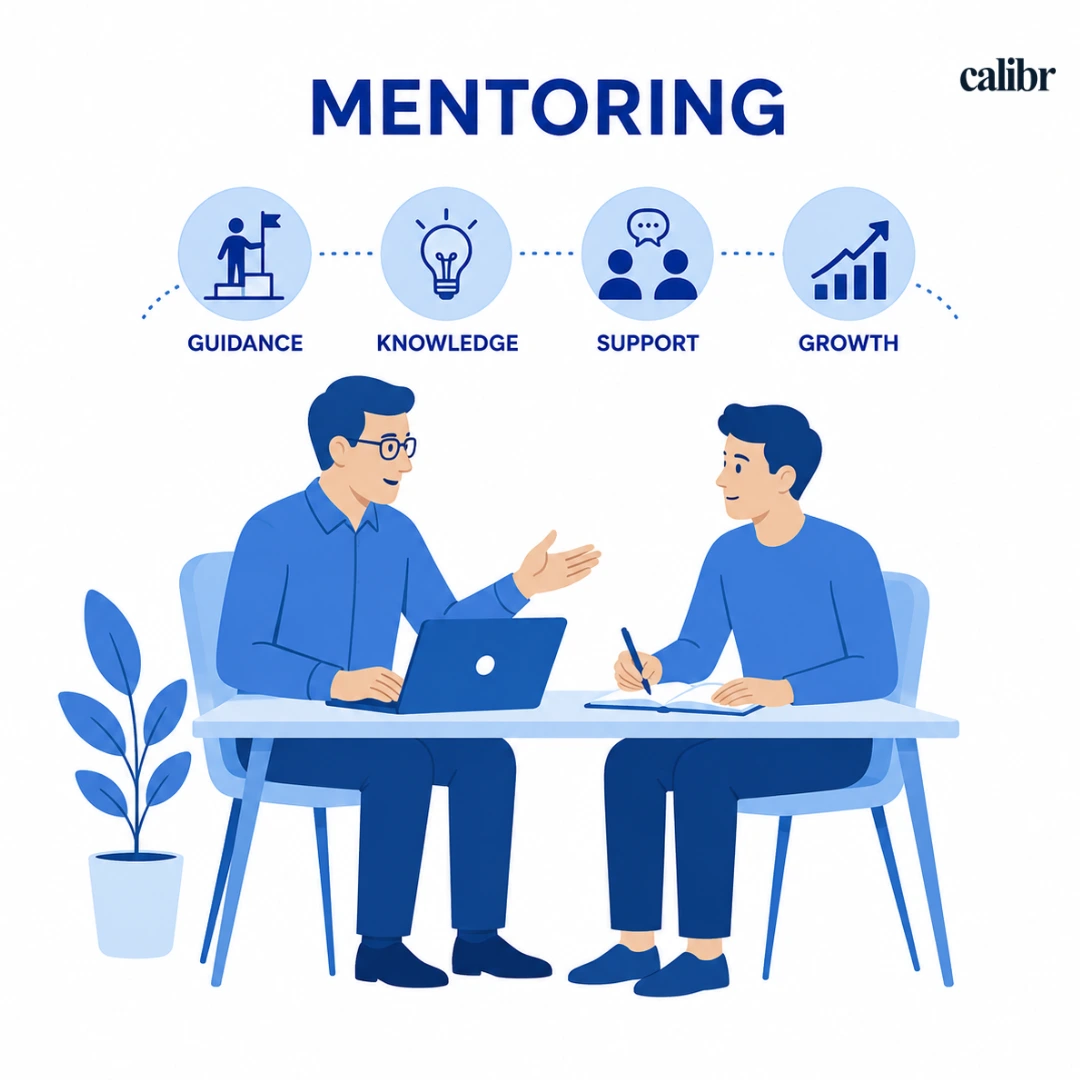
Mentoring is a relationship where a more experienced person (the mentor) guides someone less experienced (the mentee) over time. It is less structured than coaching and more about sharing wisdom, networks, and perspective.
A good mentor does not just tell you what to do. They help you see what is possible, avoid common mistakes, and build confidence in your own direction.
How mentoring works in practice:
A young HR professional aspires to move into a leadership role but isn't sure how to get there. A senior HR leader mentors them, sharing career insights, introducing them to key stakeholders, and helping them navigate workplace challenges. Over time, the mentee gains confidence, expands their network, and develops a clearer career path.
Where Mentoring Excels vs Where It Falls Short
Where Mentoring Excels | Where Mentoring Falls Short |
Career guidance | Immediate performance issues |
Professional growth | Urgent skill gaps |
Networking opportunities | Short-term measurable outcomes |
Confidence building | Specific behavior change |
Leadership development | Performance correction |
Common types of mentoring include:
Organizations use different types of mentoring to support employee development
Traditional Mentoring – An experienced professional guide a less experienced employee through career and workplace challenges.
Reverse Mentoring – Junior employees share knowledge and perspectives with senior leaders, often around technology or emerging workplace trends.
Peer Mentoring – Colleagues at similar career stages support each other's learning and development.
Group Mentoring – One mentor works with multiple mentees, encouraging collaborative learning.
Flash Mentoring – Short-term mentoring focused on solving a specific challenge or providing quick career guidance.
7 Key Differences Between Coaching vs Mentoring
While coaching and mentoring both aim to support employee growth, they differ in purpose, structure, duration, and outcomes.
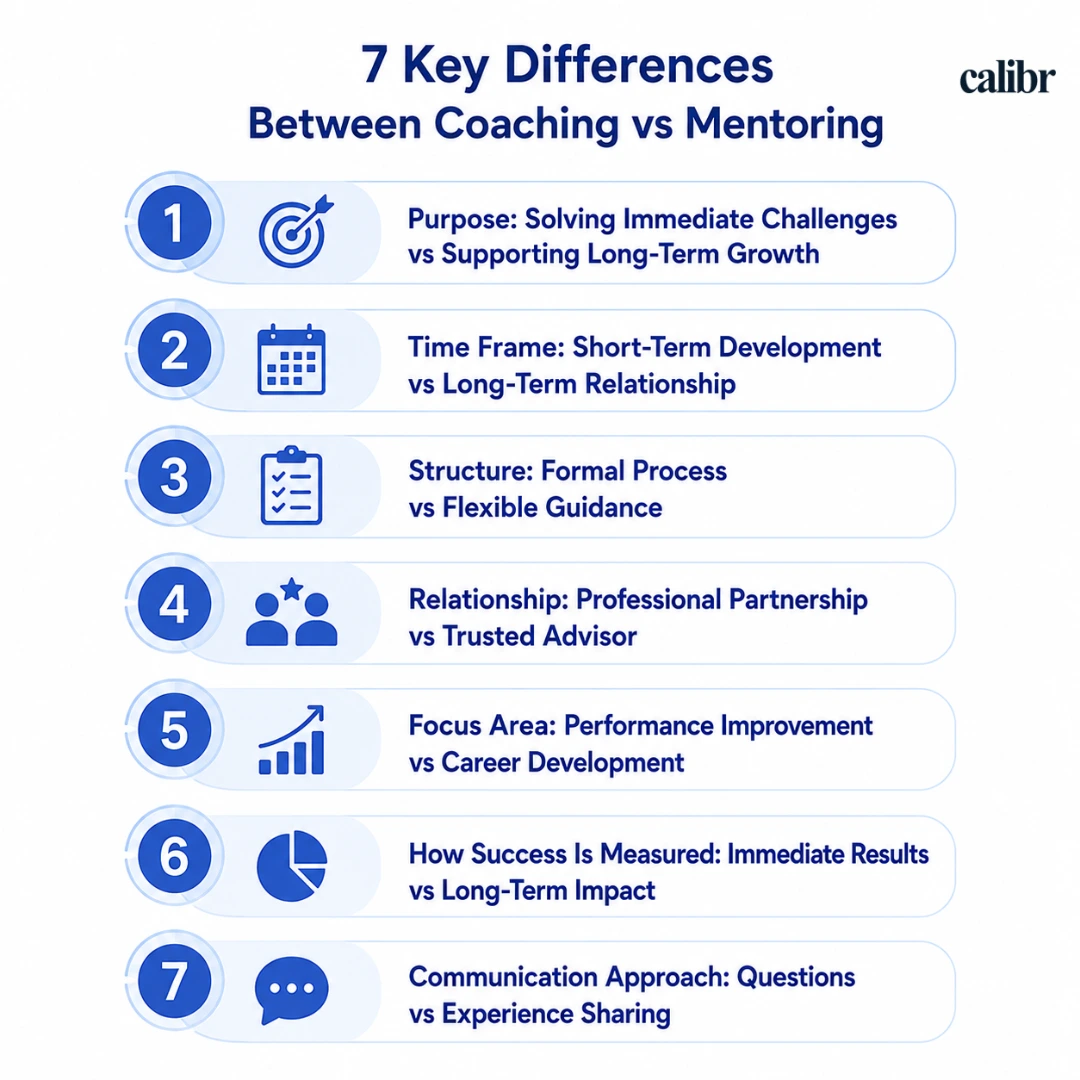
Understanding these differences between coaching and mentoring helps organizations choose the right approach for the right situation.
1. Purpose: Solving Immediate Challenges vs Supporting Long-Term Growth
The biggest difference between coaching and mentoring lies in their purpose.
Coaching is designed to help individuals improve a specific skill, overcome a challenge, or achieve a defined goal. The focus is on enhancing performance and delivering measurable results within a set timeframe.
Mentoring, on the other hand, focuses on broader professional and personal development. Instead of addressing one particular issue, mentoring helps individuals gain career guidance, confidence, industry knowledge, and long-term perspective.
Example:
A newly promoted manager struggles to handle difficult employee conversations. Coaching helps them develop communication and conflict resolution skills.
Meanwhile, a recent graduate entering the workforce may benefit more from mentoring, where an experienced professional helps them navigate career choices, workplace expectations, and future opportunities.
2. Time Frame: Short-Term Development vs Long-Term Relationship
Coaching is usually time-bound and focused on achieving specific outcomes within a defined period.
Organizations often run coaching sessions for a few weeks or months, with clear goals and regular progress reviews. Once the objective is achieved, the coaching relationship typically ends.
Mentoring is generally a long-term relationship that evolves over time. Mentors support mentees through different stages of their careers, often providing guidance for months or even years.
Example:
A leadership coaching program may run for three to six months to help a manager improve delegation skills.
A mentoring relationship may continue for several years as the mentee progresses from an entry-level role to a leadership position.
3. Structure: Formal Process vs Flexible Guidance
Coaching follows a structured framework with defined goals, timelines, action plans, and review sessions.
Each coaching conversation is designed to move the individual closer to a specific outcome. Progress is tracked, measured, and discussed regularly.
Mentoring is typically more flexible. Conversations may cover a wide range of topics, from career decisions and workplace challenges to personal growth and leadership aspirations.
The agenda is often driven by the mentee's needs rather than a fixed development plan.
Example:
A coach may spend every session working toward improving presentation skills.
A mentor may discuss career advancement one month, networking opportunities the next, and leadership challenges in a later conversation.
4. Relationship: Professional Partnership vs Trusted Advisor
The relationship between a coach and an individual is usually professional, objective, and goal-oriented.
Coaches focus on helping people find their own solutions rather than sharing personal experiences or giving direct advice.
Mentoring relationships tend to be more personal and trust-based. Mentors often become sounding boards, role models, and long-term supporters who share experiences and lessons learned throughout their careers.
Example:
After a coaching engagement ends, communication may stop because the original goal has been achieved.
In contrast, many mentoring relationships continue for years, with mentees seeking advice during major career decisions and transitions.
5. Focus Area: Performance Improvement vs Career Development
Coaching focuses primarily on improving performance, building capabilities, and changing behaviors that affect workplace success.
Mentoring focuses on broader development areas such as career progression, leadership potential, professional confidence, networking, and industry knowledge.
Think of coaching as helping someone perform better today, while mentoring helps them prepare for tomorrow.
Example:
A salesperson who struggles to close deals may receive coaching to strengthen negotiation techniques.
A high-potential employee preparing for future leadership roles may work with a mentor to understand strategic thinking, stakeholder management, and career planning.
6. How Success Is Measured: Immediate Results vs Long-Term Impact
Coaching outcomes are often measurable and visible within a relatively short period.
Organizations can track performance improvements using metrics such as productivity, sales performance, employee engagement scores, communication effectiveness, or leadership assessments.
Mentoring outcomes are often less immediate but equally valuable. Success may appear through increased confidence, stronger decision-making, career progression, improved retention, or leadership readiness.
Example:
The success of a coaching program might be measured by a manager's ability to improve team performance within six months.
The success of mentoring may become evident when a mentee secures a promotion, expands their professional network, or successfully transitions into a leadership role years later.
7. Communication Approach: Questions vs Experience Sharing
Coaches primarily use powerful questions to help individuals think critically, challenge assumptions, and discover their own solutions.
Rather than providing answers, coaches encourage self-reflection and accountability.
Mentors often share personal experiences, practical advice, lessons learned, and recommendations based on their own professional journeys.
Both approaches are valuable, but they support development in different ways.
Example:
A coach might ask:
"What options have you considered?"
"What is preventing you from taking action?"
"What outcome would success look like?"
A mentor is more likely to say:
"When I faced a similar challenge, here's what worked for me."
"One mistake I made early in my career was..."
"You may want to consider building relationships with these stakeholders."
Key Takeaway
Coaching and mentoring are not competing approaches. They serve different purposes and often work best together.
Use coaching when the goal is to improve performance, build a specific skill, or overcome a challenge. Use mentoring when the goal is long-term career growth, leadership development, and professional guidance.
Organizations that combine both create a stronger learning culture and provide employees with the support they need at every stage of their careers.
Why Coaching and Mentoring Are Often Confused
Coaching and mentoring are often confused because both focus on employee growth and involve one-to-one conversations, guidance, and support. From the outside, they can appear very similar.
The key difference lies in their purpose. Coaching helps individuals improve specific skills, overcome challenges, and achieve measurable goals. Mentoring focuses on long-term career development, professional growth, and sharing experience.
The confusion also arises because many managers naturally switch between coaching and mentoring styles during conversations. They may ask powerful questions like a coach and then share personal advice like a mentor.
Understanding the distinction is important because choosing the right approach leads to better development outcomes. Coaching improves performance, while mentoring builds future potential.
Coaching vs Mentoring: A Practical Decision Framework
One of the biggest mistakes organizations make is treating coaching and mentoring as interchangeable solutions. The right choice depends on the employee's challenge, career stage, and desired outcome.
Use the framework below to identify which approach is most likely to deliver results.
Decision Matrix
Situation | Coaching | Mentoring | Both |
Employee is underperforming | Recommended | Not Recommended | Secondary Option |
Employee needs career guidance | Not Recommended | Recommended | Secondary Option |
First-time manager transition | Recommended | Secondary Option | Recommended |
High-potential leadership development | Secondary Option | Secondary Option | Recommended |
Succession planning | Not Recommended | Recommended | Recommended |
Building a specific skill | Recommended | Not Recommended | Not Recommended |
Increasing organizational visibility | Not Recommended | Recommended | Secondary Option |
Executive leadership challenges | Recommended | Secondary Option | Recommended |
Team effectiveness issues | Recommended | Not Recommended | Not Recommended |
Major organizational change | Secondary Option | Secondary Option | Recommended |
Real-World Scenarios: Which Approach Should You Choose?
The best choice depends on the employee's challenge, career stage, and development goals. The examples below show when coaching, mentoring, or a combination of both is likely to deliver the strongest results.
Scenario | Best Approach | Why |
|---|---|---|
New Manager Struggling with Leadership Skills | Coaching | Needs targeted support in delegation, feedback, and conflict resolution. |
High-Potential Employee Preparing for Future Leadership | Mentoring | Needs career guidance, strategic perspective, and exposure to senior leaders. |
Future CEO or Executive Pipeline | Both | Requires immediate leadership development and long-term strategic guidance. |
Team Performance Is Declining | Team Coaching | Needs improved collaboration, communication, and performance. |
The Coaching vs Mentoring Scorecard
If you're unsure which approach to choose, score the employee's needs.
Choose Coaching If Most Answers Are "Yes"
Does the employee have a specific performance challenge?
Is there a skill gap that needs improvement?
Do measurable outcomes need to be achieved quickly?
Is the focus on changing behaviors or habits?
Can success be clearly measured within a few months?
Score 4-5 Yes Answers: Coaching is likely the best fit.
Choose Mentoring If Most Answers Are "Yes"
Does the employee need career guidance?
Is confidence or professional growth the main objective?
Would learning from someone else's experience be valuable?
Does the employee need networking or organizational exposure?
Is long-term development more important than immediate results?
Score 4-5 Yes Answers: Mentoring is likely the best fit.
Choose Both If Most Answers Are "Yes"
Is the employee moving into leadership?
Is succession planning involved?
Is the employee considered high potential?
Does the employee need both skill development and career guidance?
Is long-term leadership growth a business priority?
Score 3+ Yes Answers: A combined coaching and mentoring approach will likely deliver the strongest results.
The 30-Second Rule
Ask one simple question:
"Is the employee trying to perform better today or grow for tomorrow?"
If the answer is today, start with coaching.
If the answer is tomorrow, start with mentoring.
If the answer is both, combine coaching and mentoring.
This simple rule helps HR and L&D teams avoid choosing the wrong development approach and ensures employees receive the support they actually need.
Frequently Asked Questions (FAQs)
Can one person be both a coach and a mentor?
Yes, but with care. Mixing both in the same conversation gets confusing. Be clear about which role you are in at any given time.
Does coaching always need a professional coach?
No. Managers can be trained to coach. But for senior leadership or sensitive performance situations, a professional brings more objectivity.
How long should mentoring last?
Most formal programs run 6–18 months. Many informal relationships last much longer.
Can mentoring improve performance?
Indirectly, yes. It builds confidence and clarity, which tend to lift performance over time. For fast, specific improvement, coaching is more direct.
What makes a good mentor?
Someone who listens well, shares honestly (including their own mistakes), makes introductions, and genuinely invests in the other person — without trying to recreate themselves.
Can AI replace coaching or mentoring?
AI tools can offer feedback and simulate coaching conversations, but they cannot replace human judgment, empathy, and trust. AI supports these practices — it cannot substitute them.
What is the biggest mistake organizations make with mentoring?
Forcing matches. When pairs are assigned without considering fit or goals, the relationship never gains traction. The best programs allow some element of choice.
When should you invest in both?
During leadership transitions, high-potential development, and major organizational change — when people need fast skill growth and a longer-term sense of direction.
Key Takeaways
Coaching is focused, short-term, and goal driven. Mentoring is relational, long-term, and growth driven.
Using the wrong approach wastes time and leaves real development needs unmet.
Coaching works best when the challenge is specific and the goal is clear.
Mentoring works best when someone needs direction, confidence, or access to experience and networks.
The most powerful development programs offer both.
Success in coaching is measurable. Success in mentoring is often felt before it is measured.
AI can support both practices but cannot replace the human connection at their core.
Final Thoughts
There is no winner between coaching and mentoring. They are different approaches designed for different development needs. Coaching helps employees build specific skills, improve performance, and achieve measurable goals. Mentoring provides the guidance, experience, and support needed for long-term career growth and leadership development.
The most successful organizations don't choose one over the other. They combine coaching, mentoring, and continuous learning to create an environment where employees can grow, adapt, and thrive. When used together, these approaches strengthen employee development, improve engagement, and build a future-ready workforce.
Empower Coaching, Mentoring, and Continuous Learning
Great employee development doesn't happen through isolated conversations alone. It requires the right learning ecosystem to support growth every day.
Coaching and mentoring are most effective when supported by continuous learning. With Calibr, organizations can create personalized learning experiences, close skill gaps, and empower employees to grow through coaching, mentoring, and AI-driven learning journeys. As an AI-powered LMS and LXP, Calibr helps build a culture of continuous development that scales across the organization.
Take Next Steps:
Contact our team for more details or queries
Schedule a Demo to get started


Vivetha is a digital marketing professional specializing in content marketing and SEO. She focuses on developing optimized, high-quality content that improves search visibility, supports brand objectives, and drives measurable results. With a structured and analytical approach, she ensures content aligns with business and audience needs.