How Instructional Design Theories Evolved for Workplace Learning


Instructional design theories remain highly relevant, but their application has evolved alongside modern workplace learning.
Traditional approaches are being adapted to support microlearning, workflow learning, and AI-powered learning experiences.
Employees learn more effectively when learning is relevant, practical, and integrated into their daily work.
Modern learning increasingly combines social learning, self-directed learning, and real-world skill application.
Organizations are moving away from one-size-fits-all training toward personalized and learner-driven experiences.
The most effective workplace learning programs combine multiple instructional design theories rather than relying on a single approach.
Picture this: it's a Tuesday afternoon. You've got a product update to push, three Slack threads waiting on you, a 2 PM call in 20 minutes, and your manager just asked you to complete mandatory compliance training by the end of day.
You open the LMS. The course is 45 minutes long. There's a video with no captions. Slide 3 has a wall of text.
You click through as fast as possible.
Sound familiar?
This is the reality of workplace learning for most employees today. According to the LinkedIn Workplace Learning Report 2025, lack of time and resources continues to be one of the biggest barriers to employee learning and career development in modern workplaces.
They're not disengaged because they don't care. They're overwhelmed, time-poor, and surrounded by information from every direction — AI tools, team chats, YouTube, quick Google searches, and yes, the occasional LMS notification they've learned to ignore.
The interesting thing is that the science of how people learn hasn't disappeared. Instructional design theories — the frameworks that explain why some learning sticks and some doesn't — are still as relevant as ever.
They've just had to grow up alongside the workplace.
This article is about evolution. It's about how the theories that once shaped classroom learning and early eLearning are now being reinterpreted for AI-powered platforms, microlearning, workflow-based learning, and the realities of the modern employee experience.
What is Instructional Design and Why it Still Matters
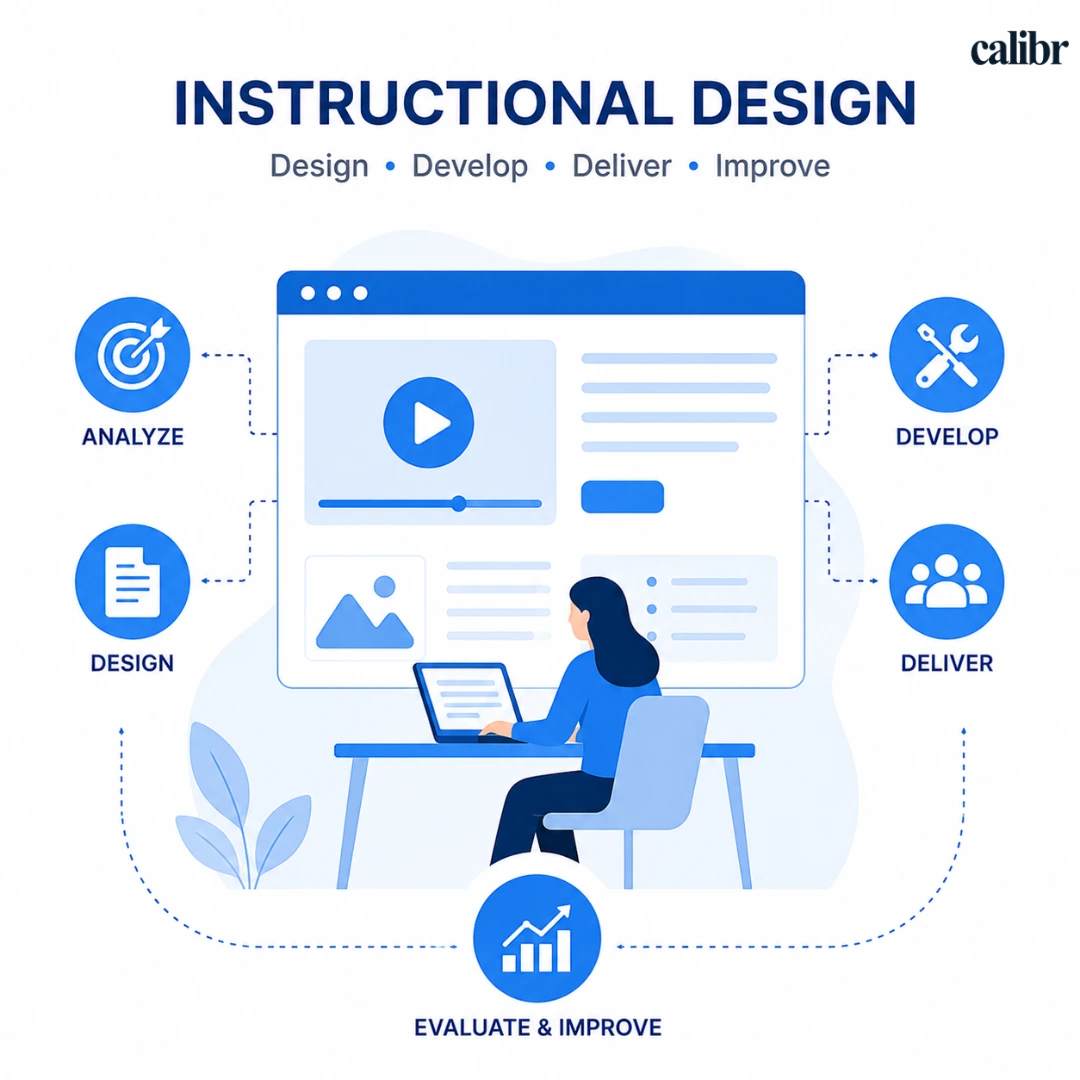
Instructional design is the process of creating learning experiences that help people understand, retain, and apply knowledge more effectively. It combines learning psychology, content structure, and teaching methods to improve how employees learn at work.
Even though workplace learning has changed significantly, the fundamentals of how people learn still remain important. Employees retain information better when learning is relevant, practical, easy to process, and connected to real work situations.
Today’s employees also learn differently. Instead of relying only on long training programs, they often search for quick answers, ask colleagues, use AI tools, watch short videos, and learn during work itself. This shift is also pushing organizations to adopt more modern instructional design tools that support interactive, flexible, and learner-centered workplace learning experiences.
That is why instructional design matters more than ever. It helps organizations create learning experiences that are shorter, more engaging, easier to retain, and better aligned with how employees actually learn in modern workplaces.
15 Instructional Design Theories Shaping Modern Workplace Learning
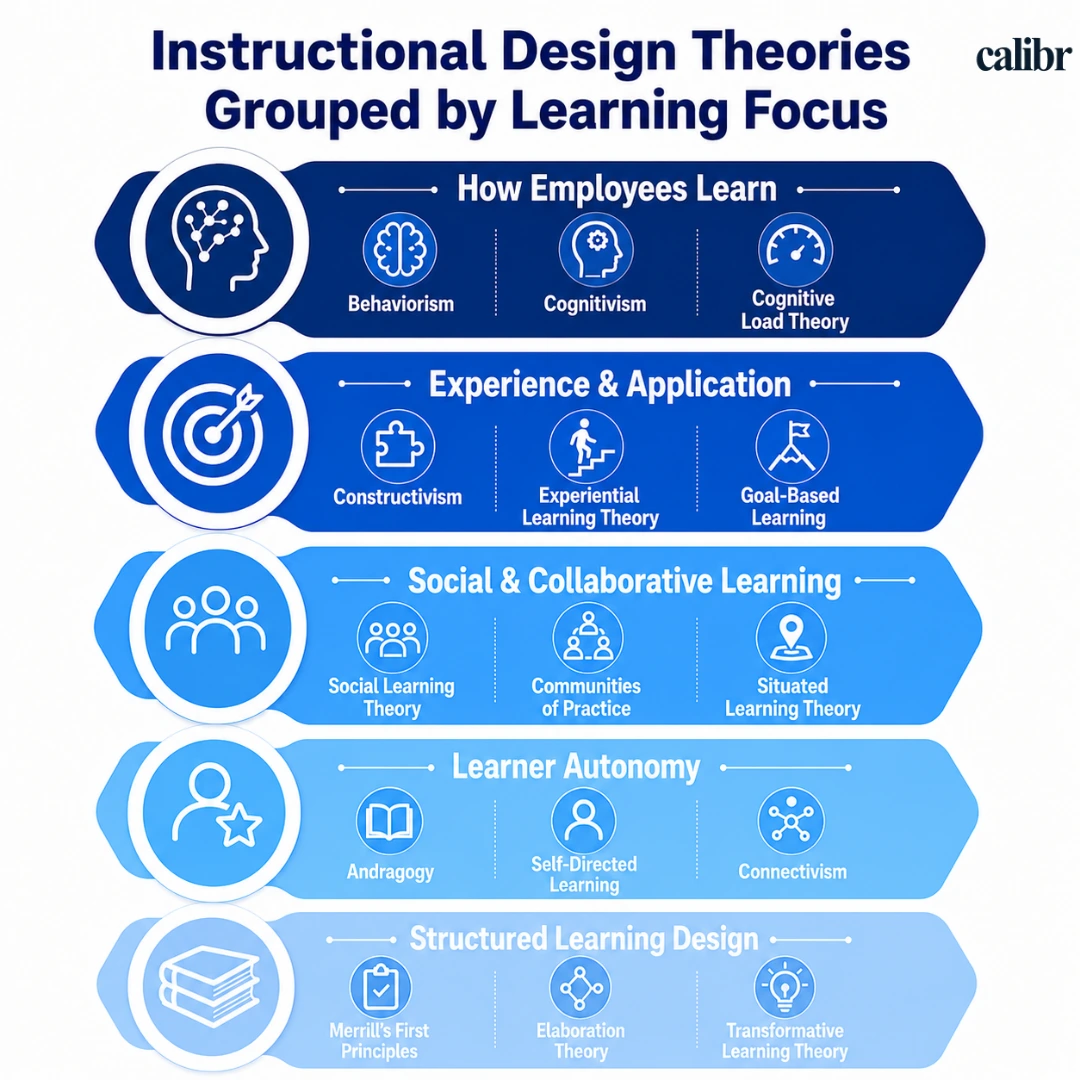
Instructional design theories have evolved significantly alongside modern workplace learning. While the core principles of how people learn still remain relevant, organizations today are applying these theories in more practical, flexible, and employee-centered ways.
Instead of viewing each theory separately, modern workplace learning increasingly combines multiple instructional design theories to support:
microlearning
workflow learning
collaborative learning
personalized learning journeys
real-world skill application
The following instructional design theories below are grouped based on how they influence modern employee learning experiences today.
Theories That Focus on How Employees Learn
Some instructional design theories focus on one core question: How do people actually process and retain information?
This is where theories like Behaviorism, Cognitivism, and Cognitive Load Theory continue to shape modern workplace learning.
1) Behaviorism
Behaviorism introduced the idea that reinforcement improves learning. In corporate learning today, this still appears through:
quizzes
streaks
badges
progress tracking
repetition-based compliance learning
However, workplace learning has moved beyond repetitive "click-next" training experiences. Employees increasingly expect learning to be relevant, engaging, and directly connected to their work.
As a result, organizations are using behavioral principles in more sophisticated ways, such as real-time feedback, personalized nudges, recognition mechanisms, and milestone-based progression.
The evolution of behaviorism in workplace learning can be seen in how reinforcement strategies have shifted over time:
Then | Now |
Learning relied heavily on repetition and drills. | Learning uses gamification, nudges, and milestone-based progression. |
Rewards focused on course completion. | Recognition focuses on skill development and application. |
Feedback was typically provided after assessments. | Feedback is delivered continuously throughout the learning journey. |
2) Cognitivism
Cognitivism shifted the focus toward how the brain processes information. This became even more important in modern workplaces where employees constantly deal with:
Slack notifications
meetings
dashboards
emails
AI-generated information
continuous multitasking
Employees are not struggling because they dislike learning. They are struggling because they are overloaded. Microsoft's Work Trend Index found that employees spend nearly 60% of their workday on emails, meetings, and chats, while Deloitte's Human Capital Trends research highlights the growing need to adapt quickly to constant workplace change.
Together, these trends create significant cognitive demands, making it harder for employees to focus, retain information, and engage with traditional learning experiences.
3) Cognitive Load Theory
Cognitive Load Theory has become one of the most relevant instructional design theories today. Employees can no longer absorb large amounts of information through long, dense training formats.
This shift explains why modern LMS and LXP platforms increasingly prioritize:
microlearning
chunked content
shorter modules
visual learning
structured learning paths
spaced learning experiences
Modern instructional design is no longer just about delivering information. It is about reducing learning friction.
For example, AI-Powered learning platforms like Calibr reduce cognitive load by delivering learning in smaller, role-relevant formats rather than overwhelming employees with lengthy courses. Employees can access bite-sized learning journeys, curated content, and contextual recommendations that make learning easier to consume within the flow of work.
A short workflow-based module often creates better retention than a long mandatory course because it aligns with how employees consume information in modern workplaces
This highlights the core principle of Cognitive Load Theory: effective learning is not about delivering more information but about making information easier to process.
Theories That Focus on Experience and Application
Another major group of instructional design theories focuses on a different idea:
People learn better through experience than passive content consumption.
This is where Constructivism, Experiential Learning Theory, and Goal-Based Learning become highly relevant in modern workplace learning.
4) Constructivism
Constructivism argues that employees build knowledge through experience and interpretation rather than simply absorbing information.
In today's workplace, employees want learning that helps them solve real problems, making simulations, scenarios, and project-based learning increasingly important.
The application of constructivist principles has evolved alongside workplace learning:
Then | Now |
Instructor-led case studies | Interactive simulations and scenarios |
Standardized learning activities | Role-specific learning experiences |
Learning happened mainly during training | Learning happens while solving workplace challenges |
5) Experiential Learning Theory
Experiential Learning Theory strengthens this further by emphasizing learning through action, reflection, and real-world application.
For example:
A sales employee will learn negotiation skills faster through:
mock client conversations
objection-handling simulations
peer feedback
than through slides explaining negotiation theory.
6) Goal-Based Learning
Goal-Based Learning focuses on meaningful outcomes. Employees engage more deeply when they understand what skill they are building, why it matters, and how it supports their growth.
This is why modern LMS and LXP platforms increasingly connect learning with skills, career goals, and capability development.
"Employees rarely ask for more training content. They ask for faster ways to perform better."
This shift toward outcome-driven learning is one of the biggest changes shaping modern workplace learning today.
Theories That Focus on Social and Collaborative Learning
Workplace learning has become increasingly collaborative.
Employees now learn through:
peers
communities
Slack channels
internal discussions
collaborative workflows
AI-assisted conversations
This evolution strongly connects with Social Learning Theory, Communities of Practice, and Situated Learning Theory.
7) Social Learning Theory
Social Learning Theory introduced the idea that people learn by observing others. Today, employees often learn as much from colleagues, peer discussions, and shared problem-solving as they do from formal training.
According to LinkedIn's Workplace Learning research, organizations that prioritize continuous learning often see stronger employee retention and internal mobility. As a result, many organizations are embedding collaborative learning directly into everyday work through modern LXP platforms.
What has evolved is the reach and accessibility of social learning.
Then | Now |
Learning was limited to immediate teams and physical workplaces. | Learning happens across departments, locations, and digital communities. |
Knowledge sharing relied on scheduled interactions. | Knowledge sharing happens continuously through collaborative platforms. |
Access to expertise was often limited. | Employees can easily connect with experts across the organization. |
8) Communities of Practice
Communities of Practice extend this idea further by showing how learning naturally develops inside groups with shared expertise.
Modern workplace learning is increasingly community-driven because employee's trust:
real experiences
peer insights
workflow knowledge
more than static training content.
9) Situated Learning Theory
Situated Learning Theory also matters here because it emphasizes that employee learning becomes more effective when it happens in real work contexts.
That is why modern organizations increasingly focus on:
workflow learning
contextual learning
embedded learning support
in-the-moment guidance
Instead of separating learning from work, companies are trying to integrate learning directly into the flow of work
For example, a customer support employee facing a difficult customer issue can access a short troubleshooting guide or AI-powered recommendation directly within their workflow instead of leaving work to complete a separate training course.
This is one of the biggest reasons AI-powered workplace learning is growing rapidly.
Theories That Focus on Learner Autonomy
Modern employees increasingly want control over how they learn.
This aligns strongly with:
Andragogy
Self-Directed Learning
Connectivism
10) Andragogy
Andragogy explains that adult learners are self-directed and relevance-driven. Employees want learning experiences that:
feel personalized
connect with their goals
fit their schedules
support career growth
This is why traditional "one-size-fits-all" training continues to lose effectiveness.
Modern learning platforms support these adult learning preferences by offering personalized learning paths, flexible access to content, skill-based recommendations, and opportunities for employees to choose learning experiences that align with their individual goals and career aspirations.
11) Self-Directed Learning
Self-Directed Learning has become even more relevant in the AI era because employees now learn independently through:
search engines
AI assistants
online communities
internal knowledge bases
digital learning platforms
According to the World Economic Forum Future of Jobs Report, continuous upskilling and reskilling are becoming critical as workplaces rapidly evolve through technology and changing skill demands.
This shift is one reason modern workplace learning increasingly focuses on learner-driven development, flexible learning access, and continuous skill growth.
12) Connectivism
Meanwhile, Connectivism reflects the reality that learning increasingly happens across connected digital networks rather than through a single source of knowledge.
Employees today learn through:
curated content
AI recommendations
collaborative platforms
external communities
shared digital knowledge ecosystems
As a result, modern learning platforms are helping employees discover knowledge more efficiently across multiple sources. For example, platforms like Calibr bring together learning content, skill development opportunities, and relevant resources in one connected experience, making it easier for employees to learn continuously as needs arise.
The growth of digital networks and AI has fundamentally changed how employees' access and apply knowledge.
Then | Now |
Learning primarily came from trainers, courses, and learning materials. | Learning comes from AI tools, digital platforms, communities, and knowledge networks. |
Information was accessed through a limited number of sources. | Employees can access knowledge from multiple connected sources in real time. |
Learning focused on acquiring information. | Learning focuses on finding, evaluating, and applying information quickly. |
Knowledge was often stored in separate systems and repositories. | Knowledge is increasingly connected, searchable, and integrated across platforms. |
Theories That Focus on Structured Learning Design
Even though workplace learning is becoming more flexible, structure still matters.
This is where:
Merrill’s First Principles
Elaboration Theory
Transformative Learning Theory
continue to shape instructional design.
13) Merrill’s First Principles
Merrill’s framework emphasizes that learning becomes more effective when employees:
solve real problems
apply knowledge immediately
connect learning with real performance
14) Elaboration Theory
Elaboration Theory focuses on progressive learning — starting simple and gradually increasing complexity.
This is highly relevant in modern onboarding and capability-building programs where employees need:
structured progression
guided learning
gradual skill development
15) Transformative Learning Theory
Transformative Learning goes even deeper by focusing on mindset shifts rather than just knowledge transfer.
This is becoming increasingly important because organizations now need employees who can:
adapt quickly
rethink assumptions
navigate uncertainty
work alongside AI systems
Modern workplace learning is therefore balancing two important needs:
flexibility
structured capability development
The goal is no longer just content completion. It is a meaningful skill transformation.
The Challenges of Applying Modern Instructional Design in Workplace Learning
Despite the benefits of modern learning approaches, organizations still face several instructional design challenges when applying these theories effectively in workplace learning.
Challenge | Why It Matters | Example |
Microlearning Cannot Replace Deep Learning | Complex skills require practice and reflection. | Leadership skills cannot be developed through short videos alone. |
Too Much Personalization Can Fragment Learning | Employees may overlook broader capabilities. | An employee may focus only on role-specific courses while ignoring leadership development. |
AI-Powered Learning Still Requires Human Context | Technology cannot replace coaching and feedback. | AI can recommend content, but managers and peers help turn learning into performance. |
These instructional design challenges highlight the need to balance technology, learning science, and human support when designing modern learning experiences.
The 5 Layers of Modern Instructional Design
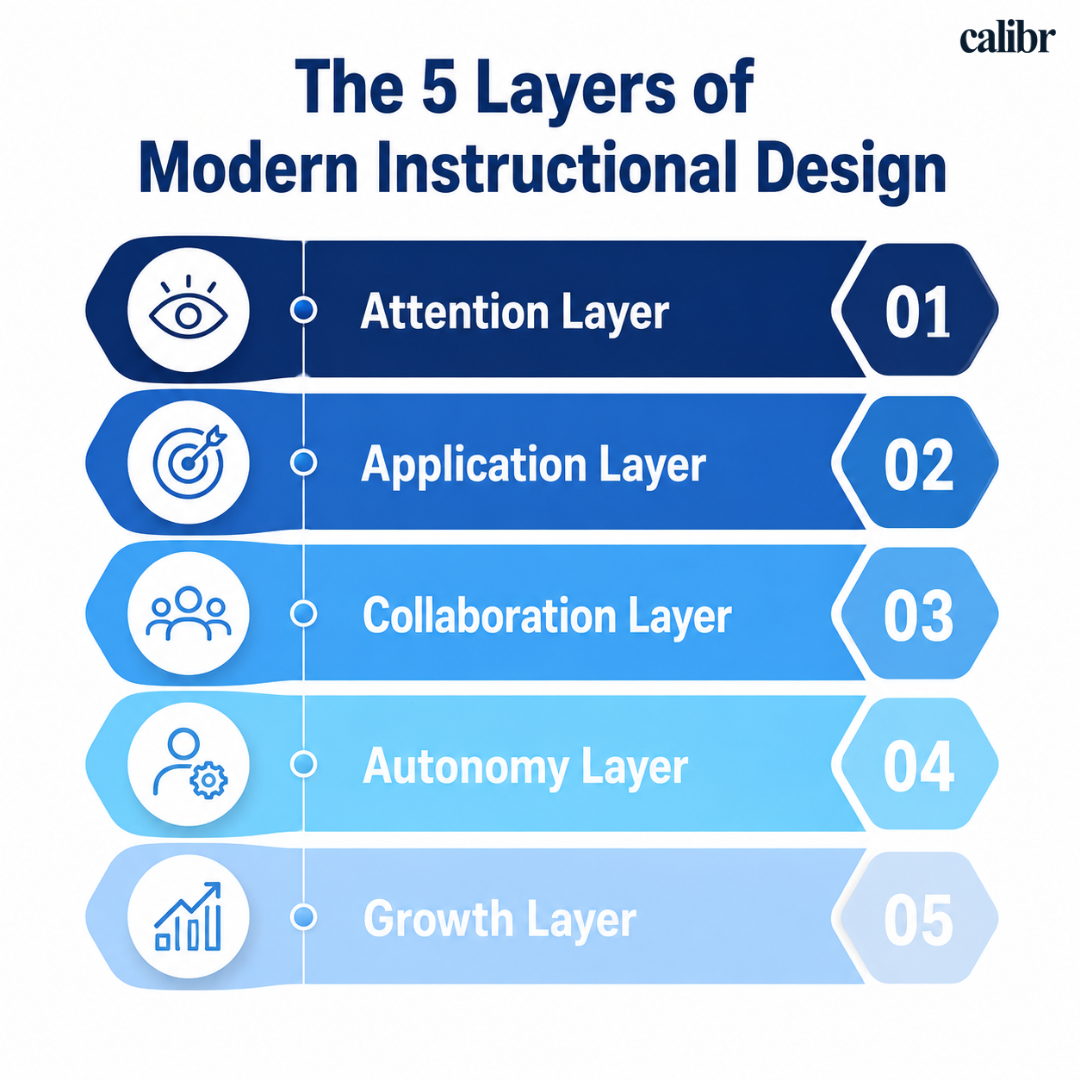
Modern workplace learning is no longer built around a single instructional design theory. Employees today learn differently based on their role, workload, goals, and work environment. That is why organizations increasingly combine multiple learning theories to create more adaptive and learner-centered experiences.
Layer | What Employees Need | Relevant Theories | How It Applies in Modern Learning |
Attention Layer | Short, easy-to-retain learning | Cognitive Load Theory, Cognitivism | Supports microlearning, chunked content, and shorter modules. |
Application Layer | Practical, real-world learning | Constructivism, Experiential Learning, Goal-Based Learning | Uses simulations, projects, and scenario-based learning. |
Collaboration Layer | Peer learning and knowledge sharing | Social Learning Theory, Communities of Practice, Situated Learning | Encourages mentoring, discussions, and workflow learning. |
Autonomy Layer | Personalized and self-directed learning | Andragogy, Self-Directed Learning, Connectivism | Enables adaptive learning paths and learner-driven development. |
Growth Layer | Structured long-term skill development | Merrill’s First Principles, Elaboration Theory, Transformative Learning | Builds progressive learning journeys and deeper capability growth. |
Modern instructional design is no longer about choosing one theory. It is about combining multiple theories to match how employees actually learn today.
Organizations that successfully combine this instructional design layers are far more likely to create learning experiences that improve engagement, retention, and real-world skill application.
Frequently Asked Questions (FAQs)
Why are instructional design theories still important in workplace learning?
Instructional design theories help organizations create learning experiences that improve engagement, retention, and practical skill application. Even though workplace learning has evolved, employees still learn better when content is relevant, structured, interactive, and connected to real work situations.
Which instructional design theories are most relevant in modern workplace learning?
Some of the most relevant theories today include Cognitive Load Theory, Constructivism, Social Learning Theory, Andragogy, Connectivism, and Experiential Learning. These theories support modern learning approaches such as microlearning, workflow learning, collaborative learning, and personalized learning journeys.
How has workplace learning changed in modern organizations?
Modern workplace learning has become shorter, more flexible, and integrated into daily work. Employees now learn through workflow interactions, AI tools, peer collaboration, short videos, knowledge-sharing platforms, and personalized learning experiences instead of relying only on long traditional training programs.
Why is microlearning becoming more common in workplace learning?
Microlearning helps employees consume and retain information more effectively without cognitive overload. It aligns strongly with Cognitive Load Theory by delivering shorter, easier-to-process learning experiences that fit naturally into busy workflows and modern employee attention spans.
How do modern LMS and LXP platforms apply instructional design theories?
Modern LMS and LXP platforms apply instructional design theories through personalized learning journeys, adaptive recommendations, collaborative learning spaces, workflow-based learning, skill-focused development, and contextual learning experiences designed around how employees actually learn today.
Final Thoughts
The evolution of workplace learning is not about replacing traditional instructional design theories. It is about adapting them to fit the realities of how employees learn today.
The most effective learning experiences combine multiple theories rather than relying on a single approach. Employees need content that is easy to access, opportunities to apply knowledge, support from peers and managers, the flexibility to learn independently, and structured pathways for long-term growth.
As organizations navigate AI, rapid skill shifts, and changing employee expectations, the question is no longer which instructional design theory works best. The real challenge is knowing how to combine these theories to create learning experiences that drive both employee development and business performance.
Organizations that get this balance right will be better positioned to build adaptable, capable, and future-ready workforces.
At Calibr, workplace learning is built around personalized learning journeys, workflow-based experiences, and skill focused development aligned with the realities of modern work.
Ready to build workplace learning experiences employees actually engage with?
Contact our team for more details or queries
Schedule a Demo to get started


Vivetha is a digital marketing professional specializing in content marketing and SEO. She focuses on developing optimized, high-quality content that improves search visibility, supports brand objectives, and drives measurable results. With a structured and analytical approach, she ensures content aligns with business and audience needs.