
The Problem Most Organizations Don’t Realize They Have
A senior employee resigns.
Suddenly, simple questions become difficult to answer. Processes nobody documented start breaking. Teams waste hours searching through old emails and Slack threads trying to figure out why decisions were made. Meetings multiply because nobody is fully sure where information lives anymore.
Technically, the organization did not lose only an employee.
It lost knowledge.
This happens more often than companies admit. Many organizations assume knowledge naturally spreads through teams over time. In reality, knowledge frequently stays trapped:
inside individuals
inside departments
inside outdated systems
inside conversations that were never documented
The result is slower execution, repeated mistakes, weaker onboarding, and teams constantly reinventing solutions that already exist somewhere else in the organization.
Many businesses do not have a talent problem.
They have a knowledge-sharing problem.
What Is Knowledge Sharing and Why Is It Important?

Knowledge sharing is the process of exchanging information, skills, insights, and experiences so others can learn from them and apply that knowledge in their work. It ensures that valuable expertise is not limited to individuals but becomes accessible across teams and the organization.
In practice, knowledge sharing happens every day through activities such as:
A senior employee explaining how they solved a complex client issue
A project team documenting lessons learned after a product launch
Customer support agents sharing solutions to recurring problems
Managers mentoring employees through real workplace challenges
Teams recording decisions and the reasons behind them
The importance of knowledge sharing becomes clear when organizations grow and work becomes more complex. Without effective knowledge sharing, employees often:
Repeat mistakes that others have already encountered
Spend time searching for information
Duplicate work across teams
Struggle during onboarding and project handovers
Strong knowledge-sharing practices help organizations:
Improve collaboration across departments
Accelerate employee learning and onboarding
Preserve critical organizational knowledge
Support faster and better decision making
Increase productivity and operational efficiency
In today's hybrid, remote, and AI-driven workplaces, the importance of knowledge sharing continues to grow.
Organizations that make knowledge easy to find, share, and apply are often better equipped to adapt, innovate, and perform at a higher level.
Knowledge Sharing Examples in Modern Teams
Knowledge sharing can take many forms in the workplace. It may happen when teams onboard new employees, document lessons learned from failed projects, share customer insights across departments, mentor colleagues, support project handovers, or create resources that help employees solve problems faster.
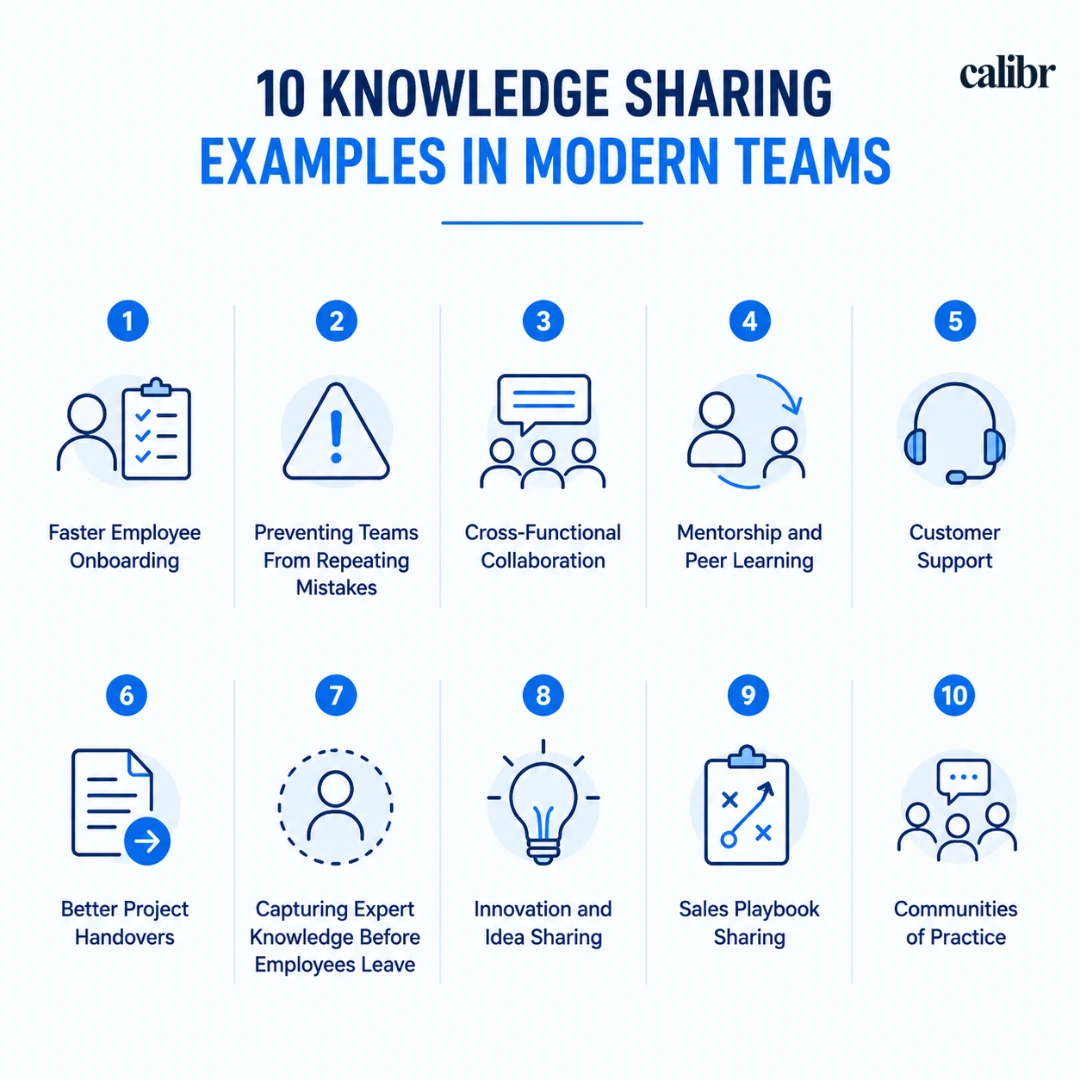
The following examples show how knowledge sharing works in practice and the value it can create for organizations.
1) Faster Employee Onboarding
When a new employee joins a team, finding the right information can be overwhelming. High-performing organizations make onboarding easier by providing:
Short workflow walkthrough videos
Searchable project summaries
Examples of past decisions and outcomes
Frequently asked questions
Recordings of customer conversations
Instead of spending weeks searching for information, new employees can understand how work gets done and start contributing more quickly. The result is not just faster onboarding—it is faster confidence and productivity.
2) Preventing Teams From Repeating Mistakes
A marketing campaign underperforms because the messaging does not resonate with customers. Rather than moving on and forgetting the experience, the team documents:
What went wrong
Why it happened
Customer feedback and insights
Recommendations for future campaigns
Months later, another team facing a similar challenge can learn from those lessons and avoid making the same mistakes. High performing organizations treat failures as learning opportunities, not hidden experiences.
3) Cross-Functional Collaboration
Sales teams often hear customer feedback that product teams never see. To close this gap, organizations create shared spaces where teams can document:
Customer objections
Feature requests
Recurring complaints
Market insights
Making this information visible across departments improves alignment, helps teams prioritize the right initiatives, and leads to better decision making.
4) Mentorship and Peer Learning
An experienced manager notices that junior employees struggle with stakeholder communication and decision making.
Instead of waiting for formal training programs, they organize monthly discussions where employees review real workplace situations and share lessons learned.
These conversations help employees learn from practical experience, build confidence, and develop skills that are difficult to teach through traditional training alone.
5) Customer Support
Support teams often solve the same issues repeatedly. Instead of relying on individual experience, one organization created a centralized knowledge system that included:
Short troubleshooting videos
Searchable support articles and snippets
Tagged summaries of recurring issues
AI-powered knowledge retrieval tools
As a result, support agents could find answers faster, resolve customer issues more efficiently, and reduce ticket resolution times.
The key improvement was not creating more content—it was making existing knowledge easier to access and use during everyday work.
6) Better Project Handovers
Many project handovers fail because teams transfer responsibilities without explaining the context behind them. As a result, the incoming team may understand what needs to be done but not why certain decisions were made.
Effective project handovers include:
The reasoning behind key decisions
Lessons learned during the project
Known risks and unresolved issues
Stakeholder expectations and concerns
Important communication and project history
By sharing both tasks and context, teams can ensure smoother transitions, reduce confusion, and maintain project momentum. Without context, critical knowledge is often lost, leading to delays, repeated mistakes, and unnecessary rework.
7) Capturing Expert Knowledge Before Employees Leave
When experienced employees resign or retire, organizations often lose years of valuable knowledge. To prevent this, some companies conduct structured knowledge transfer sessions before an employee leaves.
These sessions may include:
Key processes and best practices
Lessons learned from past projects
Important stakeholder relationships
Frequently encountered challenges
Practical tips for successors
This helps preserve critical expertise and reduces disruption during transitions.
8) Innovation and Idea Sharing
Many innovative ideas never move beyond individual teams because they are not shared across the organization. High-performing companies create channels where employees can contribute:
Process improvement ideas
Customer insights
Product suggestions
Lessons from experiments
Emerging market observations
Sharing ideas openly helps organizations learn faster and uncover opportunities that might otherwise go unnoticed.
9) Sales Playbook Sharing
Top sales performers often develop effective techniques that other team members never learn. To spread successful practices, organizations document and share:
Winning sales approaches
Successful objection-handling techniques
Customer conversation examples
Competitive insights
Best-performing outreach strategies
This enables new and existing sales representatives to learn from proven experiences rather than relying solely on trial and error.
10) Communities of Practice
Employees performing similar roles across different departments often face the same challenges. Some organizations create communities where professionals regularly share:
Industry trends
Best practices
Common challenges
Useful resources
Lessons learned from recent projects
These communities help employees learn from one another, build expertise, and reduce duplication of effort across teams.
5 Quick Knowledge Sharing Strategies for Organizations
The most effective knowledge sharing strategies are often lightweight, practical, and integrated into everyday work.
Rather than creating complex systems, organizations should focus on making knowledge easy to capture, access, share, and apply when employees need it most.
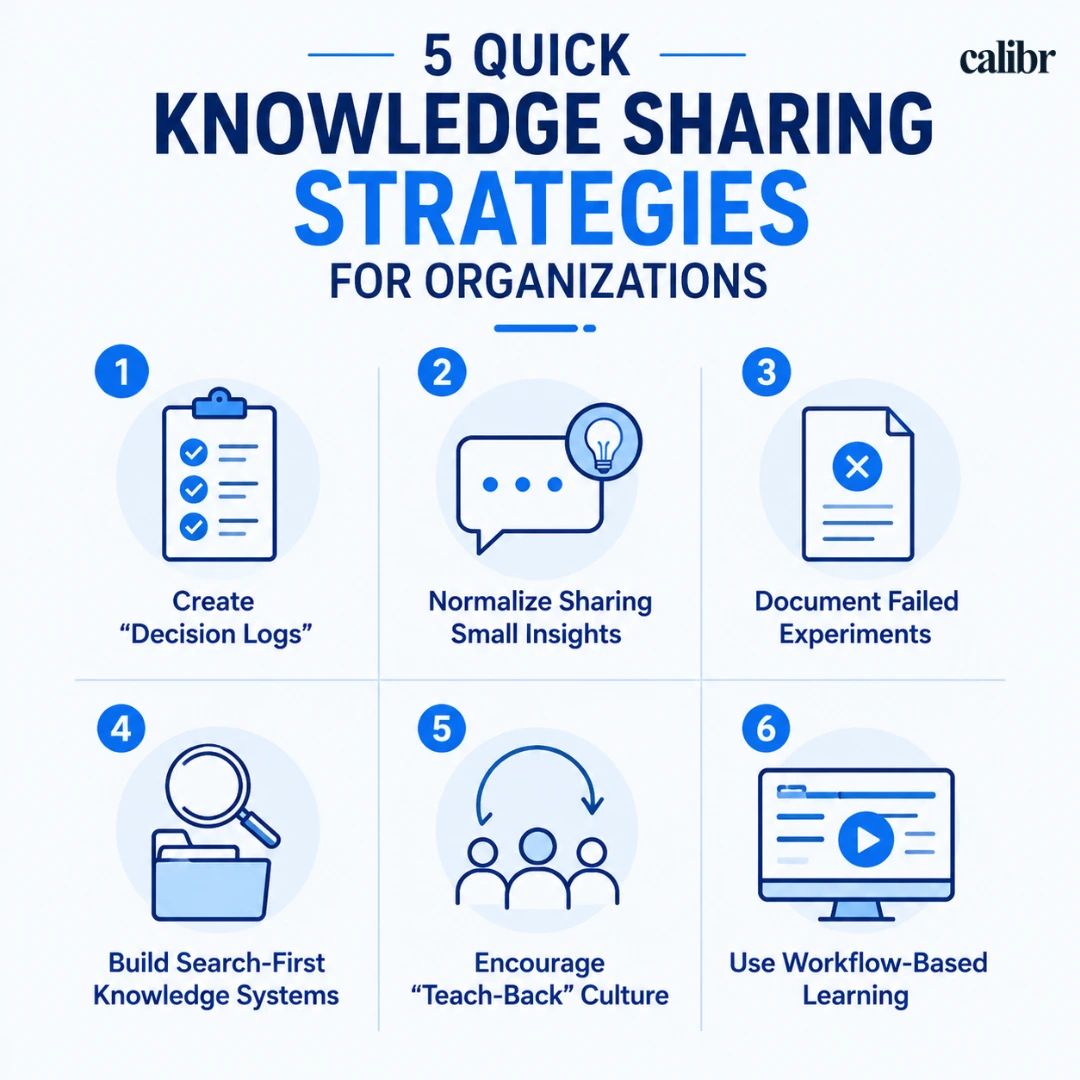
1) Create “Decision Logs”
Instead of only documenting final decisions, document:
why the decision was made
alternatives considered
risks discussed
This preserves valuable organizational context.
2) Normalize Sharing Small Insights
Not every useful insight deserves a 20-page document.
Encourage:
short summaries
quick recordings
project reflections
mini knowledge updates
Small, consistent sharing often works better than large formal documentation efforts.
3) Document Failed Experiments
Many organizations only share successes.
But failed experiments often contain the most valuable learning opportunities.
Teams improve faster when mistakes become searchable learning assets instead of hidden experiences.
4) Build Search-First Knowledge Systems
Employees should not need five tools and three meetings to find simple answers.
Modern knowledge sharing systems should prioritize:
accessibility
searchability
relevance
workflow integration
5) Encourage “Teach-Back” Culture
One of the best ways to reinforce learning is asking employees to teach concepts back to others.
This:
improves retention
spreads knowledge organically
exposes understanding gaps
encourages collaborative learning
6) Use Workflow-Based Learning
Knowledge sharing becomes far more effective when it happens during work instead of outside work.
Examples:
in-app guidance
searchable SOPs
contextual prompts
embedded documentation
workflow walkthroughs
The closer knowledge appears to the moment of need, the more useful it becomes.
A Simple Knowledge Sharing Framework for Modern Workplaces
The examples above may look different, but most successful knowledge-sharing initiatives follow a few common principles.
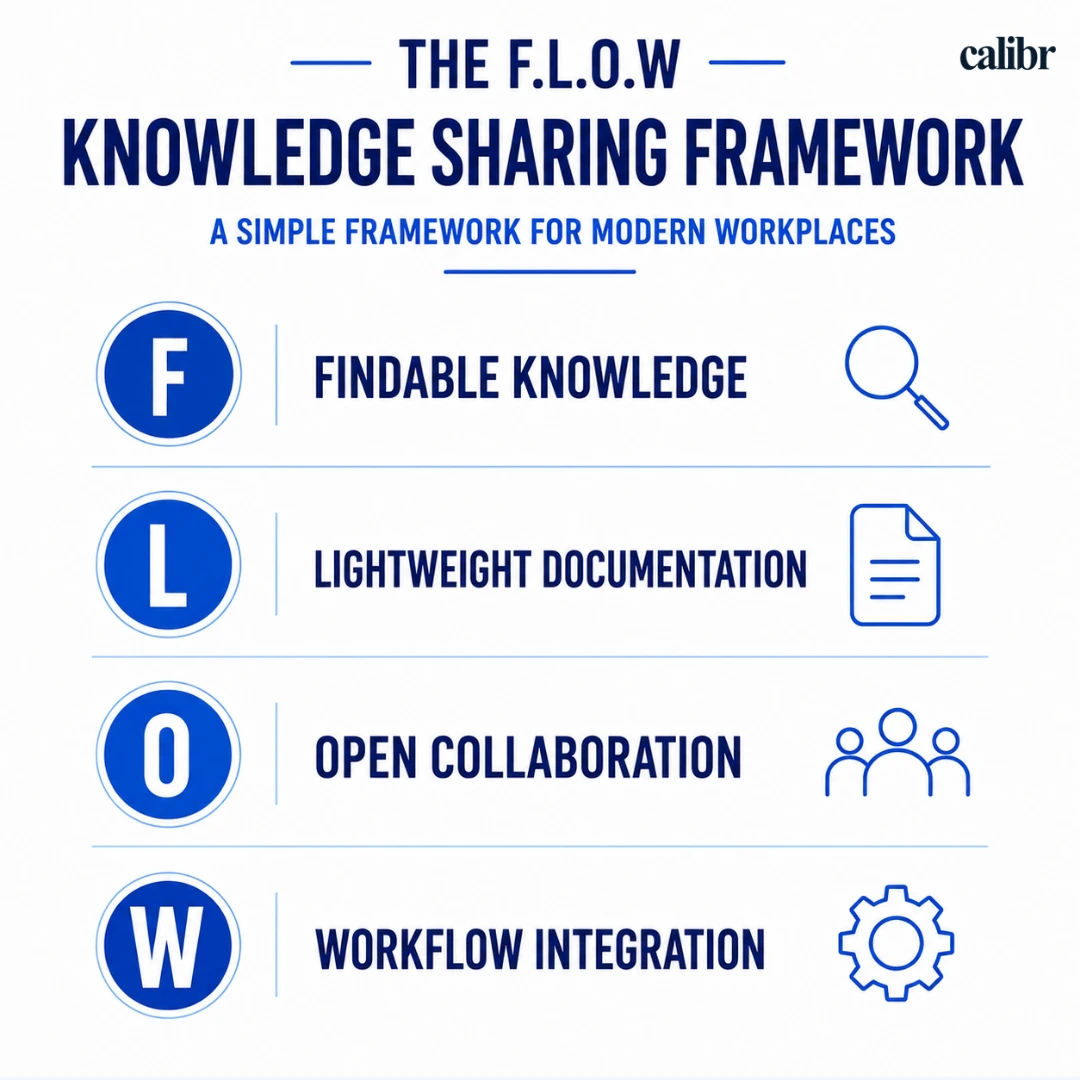
The F.L.O.W Knowledge Sharing Framework provides a simple way to understand what makes knowledge sharing effective across teams and organizations.
Element | Meaning | In Practice |
|---|---|---|
F | Findable Knowledge | Employees can quickly locate the information they need. |
L | Lightweight Documentation | Knowledge is documented in a simple, practical format. |
O | Open Collaboration | Teams openly share insights and expertise across functions. |
W | Workflow Integration | Knowledge is accessible within the flow of daily work. |
Whether it is onboarding, project handovers, customer support, or mentorship, effective knowledge sharing is typically easy to find, simple to document, openly shared, and integrated into everyday workflows.
Frequently Asked Questions (FAQs)
What is knowledge sharing?
Knowledge sharing is the process of exchanging information, expertise, insights, and experiences across individuals or teams so others can learn and apply that knowledge effectively.What is knowledge sharing?
Why is knowledge sharing important?
Knowledge sharing improves collaboration, reduces repeated mistakes, accelerates onboarding, strengthens decision-making, and prevents valuable expertise from disappearing when employees leave.
What are examples of knowledge sharing in the workplace?
Examples include mentorship, project handovers, shared documentation, onboarding walkthroughs, searchable knowledge bases, cross-functional collaboration, and internal learning sessions.
Why do employees avoid sharing knowledge?
Employees may avoid sharing knowledge because of time pressure, poor systems, lack of incentives, information overload, or fear that sharing expertise reduces their value.
How can organizations improve knowledge sharing?
Organizations can improve knowledge sharing by simplifying documentation, improving searchability, encouraging collaboration, documenting lessons learned, and integrating learning into everyday workflows.
Final Thoughts
Organizations do not become smarter simply because they hire talented people.
They become smarter when knowledge stops living only inside individuals and starts becoming part of how the organization operates every day.
The companies building resilient, high-performing teams today are not necessarily the ones creating the most content.
They are the ones making useful knowledge easier to find, easier to share, and easier to apply in moments that actually matter.
Because in modern workplaces, knowledge has value only when it moves.
Effective knowledge sharing requires more than documentation. It requires systems that make knowledge easy to create, discover, share, and apply during everyday work. Platforms like Calibr help organizations capture expertise, streamline onboarding, support collaborative learning, and make valuable knowledge accessible across teams.
Ready to build a stronger knowledge-sharing culture? Sign up for free or contact us to see how Calibr can help your teams learn, collaborate, and perform better.


Vivetha is a digital marketing professional specializing in content marketing and SEO. She focuses on developing optimized, high-quality content that improves search visibility, supports brand objectives, and drives measurable results. With a structured and analytical approach, she ensures content aligns with business and audience needs.