
SFIA (Skills Framework for the Information Age) is a globally recognized framework that helps organizations define, assess, and develop workforce skills using a common language.
Unlike traditional job-title-based approaches, SFIA focuses on actual skills and responsibilities, making workforce planning, recruitment, and career development more effective.
The framework includes seven levels of responsibility, ranging from entry-level contributors to senior leaders who define strategy and drive organizational transformation.
Organizations use SFIA to identify skill gaps, align learning initiatives, support internal mobility, improve hiring decisions, and strengthen workforce readiness.
As a leading digital skills framework, SFIA helps organizations build agile, future-ready workforces by connecting skills development with business goals and long-term capability planning.
Introduction: Why Skills Matter More Than Job Titles
As technology, business priorities, and workforce needs continue to evolve, organizations are placing greater emphasis on skills rather than job titles alone. Traditional role descriptions often fail to provide a clear picture of an employee's actual capabilities, making it difficult to identify skill gaps and plan workforce development effectively.
The SFIA Skills Framework addresses this challenge by providing a structured approach to defining, assessing, and developing professional skills. As a globally recognized Digital Skills Framework, SFIA helps organizations build a more agile, capable, and future-ready workforce.
What Is the SFIA Skills Framework?
The Skills Framework for the Information Age (SFIA) is a globally recognized framework used to define and manage professional skills and competencies. Developed and maintained by the SFIA Foundation, SFIA provides a common language for skills, responsibilities, and career development.
Rather than focusing on job titles, SFIA focuses on what people actually do and the level at which they perform those activities.
The framework helps organizations:
Define roles more accurately
Assess workforce capabilities
Identify skill gaps
Support learning and development initiatives
Improve workforce planning
Enable career progression
Today, SFIA is used by organizations across industries, including technology, finance, healthcare, education, telecommunications, government, and consulting.
Core Components of SFIA
Component | Purpose |
|---|---|
Skills | Defines professional capabilities |
Levels of Responsibility | Measures proficiency and accountability |
Categories | Groups related skills together |
Attributes | Evaluates autonomy, influence, complexity, and business skills |
The framework provides a structured foundation for organizations seeking a consistent and scalable approach to workforce capability management.
Who Is the SFIA Skills Framework For?
One of the strengths of SFIA is its flexibility. It can support multiple stakeholders across an organization.
HR professionals use SFIA to define job roles, support recruitment, and create clear career pathways. The framework provides greater consistency in talent management processes.
L&D teams can align training initiatives with actual business skill requirements, ensuring learning investments target the most important skill and capability gaps.
Executives and department leaders gain visibility into workforce strengths, risks, and future capability needs.
Managers can assess team capabilities, support employee development, and identify potential successors for critical roles.
Employees can benefit from clearer career progression pathways, skill expectations, and development opportunities.
Understanding the SFIA Framework in Depth
At its core, the SFIA framework answers two simple but important questions:
What skills does a person need to perform their role effectively?
At what level of responsibility are they expected to perform those skills?
Unlike traditional competency frameworks that focus heavily on job titles, SFIA focuses on the combination of skills and responsibility. This allows organizations to assess not just what employees know, but how they apply that knowledge in real-world situations.
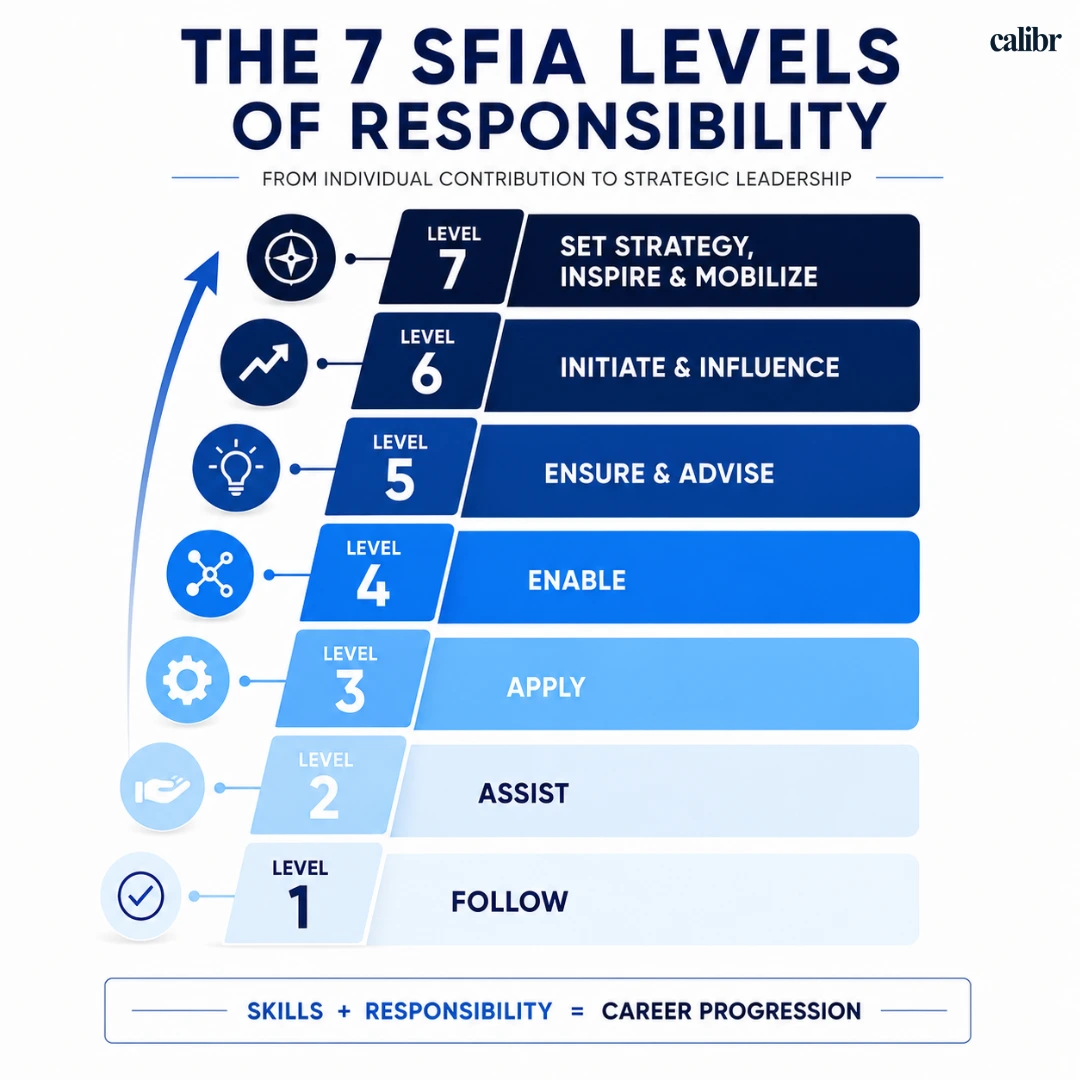
Think of SFIA as a career progression roadmap. As employees gain experience, their responsibilities, influence, and decision making authority increase. The framework captures this progression through seven levels of responsibility.
The Seven SFIA Levels of Responsibility
Each level of responsibility represents a different stage of professional growth, from performing basic tasks under supervision to shaping organizational strategy and leading large-scale transformation.
SFIA Level | What It Means in Simple Terms |
|---|---|
Level 1 – Follow | Learns and follows instructions while working under close supervision. |
Level 2 – Assist | Supports team activities and completes routine tasks with some guidance. |
Level 3 – Apply | Works independently on assigned tasks and applies professional knowledge effectively. |
Level 4 – Enable | Takes ownership of work, collaborates with others, and helps guide decisions. |
Level 5 – Ensure & Advise | Leads initiatives, provides expert advice, and influences outcomes across teams. |
Level 6 – Initiate & Influence | Drives major projects, shapes strategy, and influences business decisions. |
Level 7 – Set Strategy, Inspire & Mobilize | Defines organizational direction, inspires change, and leads at the highest level. |
How Responsibility Evolves Across the Levels
Imagine a software professional starting their career.
At Level 1, they may be learning basic programming tasks under supervision.
By Level 3, they can independently develop applications and solve technical problems.
At Level 5, they may lead development teams, mentor colleagues, and advise stakeholders on technology decisions.
At Level 7, they could be defining the organization's technology strategy and driving digital transformation initiatives.
The same progression applies across functions such as cybersecurity, project management, learning and development, and business operations.
The Five Key Responsibility Attributes
While skills define what a person does, responsibility attributes define how they perform those skills. These attributes help organizations determine the appropriate SFIA level for a role or individual.
Attribute | What It Measures |
|---|---|
Autonomy | How independently a person works. |
Influence | The extent to which they impact people, teams, and decisions. |
Complexity | The difficulty and variety of challenges they handle. |
Knowledge | The depth and breadth of expertise required. |
Business Skills | Communication, collaboration, leadership, and professional effectiveness. |
Bringing Skills and Responsibility Together
What makes SFIA particularly valuable is that it combines skills with levels of responsibility. Two employees may have the same skill, but the way they apply it can differ significantly based on their experience and role.
For example, both a junior project coordinator and a senior project director may possess project management skills. However, the coordinator may focus on supporting project activities, while the director oversees large programs, influences stakeholders, and shapes organizational priorities.
This combination of skills and responsibility is what makes SFIA such a powerful framework for workforce planning, career development, and skills-based talent management.
It provides organizations with a clear, consistent way to understand capability levels across the workforce while giving employees a transparent path for professional growth.
Practical Applications: How SFIA Works Across Different Roles
One of the key strengths of SFIA is its ability to connect skills with real-world job roles. By defining the skills and responsibility levels required for different positions, organizations can create clearer career paths, conduct more accurate skill assessments, and better align workforce development efforts with business needs.
The examples below illustrate how SFIA can be applied across different roles.
Software Engineer
Key Skill | Typical SFIA Level |
|---|---|
Programming | Level 3–4 |
Systems Design | Level 4 |
Technical Leadership | Level 5 |
Cybersecurity Analyst
Key Skill | Typical SFIA Level |
|---|---|
Threat Analysis | Level 4 |
Security Operations | Level 4 |
Risk Management | Level 5 |
Learning & Development Manager
Key Skill | Typical SFIA Level |
|---|---|
Learning Design | Level 5 |
Stakeholder Engagement | Level 5 |
Workforce Planning | Level 5 |
These examples show how SFIA can be used to define skill expectations and career progression across different roles. However, the exact skills and SFIA levels may vary depending on the organization's structure, industry, and business requirements.
The examples above are intended to provide a practical understanding of how the framework can be applied in real-world workforce planning and development.
SFIA Skills Framework for Organizations: Key Benefits and Considerations
The SFIA skills framework for organizations helps create a common language for skills, making it easier to manage workforce capabilities, support employee development, and align talent strategies with business goals.
The table below highlights some of the key benefits and considerations of implementing SFIA.
Area | Benefit | Consideration |
|---|---|---|
Workforce Visibility | Better understanding of workforce capabilities. | Requires regular skills assessments. |
Skills Gap Analysis | Identifies current and future skill gaps. | Assessments should be consistent. |
Learning & Development | Aligns training with business needs. | Learning plans need periodic updates. |
Recruitment | Supports skills-based hiring. | Roles must be mapped accurately. |
Internal Mobility | Enables clearer career pathways. | Employees need visibility into skill requirements. |
Digital Transformation | Supports emerging skill development. | Future skills should be reviewed regularly. |
Strategic Planning | Improves workforce readiness. | Requires leadership support. |
While SFIA offers significant benefits, successful implementation depends on regular reviews, accurate assessments, and organizational commitment.
When used effectively, it can help organizations build a more skilled, agile, and future-ready workforce.
Key Takeaways
SFIA provides a globally recognized framework for skills management.
The framework focuses on capabilities rather than job titles.
Seven responsibility levels define increasing expertise and accountability.
Organizations can use SFIA to support workforce planning, learning, and career development.
Understanding how SFIA helps identify skill gaps enables more effective talent decisions.
As a modern Digital Skills Framework, SFIA supports skills-based workforce transformation.
Frequently Asked Questions (FAQs)
What does SFIA stand for?
SFIA stands for Skills Framework for the Information Age.
How many levels are included in SFIA?
SFIA includes seven levels of responsibility, ranging from Follow (Level 1) to Set Strategy, Inspire and Mobilize (Level 7).
Is SFIA only for technology roles?
No. While SFIA originated in technology-related fields, it is now widely used across business, leadership, project management, learning, cybersecurity, and other professional disciplines.
How to use SFIA for workforce development?
Organizations can use SFIA by mapping roles to skills, assessing workforce capabilities, identifying gaps, creating development plans, and monitoring progress over time.
How does SFIA help identify skill gaps?
SFIA compares current employee capabilities with desired skill requirements, enabling organizations to identify development priorities and future workforce needs.
Why is SFIA considered a Digital Skills Framework?
SFIA provides a structured approach to defining, assessing, and developing digital and professional skills, making it one of the most widely used frameworks for workforce capability management.
Final Thoughts
As skills become increasingly important in a rapidly changing business landscape, organizations need a structured approach to workforce development and capability building. The SFIA skills framework for organizations provides a practical way to assess skills, identify development needs, and align talent strategies with business goals.
As a globally recognized Digital Skills Framework, SFIA helps organizations create clearer career pathways, support continuous learning, and build a workforce that is prepared for future challenges.
Ready to Build a Skills-Driven Workforce?
Whether you're implementing SFIA for the first time or looking to strengthen your learning and development strategy, the right platform can make all the difference. Platforms like Calibr help organizations deliver personalized learning experiences, support continuous upskilling, and align employee development with business goals.
Sign up for a demo or contact our team to discover how Calib can help you turn skill insights into meaningful learning outcomes and workforce growth.


Vivetha is a digital marketing professional specializing in content marketing and SEO. She focuses on developing optimized, high-quality content that improves search visibility, supports brand objectives, and drives measurable results. With a structured and analytical approach, she ensures content aligns with business and audience needs.