Examples of soft skills such as communication, adaptability, emotional intelligence, and teamwork often determine long-term career success more than technical expertise alone.
Strong employee skills help professionals collaborate effectively, build trust, solve problems, and adapt to changing workplace demands.
The growing importance of soft skills means organizations increasingly value these human capabilities alongside technical knowledge.
Developing these skills through practice, coaching, feedback, and soft skill training programs can improve individual performance and strengthen team success.
This guide explores what soft skills are, why they matter, 50+ examples of soft skills, and practical ways to develop them for today's workplace.
Picture a software engineer who writes flawless code, hits every deadline, and understands the product better than almost anyone else on the team. But in meetings, he interrupts colleagues, dismisses feedback he disagrees with, and rarely explains his reasoning to non-technical stakeholders. Over time, teammates stop looping him into early-stage discussions. Good ideas get lost. A talented employee quietly becomes a bottleneck.
This scenario plays out in offices everywhere, and it's a useful reminder that technical mastery alone rarely determines who succeeds at work. Employers today are just as focused on how people work as on what they can produce. That's where examples of soft skills — communication, collaboration, empathy, adaptability, and dozens of others — come into play. Understanding the importance of soft skills isn't just an HR talking point; it's a practical lens for building teams that actually function well under pressure, ambiguity, and change.
In this guide, we'll explore examples of soft skills, why they matter in today's workplace, and practical ways to develop them.
What Are Soft Skills and Why Do They Matter in the Workplace?
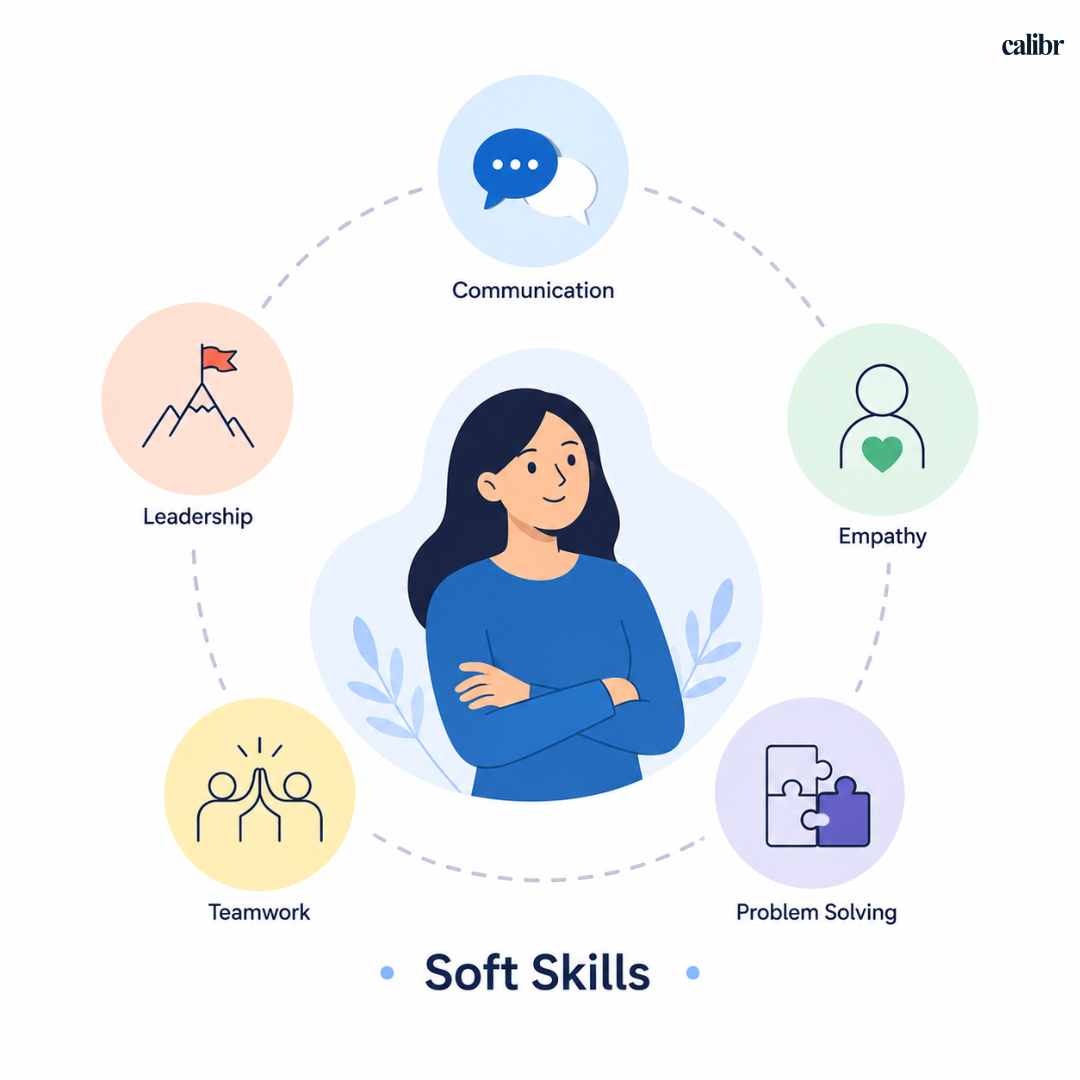
Soft skills are the interpersonal, behavioral, and self-management traits that shape how someone does their job, rather than the technical knowledge required to do it. Communication, teamwork, adaptability, and problem-solving are all soft skills — they apply across nearly every role, industry, and seniority level, unlike hard skills such as coding, accounting, or operating machinery, which are role-specific and teachable through formal instruction.
The importance of soft skills has grown sharply as automation and AI take over more routine, technical tasks. According to LinkedIn, 9 out of 10 global executives agree that soft skills are more important than ever, with communication consistently ranking among the most demanded workplace skills. As machines become better at structured, repeatable work, uniquely human capabilities such as judgment, empathy, persuasion, and creative problem-solving are becoming the true differentiators in the workplace.
This trend is echoed in the World Economic Forum's Future of Jobs Report 2025, which identifies analytical thinking, resilience, leadership, and social influence among the most sought-after skills for the future workforce.
Likewise, SHRM emphasizes that organizations can strengthen these capabilities through coaching, mentoring, continuous feedback, and practical workplace experiences and not just technical instruction. Together, these insights highlight why investing in soft skills is no longer optional but essential for long-term career and organizational success.
Many organizations now include soft skill training programs in employee onboarding and leadership development to strengthen essential employee skills. These programs recognize that soft skills can be taught, practiced, and improved just like technical competencies—they simply require different teaching methods, which we'll explore later in this guide.
50+ Examples of Soft Skills Categorized by Skill Groups
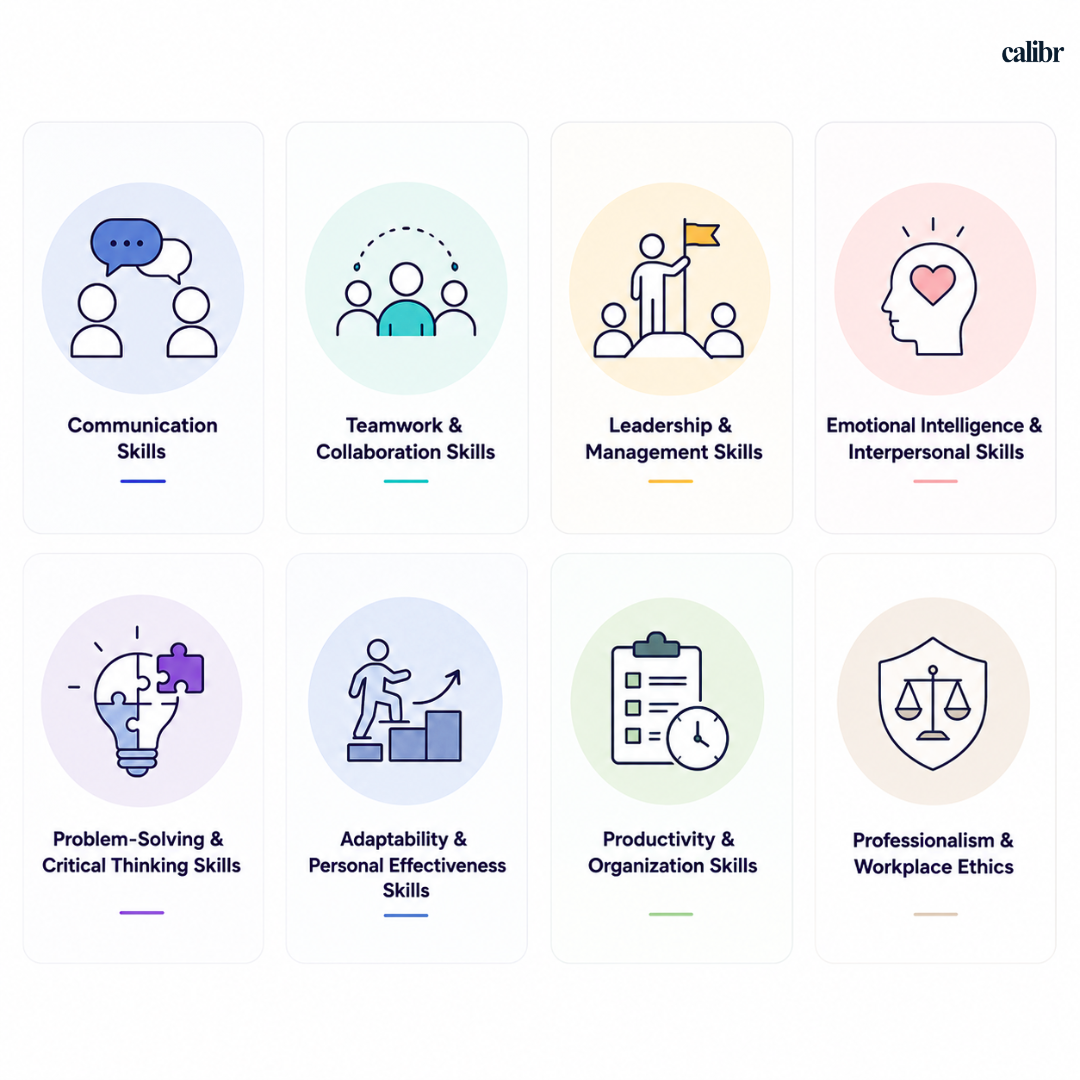
Soft skills cover a wide range of workplace abilities, from communicating effectively and collaborating with teammates to solving problems and leading others. To make them easier to understand, we've grouped these 50+ examples of soft skills into key categories based on how they're applied in professional settings.
1. Communication Skills
The ability to convey information clearly and adjust your message for different audiences, in writing, out loud, and non-verbally. A product manager who can turn a complex technical roadmap into a one-page executive summary — and a detailed technical brief for engineers — is putting this skill to work directly.
Written Communication — conveying ideas clearly and concisely in emails, documents, and reports
Public Speaking — presenting confidently to groups, large or small
Nonverbal Communication — using tone, posture, and body language to reinforce a message
Storytelling — framing information or data in a way that's memorable and persuasive
Presentation Skills — structuring and delivering information for maximum clarity and impact
Active Listening — fully concentrating on and understanding what someone else is saying before responding
Clarity & Conciseness — communicating without unnecessary jargon or filler
2. Collaboration & Teamwork Skills
Working productively within a group, balancing individual contribution with shared goals. A marketing analyst who shares raw campaign data with the design team before being asked — anticipating what they'll need next — is demonstrating strong teamwork.
Collaboration — working effectively with people across teams and working styles
Networking — building and maintaining professional relationships over time
Relationship Building — establishing trust and rapport with colleagues, clients, and partners
Cultural Competence — working effectively across different backgrounds, perspectives, and communication styles
Delegation — assigning tasks appropriately based on team members' strengths
Cross-Functional Coordination — aligning work across departments with different priorities
Cooperation — prioritizing group outcomes alongside individual goals
3. Leadership & Influence Skills
The ability to inspire, guide, and positively influence others toward shared goals, whether or not you hold a formal leadership position. For example, a senior developer who mentors junior teammates and helps the team navigate a major transition demonstrates leadership through actions, not just job title.
Mentoring — sharing knowledge and experience to help others grow
Coaching — guiding someone through developing their own skills and solutions
Motivating Others — inspiring engagement and effort, especially through setbacks
Influence & Persuasion — building buy-in for ideas without relying on authority
Vision Setting — articulating a clear direction others can rally around
Decision Making — evaluating available information and choosing a course of action confidently
Delegation & Empowerment — trusting others with meaningful ownership over their work
4. Emotional Intelligence & Self-Awareness
Awareness of your own emotions and those of others, and the ability to manage both constructively. A team lead who notices a normally engaged employee has gone quiet in meetings and checks in privately — catching early signs of burnout — is applying emotional intelligence in real time.
Empathy — understanding and being responsive to others' feelings and perspectives
Self-Awareness — recognizing your own strengths, blind spots, and emotional triggers
Self-Regulation — managing impulses and reactions, especially under pressure
Patience — staying composed through delays, ambiguity, or repeated setbacks
Humility — acknowledging mistakes and limitations without defensiveness
Confidence — expressing ideas and decisions with appropriate conviction
Interpersonal Sensitivity — reading social and emotional cues accurately
5. Adaptability & Resilience Skills
Adjusting quickly and effectively to new tools, processes, or priorities. When a company switches project management platforms mid-quarter, the employee who learns the new system within days — and starts helping colleagues troubleshoot — is showing adaptability under real conditions.
Flexibility — shifting plans or approaches as circumstances change
Resilience — recovering from setbacks and staying composed under pressure
Stress Management — maintaining performance and clarity during high-pressure periods
Open-Mindedness — considering new ideas or approaches without immediate resistance
Learning Agility — picking up new skills or knowledge quickly when needed
Grit & Perseverance — sustaining effort toward long-term goals despite obstacles
Change Management — helping yourself and others navigate organizational change smoothly
6. Critical Thinking & Problem-Solving Skills
Analyzing information objectively, questioning assumptions, and forming well reasoned judgments. A procurement specialist who questions an unusually low vendor quote — and uncovers hidden fees buried in the fine print — is thinking critically before a costly mistake happens.
Problem Solving — identifying root causes and developing workable solutions
Analytical Thinking — breaking down complex information into clear, logical components
Creativity — generating original ideas and approaching problems from unconventional angles
Innovation — turning creative ideas into practical improvements or new approaches
Curiosity — asking questions and seeking to understand the "why" behind a problem
Strategic Thinking — connecting day-to-day decisions to longer-term goals
Attention to Detail — catching small errors or inconsistencies before they compound
7. Work Ethic & Self-Management Skills
Prioritizing tasks effectively and using time efficiently without sacrificing quality. A designer facing three overlapping deadlines who proactively renegotiates timelines with stakeholders — instead of quietly falling behind on all three — is managing time well under pressure.
Organization — keeping tasks, files, and priorities structured and accessible
Accountability — owning your work, decisions, and mistakes without deflecting blame
Reliability — consistently following through on commitments
Initiative — acting on opportunities or problems without being asked
Prioritization — distinguishing urgent and important work from everything else
Goal Setting — defining clear, achievable objectives and tracking progress toward them
Self-Discipline — staying focused and consistent without constant external oversight
8. Conflict Resolution & Professionalism Skills
Addressing disagreements constructively in ways that preserve working relationships. A project lead who facilitates a conversation between two departments disputing budget ownership — focusing on shared goals instead of blame — is resolving conflict productively.
Diplomacy & Tact — delivering difficult messages without unnecessary friction
Negotiation — reaching agreements that satisfy multiple parties' core needs
Assertiveness — expressing needs or boundaries clearly and respectfully
Professionalism — maintaining composure, courtesy, and reliability in workplace interactions
Giving & Receiving Feedback — offering constructive input and accepting it gracefully
Ethical Judgment — making decisions that hold up under scrutiny, not just convenience
Composure Under Pressure — staying level-headed when conversations or situations get tense
How to Develop Soft Skills
Soft skills aren't built overnight or through theory alone. They develop through consistent practice, real workplace experiences, constructive feedback, and continuous learning. The practical steps below can help employees strengthen these skills and make lasting improvements in their everyday work.
1. Seek Regular Feedback from Colleagues and Managers
Ask for specific feedback after meetings, presentations, or projects instead of waiting for annual performance reviews. Understanding how others perceive your communication, teamwork, or leadership helps identify areas for improvement.
2. Volunteer for Cross-Functional Projects
Working with different teams exposes you to new communication styles, problem-solving approaches, and workplace challenges. It's one of the fastest ways to strengthen collaboration, adaptability, and interpersonal skills.
3. Practice Active Listening During Every Conversation
Focus entirely on the speaker, avoid interrupting, ask clarifying questions, and summarize key points before responding. Small habits like these improve workplace communication and reduce misunderstandings.
4. Learn from Mentors and Experienced Professionals
Observe how experienced leaders handle difficult conversations, resolve conflicts, and motivate teams. Their practical experience often teaches lessons that formal training cannot.
5. Put Yourself in Challenging Situations
Volunteer to lead meetings, present project updates, onboard new employees, or manage small initiatives. Growth happens when you step outside your comfort zone and apply soft skills in real situations.
6. Reflect After Important Workplace Interactions
After a meeting or difficult conversation, ask yourself:
What went well?
What could I have handled differently?
How did others respond?
Regular reflection helps reinforce positive behaviors and identify improvement opportunities.
7. Participate in Soft Skill Training Programs
Structured soft skill training programs provide guided practice, expert feedback, and realistic workplace scenarios. When combined with daily experience, they accelerate long-term professional development.
8. Turn Daily Work into Practice Opportunities
Every email, meeting, customer interaction, presentation, or team discussion is an opportunity to practice communication, empathy, leadership, and problem-solving. Consistent application is one of the most effective soft skills strategies for continuous improvement.
9. Track Your Progress with Measurable Goals
Instead of setting vague goals like "communicate better," define measurable objectives such as leading one meeting each month, giving constructive feedback weekly, or improving presentation confidence. Reviewing your progress regularly is another practical soft skills strategies that helps maintain momentum.
Final Thoughts
Soft skills aren't a soft add-on to a resume — they're often the deciding factor in who gets hired, promoted, and trusted with bigger responsibilities. The best examples of soft skills show up in ordinary moments: a clarifying question in a tense meeting, a proactive heads-up before a deadline slips, a willingness to adapt when the plan changes.
Building these skills takes consistent practice, honest feedback, and real-world application — not a single training session.
For individuals and organizations willing to invest in them deliberately, the payoff shows up everywhere: stronger teams, better retention, and workplaces that function well even when conditions don't go as planned.
Frequently Asked Questions (FAQ's)
What are examples of soft skills?
Common examples include communication, active listening, teamwork, adaptability, emotional intelligence, critical thinking, problem solving, conflict resolution, time management, and leadership. These skills shape how someone works and interacts with others, rather than what technical tasks they can perform.
Why are soft skills important in the workplace?
They directly affect collaboration, morale, retention, and how effectively teams navigate change. As routine technical tasks become more automated, uniquely human capabilities like judgment and empathy become harder to replace — and more valuable.
What is the difference between soft skills and hard skills?
Hard skills are specific, teachable, and measurable technical abilities, such as coding or financial modeling. Soft skills are interpersonal and behavioral traits, such as communication and adaptability, that apply across nearly any role or industry.
Which employee skills do employers value most?
Communication consistently ranks as the most in-demand skill across industries, followed closely by adaptability, problem solving, and leadership. Employers increasingly evaluate these alongside technical qualifications rather than as a secondary consideration.
Can soft skills be learned?
Yes. While some people develop certain traits more naturally, soft skills can be built deliberately through coaching, mentoring, role-playing, feedback, and consistent real-world practice — much like any other professional competency.
What are the best soft skill training programs?
Effective programs combine structured learning (workshops, digital courses) with real application opportunities (coaching, peer feedback, stretch projects). Programs that stop at one-time training without follow-up practice tend to see skills fade quickly.
How can managers help employees develop interpersonal skills?
Managers can model strong communication themselves, give specific and frequent feedback, create low-stakes opportunities to practice (like leading a small project or a difficult conversation), and recognize soft skill growth as explicitly as they recognize technical achievements.


Vivetha is a digital marketing professional specializing in content marketing and SEO. She focuses on developing optimized, high-quality content that improves search visibility, supports brand objectives, and drives measurable results. With a structured and analytical approach, she ensures content aligns with business and audience needs.