
Absenteeism Rate measures the percentage of scheduled work time employees miss due to unplanned absences.
Formula: (Total Absent Days ÷ Total Available Workdays) × 100
Total Available Workdays = Number of Employees × Working Days
A higher absenteeism rate may indicate attendance, health, or engagement issues.
Tracking absenteeism helps improve productivity, workforce planning, attendance management, and employee well-being.
What Is an HR Metric?
An HR metric is a measurable value used to evaluate the effectiveness of an organization's human resources activities and workforce performance. It helps HR teams monitor key areas such as recruitment, employee attendance, engagement, retention, learning and development, performance, compensation, and workforce planning.
By tracking HR metrics consistently, organizations can identify trends, solve workforce challenges more effectively, improve employee experience, optimize HR processes, and align people strategies with overall business objectives.
Absenteeism Rate is one of the most important attendance HR metrics because it helps organizations measure employee attendance, identify workforce trends, and understand how absences affect productivity and business performance.
In this guide, you'll learn what Absenteeism Rate is, how to calculate it using the standard formula, see a practical example, discover why it matters, avoid common calculation mistakes, and follow best practices for accurate attendance tracking.
What Is Absenteeism Rate?
Absenteeism Rate is an HR metric that measures the percentage of scheduled work time employees miss due to unplanned absences during a specific period. It helps organizations understand attendance patterns, evaluate workforce availability, and identify trends that may affect business performance.
Common types of absences included in the calculation are:
Sick leave
Unplanned personal leave
Unauthorized absences
Emergency leave
According to a joint SHRM and Kronos study, employee absences create significant direct and indirect costs for organizations, including overtime, replacement staffing, and productivity loss. Regularly tracking absenteeism helps organizations better manage these costs and improve workforce planning.
Thus, tracking employee absenteeism rate enables HR teams to spot attendance issues early, improve workforce planning, and implement proactive measures to support employee well-being. If left unchecked, workplace absenteeism can reduce productivity, increase overtime costs, affect customer service, and place additional pressure on other team members.
How to Calculate Absenteeism Rate
Calculating the Absenteeism Rate helps HR teams measure how much scheduled work time is lost due to employee absences. By following the steps below, you can accurately calculate your organization's absenteeism percentage, identify attendance trends, and make informed workforce planning decisions.
Step 1: Calculate Total Absent Days
Count the total number of workdays employees were absent during the selected reporting period. Include only the absence types defined in your attendance policy, such as unplanned sick leave or unauthorized absences.
Step 2: Determine Total Available Workdays
Calculate the total number of workdays your workforce was scheduled to work during the same period.
Total Available Workdays = Number of Employees × Scheduled Working Days
Step 3: Apply the Absenteeism Rate Formula
Divide the total absent days by the total available workdays, then multiply the result by 100 to calculate the absenteeism rate formula.
Absenteeism Rate (%) = (Total Absent Days ÷ Total Available Workdays) × 100
Step 4: Interpret the Results
The final percentage shows how much scheduled work time was lost due to employee absences. Monitor this metric monthly or quarterly to identify attendance trends, detect potential workforce issues early, and improve productivity, workforce planning, and employee well-being.
Absenteeism Rate Calculation Example
Example Data
Metric | Value |
Number of employees | 100 |
Working days in month | 22 |
Total absent days | 40 |
Total available workdays | 2,200 |
Final absenteeism rate | 1.82% |
Calculation Walkthrough
Step 1: Calculate Available Workdays
100 × 22 = 2,200
Step 2: Apply Formula
(40 ÷ 2,200) × 100
= 1.82%
Result
The organization's Absenteeism Rate for the month is 1.82%.
This simple absenteeism rate calculation can be used monthly, quarterly, or annually.
Why HR Teams Should Track Absenteeism Rate
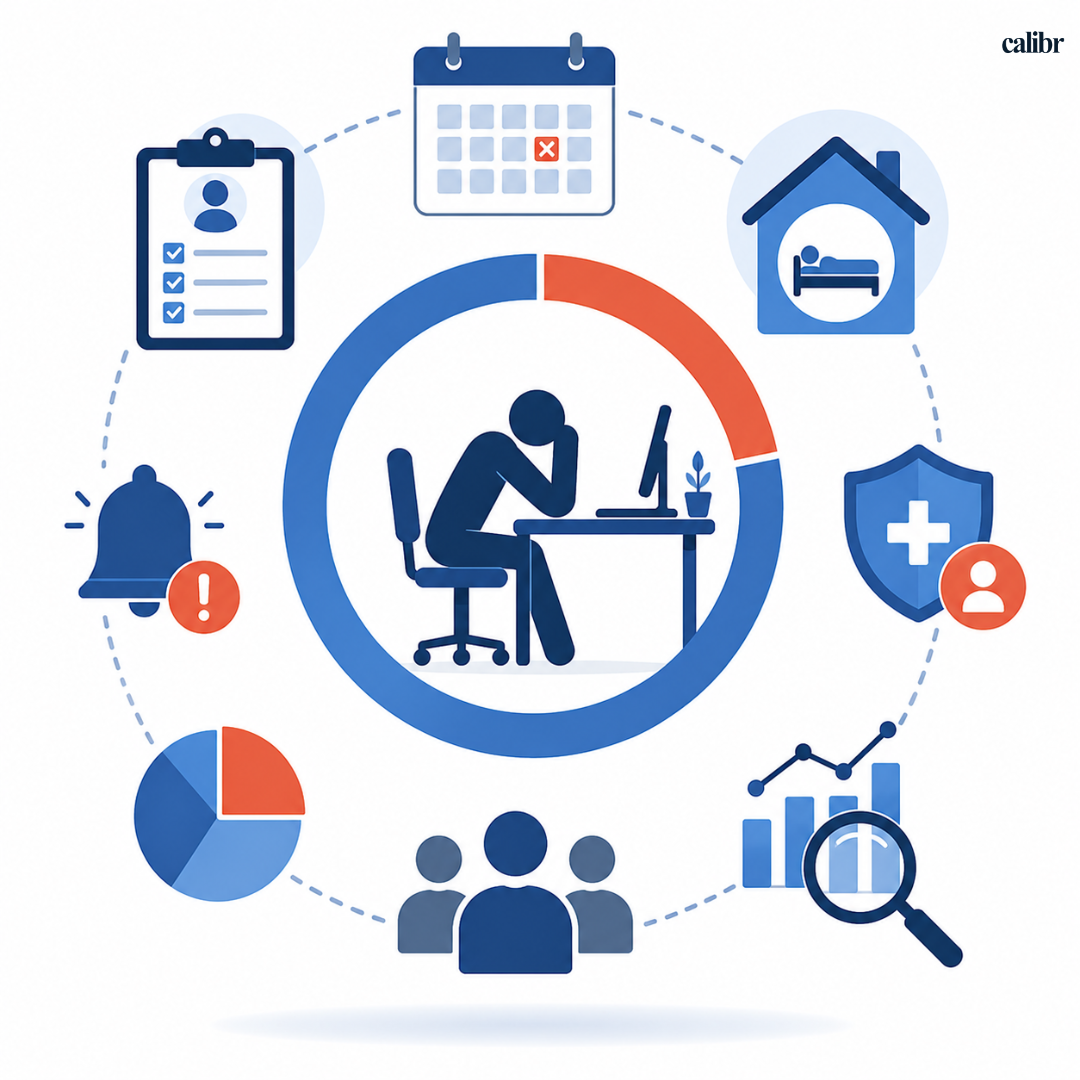
Keeps projects and daily operations running smoothly by identifying attendance issues before they disrupt teams, customer service, or business deadlines.
Helps managers plan staffing more effectively, ensuring the right number of employees are available to meet business demands.
Reduces unnecessary labor costs by minimizing overtime, temporary staffing expenses, and productivity losses caused by frequent absences.
Highlights potential employee well-being concerns, such as burnout, workplace stress, low morale, or declining engagement, so HR can intervene early.
Tracks the employee absenteeism rate over time to identify recurring attendance patterns, high-risk departments, and seasonal workforce trends.
Provides insights into workplace absenteeism, helping organizations uncover operational, cultural, or policy-related issues that may be affecting attendance.
Supports better attendance policies and HR decisions by providing reliable data to improve workforce planning, employee experience, and long-term organizational performance.
Enables managers to measure the impact of attendance initiatives, allowing HR teams to evaluate whether wellness programs, flexible work policies, or attendance incentives are improving attendance outcomes.
Common Absenteeism Calculation Mistakes
Even a simple absenteeism rate formula can produce misleading results if the underlying data is inaccurate or inconsistent.
Avoiding these common calculation mistakes helps ensure reliable attendance reporting, meaningful workforce insights, and better HR decision-making.
Mistake | Best Practice |
Counting vacation days as absences | Exclude planned leave if required by policy |
Using inaccurate attendance records | Maintain reliable HRIS or attendance systems |
Ignoring department-level trends | Analyze absenteeism by team and location |
Measuring only annually | Track monthly and quarterly |
Comparing different reporting periods | Use consistent measurement periods |
Excluding partial-day absences | Apply a consistent attendance policy |
What Is a Good Absenteeism Rate Percentage?
There is no universal "good" absenteeism rate percentage because acceptable levels vary across organizations. Factors such as industry, workforce size, job roles, shift patterns, company policies, and regional labor conditions all influence what is considered a healthy attendance rate.
Instead of comparing your organization to a single benchmark, HR leaders should evaluate absenteeism by monitoring:
Historical absenteeism trends
Department or team comparisons
Industry benchmarks (where available)
Seasonal or recurring attendance patterns
A sudden or consistent increase in absenteeism is often a stronger indicator of workplace challenges—such as employee burnout, low engagement, poor morale, or health-related issues—than the percentage alone.
Quick Tip
Measure Absenteeism Rate monthly rather than annually. Monthly tracking helps HR teams detect attendance issues early, respond proactively, and make data-driven workforce decisions before small problems become larger operational challenges.
The CIPD also recommends measuring and managing absence consistently through clear absence policies, reliable reporting, and regular analysis to support employee well-being while maintaining operational effectiveness.
Regular monitoring can help organizations:
Identify attendance trends before they impact productivity
Improve workforce planning and scheduling
Detect employee burnout and well-being concerns early
Reduce overtime and replacement staffing costs
Evaluate the effectiveness of attendance and wellness initiatives
For deeper workforce insights, review Absenteeism Rate alongside Employee Turnover Rate, Employee Engagement Score, Overtime Rate, and Productivity Metrics rather than analyzing it in isolation. This provides a more complete picture of workforce health and organizational performance.
Learning the formula is only the first step. Reinforce your understanding by testing your knowledge with practical HR metric questions.
Test your HR knowledge with our HR Metrics Quiz and see how well you understand the most important workforce metrics.
Frequently Asked Questions (FAQs)
What is the absenteeism rate?
Absenteeism Rate is the percentage of scheduled work time employees miss due to unplanned absences during a specific period.
How often should absenteeism rate be measured?
Most organizations measure absenteeism monthly, quarterly, and annually to identify trends and workforce risks.
What is the absenteeism formula?
The standard absenteeism formula is:
(Total Absent Days ÷ Total Available Workdays) × 100
Why is absenteeism important?
Absenteeism affects productivity, workforce planning, employee well-being, labor costs, and operational performance.
Final Thoughts
Absenteeism Rate is one of the most valuable attendance metrics for understanding workforce health and operational efficiency. Regularly measuring and reviewing this metric helps HR teams identify attendance trends early, improve workforce planning, and reduce productivity losses.
For the most meaningful insights, analyze absenteeism alongside other HR metrics such as employee engagement, turnover, overtime, and retention to gain a complete picture of workforce performance.
Want to explore more workforce KPIs? Read our comprehensive guide covering over 75 HR metrics, complete with formulas, examples, and practical use cases.


Vivetha is a digital marketing professional specializing in content marketing and SEO. She focuses on developing optimized, high-quality content that improves search visibility, supports brand objectives, and drives measurable results. With a structured and analytical approach, she ensures content aligns with business and audience needs.