12 Instructional Design Trends Transforming Workplace Learning in 2026

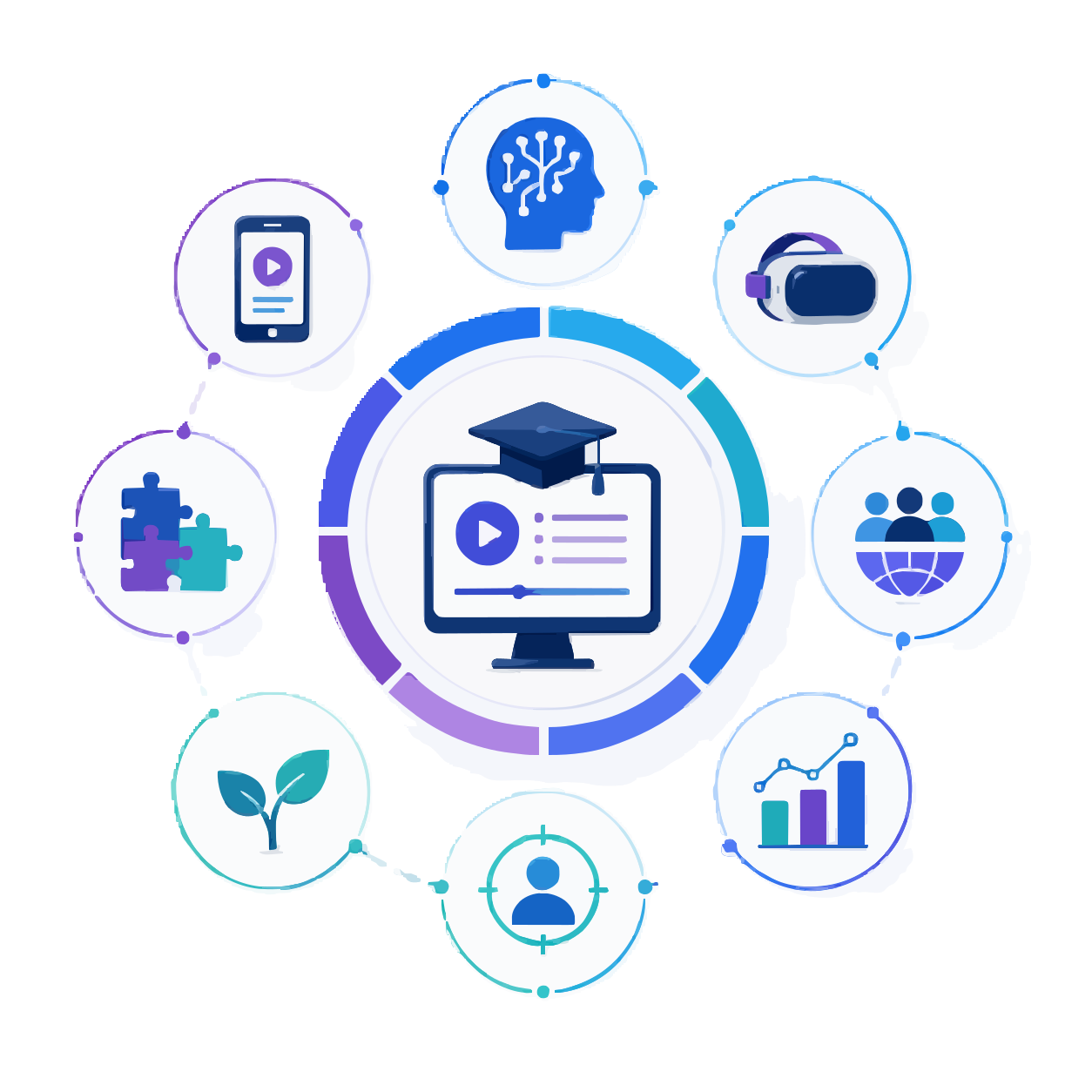
Instructional design is becoming more important than ever as organizations face rapid technological change, evolving job roles, and growing skills gaps across the workforce.
AI is transforming instructional design, helping organizations create learning content faster while enabling more personalized learning experiences.
Skills-based learning is becoming a priority, as organizations focus on building workforce capabilities that directly support business goals.
Microlearning, adaptive learning, and mobile-first design are making workplace learning more flexible, engaging, and accessible.
The future of instructional design lies in balancing AI-powered efficiency with human-centered learning experiences that drive performance, growth, and business impact.
Introduction: Learning Is Changing Faster Than Ever
The way people learn at work is changing rapidly. New technologies, evolving job roles, and growing skill demands mean employees need to learn continuously to stay effective.
Traditional training methods are no longer enough. Today's learners expect training that is engaging, personalized, accessible, and relevant to their daily work.
This is where instructional design plays a critical role. By creating structured and effective learning experiences, instructional design helps organizations build skills, improve performance, and prepare employees for future challenges.
What Is Instructional Design?
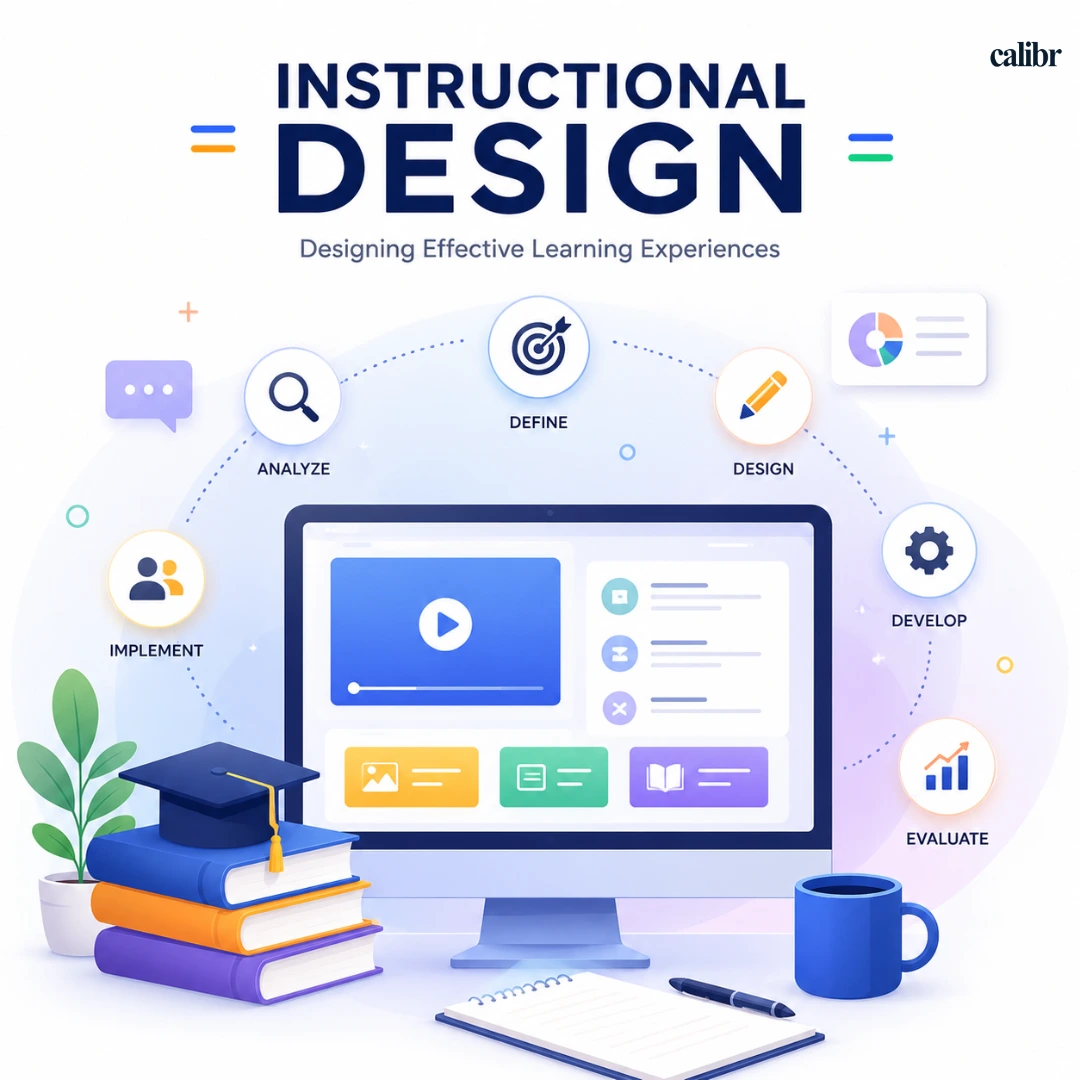
Instructional design is the process of creating learning experiences that help people gain knowledge and develop skills effectively. It focuses on how training is planned, structured, delivered, and evaluated to ensure learners achieve specific outcomes.
For example, instead of asking employees to read a lengthy policy document, an instructional designer might create a short video, interactive module, and quiz to make the content easier to understand and remember.
The Role of Instructional Design in Workplace Learning
The role of instructional design in workplace learning is to create structured, engaging, and outcome-driven learning experiences that align employee development with business goals.
It helps:
Improve knowledge retention
Build job-specific skills
Increase learner engagement
Support employee performance
Measure training effectiveness
Whether it's onboarding new hires, leadership development, compliance training, or upskilling employees, instructional design ensures learning delivers real business value.
Top 12 Instructional Design Trends Transforming Workplace Learning in 2026
As technology, employee expectations, and business needs continue to evolve, instructional design is becoming more strategic than ever.
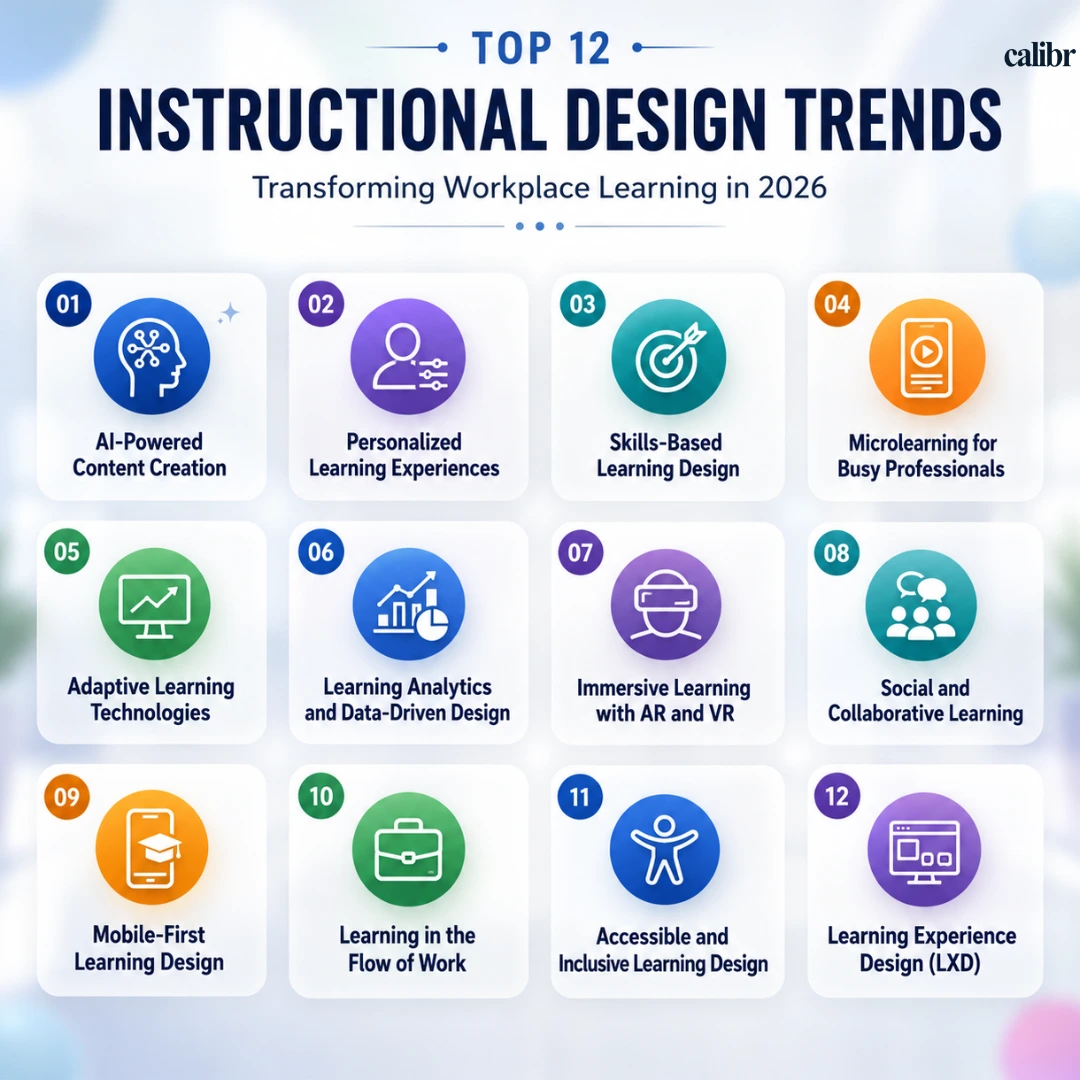
The following instructional design trends are shaping how organizations design, deliver, and measure workplace learning in 2026.
1. AI-Powered Content Creation
Meaning
The growing use of AI in instructional design is helping learning teams accelerate content development, personalize learning experiences, and improve training efficiency at scale.
Why It's Growing
Organizations are under increasing pressure to deliver training faster while managing limited L&D resources. AI helps instructional designers accelerate content development, reduce repetitive tasks, and scale learning programs more efficiently.
How It Can Be Applied in the Workplace
L&D teams can use AI to speed up course development, update training materials, generate knowledge checks, and create personalized learning content.
Example
A company needs to launch cybersecurity training for all employees. Instead of creating everything from scratch, the instructional designer uses AI to generate a course outline and quiz questions, then reviews and customizes the content before publishing.
2. Personalized Learning Experiences
Meaning
Personalized learning delivers training based on an employee's role, skills, interests, learning goals, or performance data.
Why It's Growing
Employees increasingly expect learning experiences that align with their roles, career goals, and skill levels. Personalized learning improves engagement, relevance, and knowledge retention by delivering content tailored to individual needs.
How It Can Be Applied in the Workplace
Organizations can recommend different learning paths for different employees, ensuring everyone receives training that is relevant to their needs.
Example
A new manager receives leadership and team management courses, while a software developer receives technical training aligned with their career goals.
3. Skills-Based Learning Design
Meaning
Skills-based learning focuses on developing specific workplace skills rather than simply completing courses.
Why It's Growing
As job roles evolve rapidly, organizations are placing greater emphasis on measurable skills rather than course completion. Skills-based learning helps employees develop competencies that directly support business performance and workforce readiness.
How It Can Be Applied in the Workplace
Organizations can identify critical skills for each role and design learning programs that help employees build those competencies.
Example
Instead of assigning a general customer service course, employees complete learning activities focused on skills such as communication, problem-solving, and conflict resolution.
4. Microlearning for Busy Professionals
Meaning
Microlearning delivers information through short, focused learning modules that are easy to consume in a few minutes.
Why It's Growing
Modern employees have limited time for lengthy training sessions. Microlearning supports just-in-time learning by providing concise, focused content that fits easily into busy work schedules.
How It Can Be Applied in the Workplace
Organizations can provide quick lessons, videos, infographics, or quizzes that employees can access whenever they need them.
Example
Before meeting a client, a sales representative watches a three-minute product update video to quickly refresh their knowledge.
5. Adaptive Learning Technologies
Meaning
Adaptive learning uses technology to adjust learning content and difficulty levels based on a learner's performance and progress.
Why It's Growing
Organizations are seeking more efficient ways to address varying learner needs. Adaptive learning improves learning outcomes by automatically adjusting content, pace, and difficulty based on individual performance.
How It Can Be Applied in the Workplace
Learning platforms can automatically recommend additional content to employees who need support while allowing advanced learners to move ahead faster.
Example
An employee scores highly on a pre-assessment and skips beginner-level modules, while another employee receives extra practice activities to strengthen their understanding.
6. Learning Analytics and Data-Driven Design
Meaning
Learning analytics involves collecting and analyzing learner data to understand how employees engage with training and where improvements are needed.
Why It's Growing
Businesses increasingly expect training programs to demonstrate measurable impact. Learning analytics provide valuable insights into learner behavior, skill development, and training effectiveness, enabling data-informed decisions.
How It Can Be Applied in the Workplace
Organizations can track completion rates, skill development, learner engagement, and assessment scores to improve learning programs.
Example
An L&D team notices that many employees struggle with a specific module. Using learning analytics, they identify the issue and redesign the content to improve understanding and completion rates.
7. Immersive Learning with AR and VR
Meaning
Immersive learning uses technologies such as Augmented Reality (AR) and Virtual Reality (VR) to create realistic, interactive learning experiences.
Why It's Growing
Organizations are looking for safer and more engaging ways to develop practical skills. AR and VR create realistic environments where employees can practice complex tasks without real-world risks.
How It Can Be Applied in the Workplace
Organizations can use AR and VR to provide hands-on practice in a safe environment, especially for technical, operational, or high-risk roles.
Example
A manufacturing company uses VR simulations to train employees on operating machinery before they work with actual equipment.
8. Social and Collaborative Learning
Meaning
Social and collaborative learning encourages employees to learn from one another through discussions, knowledge sharing, mentoring, and collaboration.
Why It's Growing
Knowledge sharing has become essential in today's fast-changing workplace. Social learning enables employees to learn from peers, exchange expertise, and build stronger learning communities.
How It Can Be Applied in the Workplace
Organizations can create learning communities, discussion forums, peer-learning groups, and mentoring programs.
Example
After completing a leadership course, managers participate in discussion groups where they share experiences and best practices with peers.
9. Mobile-First Learning Design
Meaning
Mobile-first learning is designed primarily for smartphones and tablets, allowing employees to learn anytime and anywhere.
Why It's Growing
Remote, hybrid, and frontline workers need access to learning regardless of location. Mobile-first learning ensures employees can access training resources whenever and wherever they need them.
How It Can Be Applied in the Workplace
Organizations can provide mobile-friendly courses, videos, job aids, and assessments that employees can access on the go.
Example
A field technician uses a mobile learning app to quickly access troubleshooting guides while working at a customer site.
10. Learning in the Flow of Work
Meaning
Learning in the flow of work integrates learning directly into employees' daily tasks and workflows instead of requiring separate training sessions.
Why It's Growing
Employees often struggle to find time for formal training. Learning in the flow of work embeds learning directly into daily tasks, making skill development more practical and immediately applicable.
How It Can Be Applied in the Workplace
Organizations can provide performance support tools, knowledge bases, and contextual learning resources within the applications employees already use.
Example
A customer support agent receives step-by-step guidance and learning resources directly within the helpdesk system while handling customer inquiries.
11. Accessible and Inclusive Learning Design
Meaning
Accessible and inclusive learning ensures that training can be effectively used by employees with different abilities, learning preferences, languages, and backgrounds.
Why It's Growing
Organizations are prioritizing equitable learning opportunities for diverse workforces. Accessible learning ensures all employees can participate effectively, regardless of ability, language, or learning preference
How It Can Be Applied in the Workplace
Organizations can include captions, screen-reader compatibility, keyboard navigation, multilingual support, and flexible learning formats.
Example
A training program includes video captions, downloadable transcripts, and mobile-friendly content so all employees can access learning in a way that works best for them.
12. Learning Experience Design (LXD)
Meaning
Learning Experience Design (LXD) combines instructional design principles with user experience (UX) design to create engaging, learner-centered experiences.
Why It's Growing
Employees compare workplace learning experiences with the digital experiences they encounter every day. LXD focuses on creating intuitive, engaging, and learner-centered experiences that improve participation and outcomes.
How It Can Be Applied in the Workplace
Organizations can design learning journeys that are intuitive, interactive, and aligned with employee needs, making training more engaging and effective.
Example
Instead of presenting employees with long slides and documents, a company creates an interactive onboarding journey that includes videos, activities, milestones, and personalized recommendations.
When Should Organizations Use Each Instructional Design Trend?
Trend | Best Used When |
AI-Powered Content Creation | You need to develop or update training quickly at scale. |
Personalized Learning | Employees have different roles, skill levels, or learning goals. |
Skills-Based Learning Design | The focus is on building measurable workplace competencies. |
Microlearning | Learners need quick, just-in-time training support. |
Adaptive Learning | Employees require different learning paths based on performance. |
Learning Analytics | You want to measure training effectiveness and improve outcomes. |
AR and VR Learning | Employees need realistic, hands-on practice in safe environments. |
Social and Collaborative Learning | Knowledge sharing and peer learning are important. |
Mobile-First Learning | Learners frequently work remotely, travel, or work in the field. |
Learning in the Flow of Work | Employees have limited time for formal training sessions. |
Accessible and Inclusive Learning | Training must support diverse learner needs and abilities. |
Learning Experience Design (LXD) | Improving learner engagement and overall learning experience is a priority. |
Key Insight:
The best learning programs rarely rely on just one instructional design trend.
Most organizations achieve better results by combining multiple approaches based on their learning objectives, workforce requirements, technology infrastructure, and available resources.
The right mix will vary from one organization to another.
Key Considerations When Adopting Instructional Design Trends
Consideration | What Organizations Should Know |
AI Requires Human Oversight | AI can speed up content creation, but human review is still needed to ensure accuracy, relevance, and quality. |
Personalization Depends on Quality Data | Effective personalized learning requires reliable learner data, skills assessments, and performance insights. |
Microlearning Has Its Limits | Microlearning is ideal for quick learning needs but may not be suitable for complex topics that require deeper understanding. |
AR and VR Can Be Resource-Intensive | While immersive learning can be highly effective, organizations should consider costs, hardware requirements, and implementation efforts. |
Learning Analytics Need Clear Goals | Tracking data alone is not enough. Organizations should focus on metrics that support learning and business outcomes. |
Accessibility Should Be Built In From the Start | Accessibility features such as captions, transcripts, and screen-reader support should be included during the design process, not added later. |
Focus on Outcomes, Not Trends | Adopt trends that solve real business challenges and learner needs rather than following every new technology. |
Key Takeaway
The most successful organizations don't adopt every instructional design trend. Instead, they select the approaches that align with their learning objectives, workforce needs, and business goals.
What Industry Research Reveals About the Future of Learning
Leading learning organizations and technology companies consistently highlight the growing importance of skills development, personalized learning, and AI-enabled training.
Research from Association for Talent Development shows that organizations with strong learning cultures are more likely to improve employee development, engagement, and retention.
According to the 2025 Workplace Learning Report from LinkedIn Learning, nearly half of learning professionals report growing concerns about skills gaps, reinforcing the need for continuous learning and workforce upskilling.
Technology leaders including Microsoft and Google are increasingly embedding AI-powered learning, skills development, and productivity tools into workplace ecosystems, accelerating the shift toward continuous learning.
These developments reinforce a common theme in the future of workplace learning: modern instructional design is evolving beyond course creation to support ongoing skill development, career growth, and business performance.
The Future of Instructional Design in the Age of AI
As AI in instructional design continues to evolve, learning teams can create more scalable, adaptive, and personalized learning experiences.
The future of instructional design is being shaped by artificial intelligence, personalized learning, data-driven decision-making, and skills-based workforce development.
While AI can accelerate content creation and automate routine tasks, it cannot replace the strategic thinking required to design effective learning experiences. The role of instructional designers is to identify learner needs, structure content effectively, select appropriate learning methods, and ensure training aligns with both learner and business objectives.
As AI becomes more integrated into workplace learning, the role of the instructional designer is evolving from content creator to learning strategist. Modern instructional designers focus on performance improvement, skills development, learner experience, and measurable business impact. Organizations that successfully combine AI-powered efficiency with human-centered design will be better positioned to build agile, future-ready workforces.
Key Takeaway: The most effective instructional design strategies will balance the speed and scalability of AI with meaningful learning experiences that help employees build skills, improve performance, and adapt to change.
Frequently Asked Questions (FAQs)
What are instructional design trends?
Instructional design trends are emerging approaches, technologies, and best practices that influence how learning experiences are designed, delivered, and measured in the workplace.
Why is instructional design important in workplace learning?
Instructional design helps organizations create structured, engaging, and effective learning experiences that improve knowledge retention, skill development, and employee performance.
How is AI changing instructional design?
AI in instructional design is helping designers automate content creation, personalize learning paths, analyze learner data, and reduce course development time while maintaining learning effectiveness.
What is the most important instructional design trend in 2026?
While several trends are shaping workplace learning, AI-powered content creation and personalized learning are expected to have the greatest impact due to their ability to improve efficiency and learner engagement.
Is microlearning effective for employee training?
Yes. Microlearning can improve engagement and knowledge retention by delivering short, focused learning experiences that fit into employees' daily workflows.
What skills do instructional designers need for the future?
Future instructional designers will need skills in learning design, AI tools, data analysis, learner experience design, content strategy, and performance consulting.
Final Thoughts
The future of instructional design will be defined by organizations that successfully combine AI-powered innovation, learner-centric design, and measurable business outcomes.
While the tools may change, the goal remains the same: helping people learn effectively and perform better. Organizations that embrace the right instructional design trends today will be better prepared for the workforce challenges of tomorrow.
At Calibr, we believe the future of workplace learning lies in combining AI powered innovation with learner-centric experiences that drive measurable business outcomes. By helping organizations deliver personalized skills focused learning at scale, we empower teams to continuously grow, adapt, and perform in a rapidly changing world.


Vivetha is a digital marketing professional specializing in content marketing and SEO. She focuses on developing optimized, high-quality content that improves search visibility, supports brand objectives, and drives measurable results. With a structured and analytical approach, she ensures content aligns with business and audience needs.