AI can process language, summarize meetings, and even mimic empathetic phrasing.
Examples of soft skills include communication, empathy, leadership, adaptability, and conflict resolution—abilities that rely on human judgment rather than algorithms.
What it can't do is read a room, sense when a top performer is quietly burning out, or rebuild trust after a manager mishandles a layoff conversation.
Why can't AI learn soft skills? Because soft skills aren't a knowledge problem—they're a judgment, context, and relationship problem, built through lived experience, accountability, and consequence.
This article breaks down what soft skills actually are, where AI genuinely helps, where it falls short, and what would have to change for that to be different.
Let's assume, a mid-sized logistics company few years ago rolled out an AI coaching tool to help new managers handle "difficult conversations." The tool gave solid scripts for delivering tough feedback. On paper, it worked.
In practice, managers using it still froze in real conversations. One admitted she'd memorized the AI's suggested opening line word for word — and had no idea what to do when the employee started crying instead of following the script.
That sums up the whole problem. Why can't AI learn soft skills? Because they were never really about having the right words. They're about reading a person in real time, adjusting on the fly, and carrying the emotional weight of the outcome. AI can generate the script. It can't sit in the room.
This matters more now than it did five years ago, because AI has gotten genuinely good at the things it is good at — drafting, summarizing, analyzing, predicting. That's exactly why the gap around soft skills is becoming more visible, not less. As routine tasks get automated, the value of human judgment, empathy, and relationship-building goes up.
This guide is for HR leaders, L&D professionals, and managers who want a straight answer: what soft skills actually are, why AI keeps hitting a wall with them, and where the human advantage genuinely holds.
What Are Skills?
Skills are the abilities people develop through learning, practice, and experience to perform tasks effectively. They enable employees to complete technical tasks, solve problems, communicate with others, and adapt to changing workplace demands.
Whether you're writing code, analyzing sales data, leading a team meeting, or resolving a customer complaint, every task relies on a combination of different skills.
Together, these abilities help individuals perform their roles efficiently and contribute to overall business success.
What Are the Different Types of Skills Every Employee Needs?
Every employee relies on a combination of skills to succeed at work. The four main types of skills are:
Technical (Hard) Skills – Coding, data analysis, financial modeling, software proficiency.
Cognitive Skills – Critical thinking, analytical reasoning, decision-making, problem-solving.
Interpersonal (Soft) Skills – Communication, empathy, teamwork, conflict resolution.
Self-Management Skills – Adaptability, resilience, time management, self-awareness.
While all four types of skills contribute to workplace success, they aren't equally easy to develop, measure, or automate. Understanding the difference between hard skills and soft skills is especially important because AI is changing how organizations value these capabilities.
Before exploring why AI struggles with soft skills, let's compare how these two skill sets differ.
Soft Skills and Hard Skills: What's the Difference?
Soft skills and hard skills are equally important, but they serve different purposes. Hard skills help you perform specific job tasks, while soft skills determine how effectively you communicate, collaborate, and adapt in the workplace. Most successful professionals need a balance of both.
Hard Skills | Soft Skills |
|---|---|
Technical, job-specific abilities | Interpersonal and behavioral abilities |
Learned through courses and training | Developed through experience and practice |
Easy to test and measure | Harder to measure and observe |
Examples: Coding, Excel, Data Analysis | Examples: Communication, Empathy, Teamwork |
Key takeaway: Hard skills may help you get hired, but soft skills often determine how well you perform, communicate and collaborate effectively with colleagues, and grow in your career. AI can increasingly support hard skills, but soft skills still rely on human judgment and real-world experience.
What Are Soft Skills, Really — and Why Do They Confuse AI?
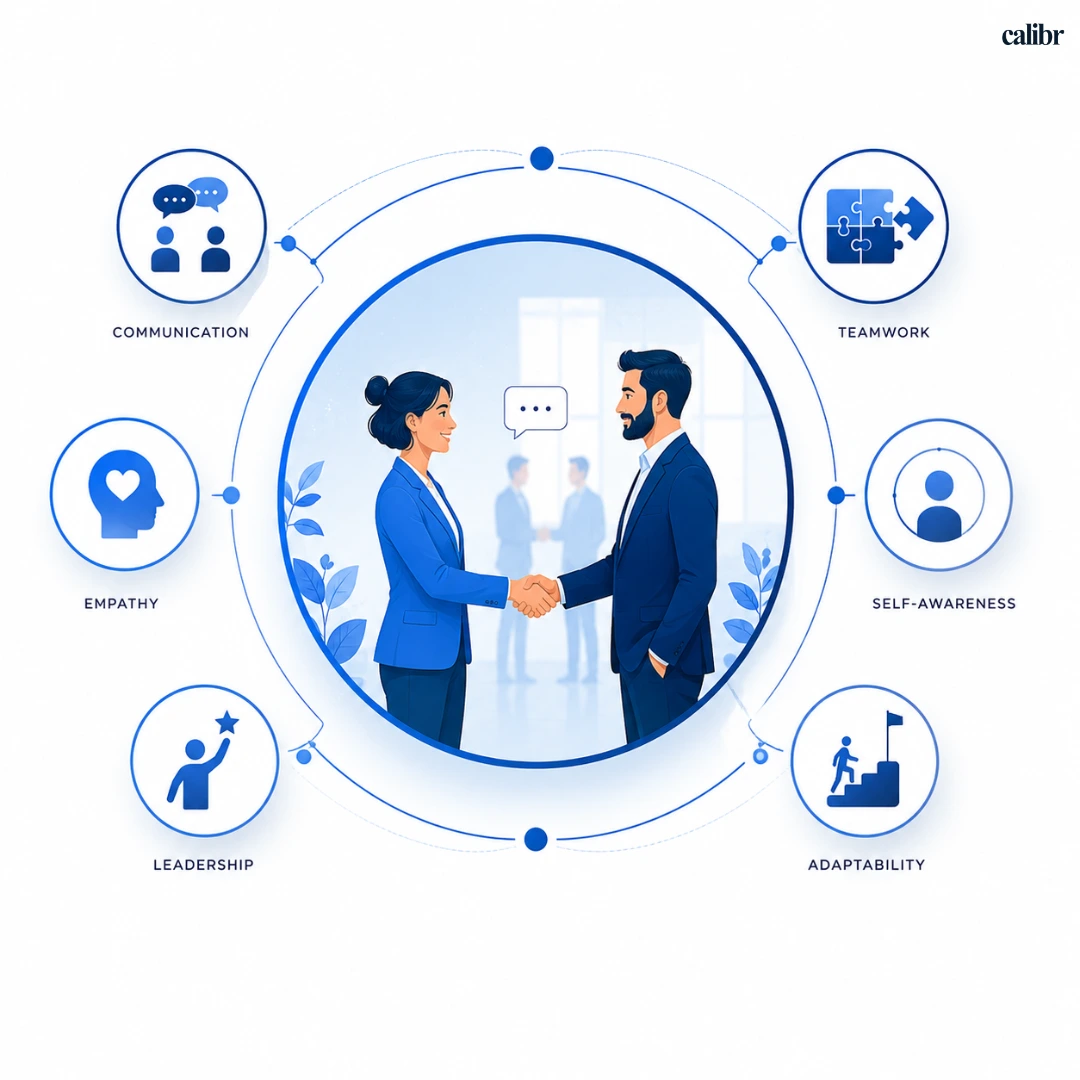
Soft skills are the interpersonal and self-management capabilities that determine how someone does their work, not just what they produce including communication, empathy, adaptability, and conflict resolution. These are common examples of soft skills that employers consistently value across industries.
According to the World Economic Forum's Future of Jobs Report 2025, analytical thinking, resilience, leadership, and social influence remain among the most demanded workplace soft skills.
AI struggles with them because they depend on context, emotion, and consequence, none of which a language model actually experiences.
Here's the part most articles skip: soft skills aren't really "skills" in the way we usually use that word. A hard skill is a procedure — you can write it down, test it, and verify whether someone did it correctly. Soft skills are judgment calls made under uncertainty, with incomplete information and real stakes attached.
Take active listening. It sounds simple. But it means noticing that an employee's words say "I'm fine" while their body language says otherwise, then deciding — in the moment — whether to push, wait, or let it go. There's no transcript that teaches that decision. It's built through conversations that went wrong before you learned what "wrong" felt like.
AI models are trained on text. They can describe empathy beautifully. They can't feel the discomfort of an awkward pause — and that discomfort is often exactly what teaches a person to sit with silence instead of filling it.
Why Can't AI Learn Soft Skills? The Real Reasons
AI can't learn soft skills because it lacks lived consequence, embodied emotion, and situational memory of this specific person — three things that soft skills are built on. It can pattern-match language associated with empathy or leadership, but it can't generate the judgment that comes from having been wrong before and having to live with it.
Let's get specific about what's actually missing.
1. AI has no stakes
When a manager mishandles a firing conversation, they carry that for weeks, and it shapes how they handle the next one. AI generates its next response the same way regardless of whether the last one caused someone to cry or quit. There's no accountability loop.
2. AI doesn't read nonverbal signals in real time
A skilled manager notices the exact second an employee's tone shifts from defensive to defeated, and changes tack accordingly. AI tools built for video calls flag sentiment after the fact — they don't adjust the conversation as it happens.
3. AI has no relationship history with a specific human
Trust is built cumulatively — this manager showed up for me during a hard time, so I'll extend the benefit of the doubt now. AI has no continuous relational memory of you the way a colleague who's worked beside you for years does.
4. AI optimizes for plausible output, not moral weight
Soft skills often require choosing the harder right answer over the easier wrong one — telling a founder their idea won't work, for instance. AI tends toward agreeable, safe phrasing unless deliberately pushed otherwise.
5. Judgment requires context AI doesn't have access to
Knowing when to escalate a conflict to HR versus letting two employees work it out themselves depends on history, personalities, and politics that live in people's heads, not in any dataset.
This does not diminish AI's value. It remains a powerful tool for practice, personalized feedback, and identifying patterns at scale. However, there is a fundamental difference between simulating a behavior and exercising the human judgment required to apply it effectively.
What AI Can Do vs. What Only Humans Can Do
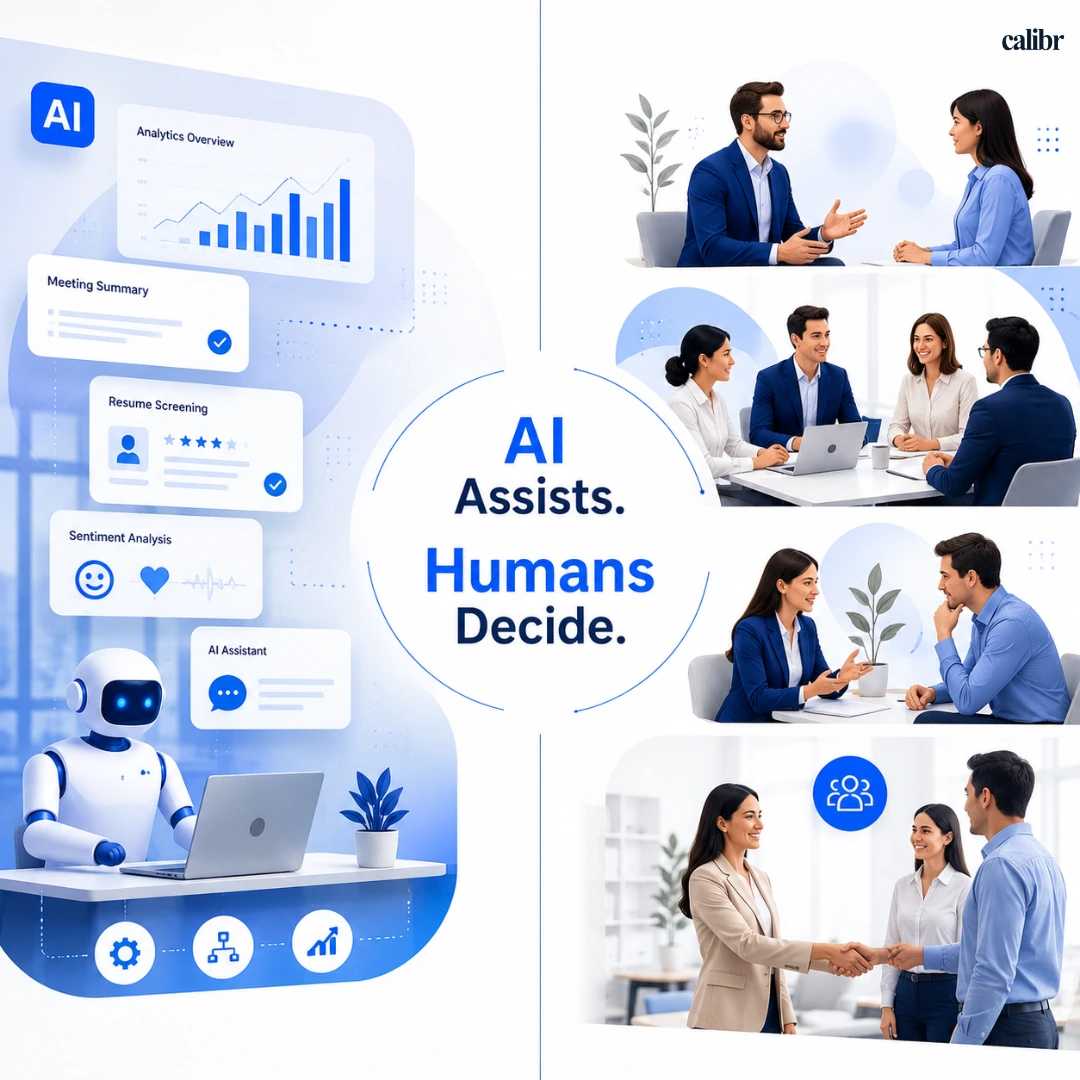
AI genuinely outperforms humans at scale, speed, and consistency for defined tasks, while humans remain irreplaceable wherever human judgment, trust, emotional intelligence, and the ability to interpret emotional nuance determine the outcome.
AI Can | Humans Can |
|---|---|
Draft a performance review from notes | Deliver that review with the right tone for this person |
Flag sentiment trends in survey data | Sense when a quiet team member is disengaging before it shows in data |
Suggest scripts for difficult conversations | Adapt mid-conversation when the script stops working |
Summarize a conflict from written accounts | Mediate the conflict and rebuild trust between two people |
Generate onboarding content at scale | Make a new hire feel genuinely welcomed on day one |
Identify skills gaps from resume data | Judge whether a candidate will actually fit the team culture |
McKinsey Global Institute found that 57% of current U.S. work hours are technically automatable with today's technologies. However, more than 70% of the skills employers seek are still used across both automatable and non-automatable work, highlighting that AI is changing how work is done rather than eliminating the need for human skills such as communication, leadership, and problem-solving.
This perspective is further supported by Microsoft's 2026 Work Trend Index, which suggests that as AI becomes more capable of executing tasks, organizations increasingly rely on human judgment, critical thinking, and decision-making to guide meaningful outcomes.
Real Workplace Scenarios Where the Human Advantage Shows Up
Onboarding: The First 90 Days
Imagine this: a new hire joins remotely and gets a beautifully AI-generated onboarding schedule, complete with a chatbot that answers HR policy questions instantly. Efficient? Yes. Enough? No.
What actually determines whether that hire stays past six months is whether their manager checked in on week two, noticed they seemed lost, and made time for a real conversation instead of pointing them back to the chatbot. This is where most companies go wrong — they mistake information delivery for genuine support.
Coaching a Struggling High Performer
Here's a simple example. A top salesperson starts missing targets. AI-pulled data shows a drop in call volume and slower email response times. A less experienced manager might read that as a performance problem and start a formal improvement plan.
A seasoned manager asks a different question first: what changed? Maybe it's a divorce, or burnout from covering an underperforming teammate's workload for months. The data tells you what happened. Only a human conversation, built on trust, uncovers why — and the "why" determines whether the right response is coaching, workload rebalancing, or tougher performance management.
Conflict Resolution Between Two Strong Performers
Two team leads disagree publicly in a meeting about resourcing priorities. AI meeting-notes tools might flag "tension detected" after the fact. What actually resolves it is a manager who understands the personal history — that one feels chronically under-resourced and the other feels constantly second-guessed — and mediates accordingly. Generic frameworks miss the specifics that make conflict personal.
Will AI Ever Learn Soft Skills?
Not with current technology, and not by simply training on more text. Soft skills would require AI to carry consequence across time, sense embodied emotional cues, and hold a continuous relationship with a specific person — none of which today's models are built to do, no matter how much data they're fed.
It's worth being precise about what would actually have to change. AI would need something like a persistent, personal memory of every interaction with you specifically — not a generic pattern learned from millions of conversations, but a private history that shapes how it treats you differently from everyone else, the way a real colleague does.
It would need to genuinely bear the cost of getting things wrong, not just generate a corrected response next time. And it would need real-time sensing of tone, posture, and hesitation — not sentiment analysis run after the fact.
Some of these gaps may narrow. AI is already better at detecting emotional cues in text and voice than it was a few years ago. But narrowing a gap isn't the same as closing it.
Even a system that could perfectly detect that someone is upset still has no stake in what happens next, and that missing stake is where a lot of soft skill actually lives — in the willingness to sit with someone else's discomfort because you care what happens to them, not because a model told you to.
Final Thoughts
Why can't AI learn soft skills? Because soft skills were never a knowledge problem — they're built from consequence, context, and relationship, and no model trained on text has lived through any of those. AI will keep getting better at drafting the email, summarizing the meeting, and flagging the sentiment shift. It will not get better at sitting across from a grieving employee and knowing, from experience, exactly how long to let the silence sit.
That's not a reason to fear AI in HR and L&D. It's a reason to be precise about where you point it. Let AI handle the volume — scheduling, summarizing, drafting. Protect and invest in the parts of the job that require a human in the room: coaching, mediating, and making the hard calls that carry real consequences for real people.
The organizations that get this balance right won't be the ones with the most AI tools. They'll be the ones that used AI to free up time for the human work that actually builds trust — and made sure their people were genuinely good at it.
Frequently Asked Questions (FAQs)
Why can't AI learn soft skills the way it learns technical skills?
Technical skills follow rules that can be codified and tested. Soft skills depend on context and consequence AI doesn't experience — it can describe empathy but can't feel the discomfort that shapes real judgment.
Can AI help develop soft skills at all?
Yes. AI is useful for generating realistic practice scenarios and spotting patterns in feedback data. It just can't replace the judgment behind the behavior itself.
What's the difference between soft skills and hard skills?
Hard skills are technical and teachable through structured training. Soft skills are interpersonal and behavioral, built through practice, feedback, and lived experience.
What are some examples of soft skills employers look for most?
Active listening, giving and receiving feedback, conflict resolution, adaptability, emotional intelligence, and clear communication.
What are hard skills examples in a modern workplace?
Data analysis, financial modeling, coding languages, project management software proficiency, and industry-specific certifications.
Will AI eventually replace jobs that rely heavily on soft skills?
Unlikely soon. Research from the World Economic Forum and McKinsey both point to rising demand for human-centered skills like leadership and judgment as automation handles routine tasks.
What types of skills matter most alongside soft skills?
Technical/hard skills, cognitive skills, and self-management skills all combine with soft skills — most roles need a blend, not just one category.
How should soft skills and hard skills be weighed in hiring decisions?
Both matter, but soft skills are harder to screen for and more predictive of retention. Weighing hiring purely toward technical skills often produces candidates who struggle with collaboration.
Could future AI eventually develop real soft skills?
Only if it gained persistent personal memory, genuine stakes in outcomes, and real-time emotional sensing — none of which current AI architectures are built for. Narrower emotional detection is improving, but that's not the same as judgment.

Vivetha is a digital marketing professional specializing in content marketing and SEO. She focuses on developing optimized, high-quality content that improves search visibility, supports brand objectives, and drives measurable results. With a structured and analytical approach, she ensures content aligns with business and audience needs.