The Dreyfus Model of Skill Acquisition helps organizations understand how employees develop skills over time from Novice to Expert through experience, practice, and continuous learning.
Employees progress through five stages: Novice, Advanced Beginner, Competent, Proficient, and Expert.
Each stage requires different learning experiences, coaching, and support.
The model helps organizations create personalized learning pathways, improve performance, and accelerate workforce capability development.
It can be applied across roles, industries, hiring, career development, and succession planning.
Organizations should use the framework as a development guide, not as a fixed employee label.
As organizations adopt skills-based workforce strategies, the Dreyfus Model provides a practical way to measure and develop expertise over time.
Introduction: Why Training Completion Isn't Enough
Organizations today face a growing challenge: skills are becoming obsolete faster than ever.
According to the World Economic Forum, 39% of workers' core skills are expected to change by 2030, making workforce development a strategic business priority rather than just an HR initiative. At the same time, the World Economic Forum estimates that 59% of the global workforce require reskilling by 2030 to keep pace with changing business demands.
Yet many organizations continue to measure learning success through:
Course completions
Training hours
Certification counts
The problem?
Completing training does not automatically create expertise.
An employee may finish a leadership program but still struggle to manage complex team dynamics. A software developer may complete a coding course but need months of real-world experience before independently solving business critical problems.
This is where the Dreyfus Model becomes valuable.

Understanding the Dreyfus Model of Skill Acquisition
The Dreyfus Model of Skill Acquisition, developed by Hubert and Stuart Dreyfus, explains how individuals progress from beginners to experts through experience, practice, and continuous learning.
Rather than treating learning as a one-time event, the model views skill development as an ongoing journey that unfolds across five distinct stages.
For example, a new sales representative may initially rely on scripts and predefined processes. As they gain experience, they begin recognizing customer patterns, adapting their approach, and eventually handling complex negotiations with confidence and intuition.
Why It Matters for Workforce Development
Many organizations assume employees learn at the same pace. In reality, different stages of development require different levels of support:
New employees need structured guidance and clear instructions.
Developing employees benefit from practice, coaching, and feedback.
Experienced employees require autonomy, stretch assignments, and leadership opportunities.
The Dreyfus Model helps organizations align learning and development initiatives with these evolving needs, creating more effective pathways for skill growth.
How It Differs from Traditional Training
Traditional Training | Dreyfus Model |
Focuses on content delivery | Focuses on skill progression |
Assumes learning ends after training | Treats learning as continuous |
Measures completion | Measures capability growth |
Uses a standardized approach | Supports personalized development |
By focusing on how expertise develops over time, the Dreyfus Model enables organizations to build stronger learning programs, accelerate capability development, and create a more future-ready workforce.
The 5 Stages of the Dreyfus Model of Skill Acquisition
The Dreyfus Model outlines five distinct stages of skill development, showing how individuals progress from following rules and instructions to applying deep expertise and intuitive judgment.
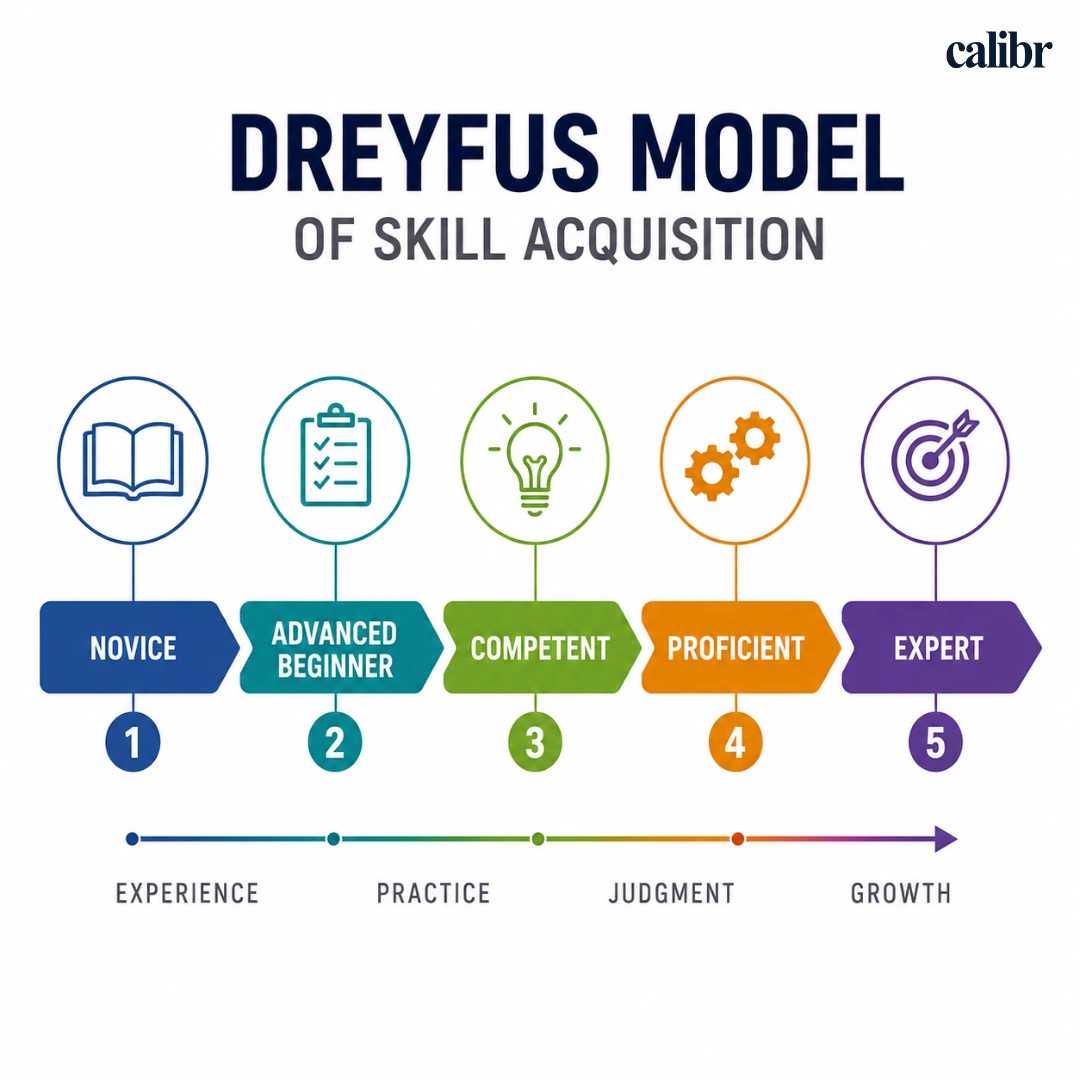
Understanding the 5 stages of the Dreyfus Model helps organizations deliver the right learning interventions, support employee growth, and accelerate workforce capability development.
Stage | Mindset | Key Characteristics | Primary Development Focus |
Novice | "Tell me what to do." | Relies on rules, instructions, and close supervision. | Learning fundamentals and following established processes. |
Advanced Beginner | "I've seen this before." | Starts recognizing patterns and handling routine situations. | Building practical experience through guided application. |
Competent | "I can manage this." | Prioritizes tasks, makes decisions, and takes ownership. | Strengthening problem-solving and independent execution. |
Proficient | "I understand the bigger picture." | Applies judgment, adapts to context, and anticipates challenges. | Developing strategic thinking and leadership capabilities. |
Expert | "I know what works and why." | Operates intuitively, solves complex problems, and mentors others. | Driving innovation, influencing strategy, and developing talent. |
While progression through these stages is not always linear, each stage requires different learning experiences, levels of support, and opportunities for practice. Employees move beyond knowledge acquisition through real-world application, feedback, and experience.
By recognizing where individuals are in their development journey, organizations can create more personalized learning pathways and build a stronger, more capable workforce.
How to use the Dreyfus Model to Build a High-Performing Workforce
Organizations can use the Dreyfus Model to create a structured approach to skill development, ensuring employees receive the right support at every stage of their growth journey.
Here's how to apply the model:
Assess current skill levels to determine where employees fall within the five Dreyfus stages.
Create stage-specific learning paths that align training, coaching, and development activities with employee capability levels.
Equip managers to coach effectively through regular feedback, mentoring, and stretch assignments.
Align skill development with business goals by linking progression to role readiness, performance, and organizational priorities.
Track progression continuously using skills assessments, performance outcomes, and career advancement metrics.
Once this foundation is established, organizations can apply the model across employee levels, roles, and industries.
Table 1: Applying the Dreyfus Model Across Employee Levels
Dreyfus Stage | Recommended Learning Strategy | Manager Support Needed | Success Indicators |
Novice | Structured onboarding and foundational training | Frequent guidance and clear instructions | Understands basic concepts and processes |
Advanced Beginner | Guided practice and hands-on learning | Coaching and regular feedback | Completes routine tasks independently |
Competent | Scenario-based learning and stretch assignments | Performance coaching and increased autonomy | Consistently delivers quality results |
Proficient | Cross-functional projects and leadership exposure | Mentoring and strategic guidance | Demonstrates strong judgment and influence |
Expert | Innovation initiatives and mentoring opportunities | Sponsorship and executive visibility | Drives business impact and develops others |
Table 2: Dreyfus Model Across Different Roles
Dreyfus Stage | Sales | Customer Support | Software Development | Leadership |
Novice | Follows scripts | Uses standard responses | Writes basic code | Manages tasks with guidance |
Advanced Beginner | Handles simple customer interactions | Resolves common issues | Completes assigned development tasks | Begins managing small teams |
Competent | Manages sales pipeline independently | Solves complex customer concerns | Develops solutions independently | Makes operational decisions |
Proficient | Builds strategic client relationships | Anticipates customer needs | Designs scalable solutions | Leads teams strategically |
Expert | Trusted advisor for key accounts | Handles critical escalations | Drives innovation and mentors developers | Shapes organizational direction |
Table 3: Dreyfus Model Across Industries
Dreyfus Stage | Technology | Healthcare | Manufacturing | Financial Services |
Novice | Learns tools and coding fundamentals | Follows clinical procedures | Learns equipment and safety processes | Understands regulations and processes |
Advanced Beginner | Applies technical knowledge to projects | Handles routine patient care | Performs standard operational tasks | Processes standard financial activities |
Competent | Independently delivers projects | Makes informed clinical decisions | Manages production efficiently | Conducts analysis and risk assessments |
Proficient | Leads complex technical initiatives | Handles complex cases confidently | Optimizes operations and quality | Advises on strategic financial decisions |
Expert | Drives innovation and technical strategy | Recognized specialist and mentor | Establishes operational best practices | Influences business and risk strategy |
Key Considerations Before Implementing the Dreyfus Model
While the Dreyfus Model provides a valuable framework for skill development, organizations should apply it thoughtfully to maximize its impact.
Here's what you may have to consider before implementing the Dreyfus Model:
Avoid Rigid Employee Categorization
The five stages are intended to guide development, not label employees permanently. An employee may be an expert in one skill area while still being a novice in another.
Best practice: Use the stages as flexible development benchmarks rather than fixed employee classifications.
Make Skill Assessment an Ongoing Process
Employee capabilities evolve through experience, learning, and changing job responsibilities. A one-time assessment can quickly become outdated.
Best practice: Conduct regular skill reviews and combine self-assessments, manager feedback, and performance data to maintain an accurate view of workforce capabilities.
Empower Managers and Mentors
Learning progression often depends on the quality of coaching employees receive. Without manager involvement, even well-designed development programs can struggle to deliver results.
Best practice: Equip managers with coaching frameworks, mentoring opportunities, and clear guidelines for supporting employee growth.
Recognize That Progression Is Not Linear
Employees develop at different speeds based on factors such as prior experience, motivation, learning opportunities, and role complexity.
Best practice: Focus on individual growth and readiness rather than expecting all employees to progress through the stages at the same pace.
Combine Skills Data with Performance Outcomes
Skill assessments alone do not provide a complete picture of employee effectiveness. Organizations should evaluate how skills translate into business performance.
Best practice: Measure progression using a combination of skills assessments, performance metrics, project outcomes, and career advancement indicators.
By following these practices, organizations can implement the Dreyfus Model more effectively and create a development strategy that supports both employee growth and business success.
The Dreyfus Model in Modern Workforce Development
As organizations shift toward skills-based workforce strategies, the focus is moving beyond training completion to measurable skill development and job readiness.
The Dreyfus Model supports this transition by helping organizations understand how employees progress from beginners to experts and what support they need at each stage.
For example, a new customer support agent may initially rely on scripts and predefined responses. As they gain experience, they develop the ability to handle complex customer issues independently and make sound decisions in challenging situations.
This approach aligns well with modern workforce trends such as personalized learning, AI-powered skills intelligence, internal mobility, and competency-based talent development. By applying the model, organizations can identify skill gaps, create targeted development pathways, and build stronger talent pipelines.
Modern learning platforms such as Calibr help support these efforts by enabling skills tracking, personalized learning experiences, and continuous workforce development, making it easier to align employee growth with business goals.
Frequently Asked Questions (FAQs)
What is the Dreyfus Model of Skill Acquisition?
The Dreyfus Model of Skill Acquisition is a framework that explains how individuals develop skills over time through experience and practice. It outlines five stages of progression: Novice, Advanced Beginner, Competent, Proficient, and Expert.
How is the Dreyfus Model used in workforce development?
Organizations use the Dreyfus Model to assess employee capabilities, create personalized learning pathways, support career progression, and build structured development programs that help employees move from beginner to expert levels.
What are the five stages of the Dreyfus Model?
The five stages are:
Novice
Advanced Beginner
Competent
Proficient
Expert
Each stage represents a different level of skill, experience, decision-making ability, and professional judgment.
How does the Dreyfus Model differ from traditional training approaches?
Traditional training often focuses on course completion and knowledge transfer, whereas the Dreyfus Model focuses on long-term skill progression. It emphasizes practical experience, continuous learning, and the development of expertise over time.
Why is the Dreyfus Model important for modern organizations?
The Dreyfus Model helps organizations identify skill gaps, personalize learning experiences, improve succession planning, and measure employee growth more effectively. It provides a structured approach to developing a high-performing and future-ready workforce.
Key Takeaways
The Dreyfus Model provides a practical framework for understanding skill development.
The Dreyfus Model of Skill Acquisition helps organizations move beyond training completion metrics.
The five stages—Novice, Advanced Beginner, Competent, Proficient, and Expert—require different learning approaches.
Understanding how to use the Dreyfus Model enables more personalized workforce development.
The Dreyfus Model in workplace learning supports succession planning, performance improvement, and internal mobility.
Organizations can improve how to measure employee skill progression through continuous assessment and skills-based metrics.
AI-powered learning platforms are making it easier to implement a scalable skill acquisition framework for organizations.
Final Thoughts
As skill requirements continue to evolve, organizations can no longer afford to treat learning as a one-time event. The most successful companies are shifting their focus from training completion to capability development.
The Dreyfus Model offers a practical roadmap for this transformation. By helping employees progress from novice to expert through structured learning, real-world application, and continuous feedback, organizations can build stronger talent pipelines, improve performance, and future-proof their workforce.
In the coming years, the organizations that consistently develop expertise—not just deliver training—will be the ones that outperform competitors, adapt faster to change, and create sustainable business advantage


Vivetha is a digital marketing professional specializing in content marketing and SEO. She focuses on developing optimized, high-quality content that improves search visibility, supports brand objectives, and drives measurable results. With a structured and analytical approach, she ensures content aligns with business and audience needs.