
Feeling Drained by Training?
Another course. Another webinar. Another mandatory learning module.
In today's workplace, employees are expected to continuously learn new skills, complete training, and adapt to change. While learning is essential for growth, too much of it without enough time to absorb and apply new knowledge can lead to learning fatigue.
Over time, learning fatigue can reduce engagement, impact knowledge retention, and make training feel more like a task than an opportunity.
Take this Learning Fatigue Quiz to find out whether learning fatigue may be affecting you or your team.
What Is Learning Fatigue?
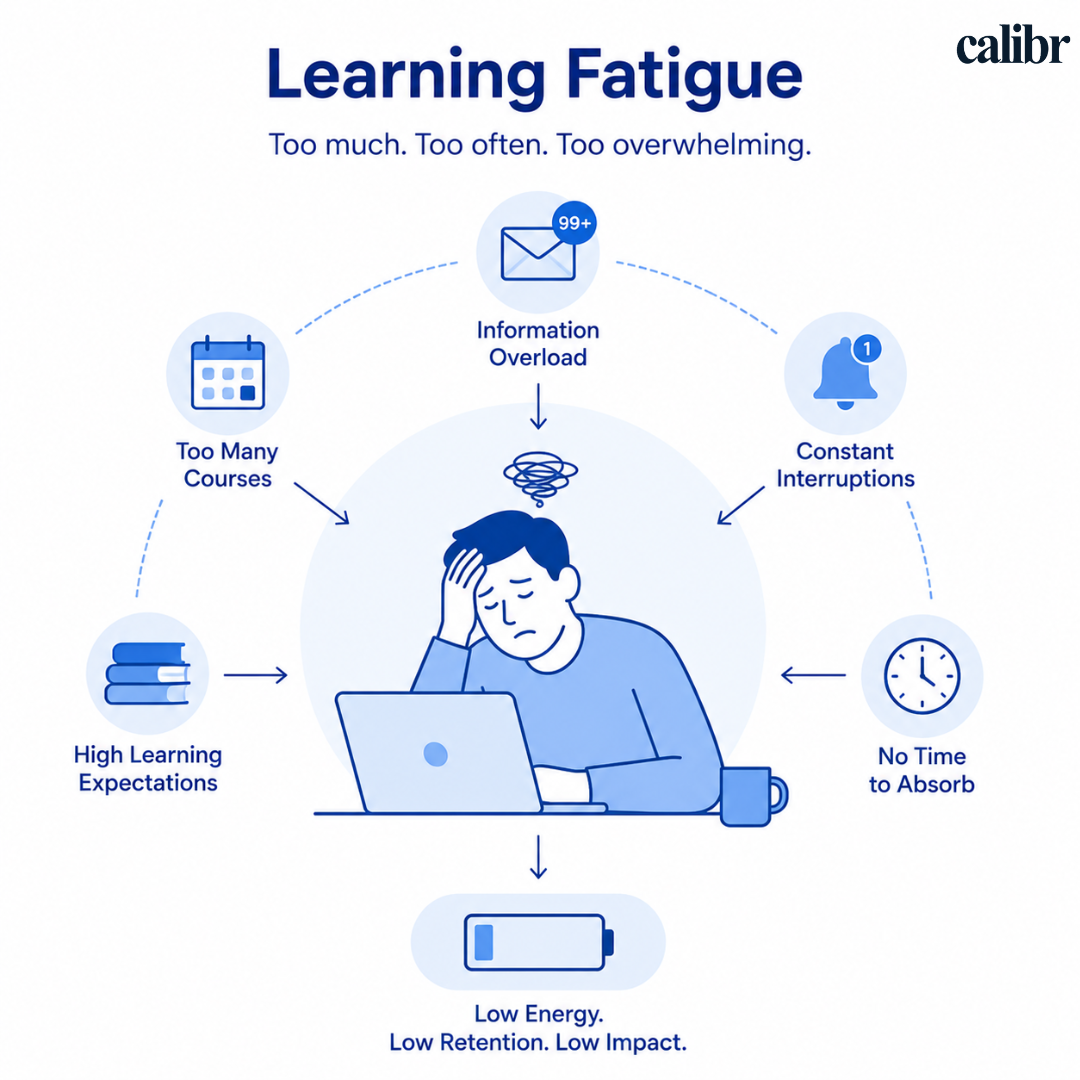
Learning fatigue is a state of mental exhaustion caused by continuous learning demands, information overload, and back-to-back training without enough time to absorb and apply new knowledge.
A common learning fatigue example is an employee completing multiple training programs while also managing meetings, deadlines, and daily responsibilities. Although the training gets completed, retaining and applying the information becomes much harder.
Understanding learning fatigue is important because it can reduce employee engagement, knowledge retention, and the ability to apply new skills effectively. Even well-designed training programs may produce weaker results when employees feel overwhelmed by constant learning demands.
Recognizing learning fatigue early can help organizations create effective learning experiences that support both employee development and business performance.
Signs of Learning Fatigue
Learning fatigue often develops gradually rather than appearing all at once. Common signs include:
Difficulty concentrating during training sessions
Poor knowledge retention after learning
Frequently postponing courses or learning activities
Multitasking during training programs
Feeling overwhelmed by continuous learning requirements
Low motivation to participate in training
Viewing learning as a task rather than an opportunity
Feeling mentally drained after completing training
Learning Fatigue Quiz: Test Your Knowledge and Check Your Score
Think you understand learning fatigue?
Test your knowledge with this comprehensive Learning Fatigue Quiz featuring 15 multiple-choice questions and 5 workplace case-study scenarios. Designed for employees, managers, HR professionals, and L&D teams, this quiz helps identify signs of learning overload, reduced engagement, and training fatigue.
After completing both sections, use the answer key and scoring guide to evaluate your results and understand what your score may reveal about your current learning experience.
Part 1: Multiple-Choice Questions
Choose the option that best describes your experience.
1. How do you feel when assigned a new training course?
A. Excited and motivated
B. Interested but cautious
C. Indifferent
D. Exhausted before starting
2. During online training sessions, how often does your attention drift?
A. Rarely
B. Occasionally
C. Frequently
D. Almost always
3. How much information from recent training can you recall after one week?
A. Most of it
B. A good amount
C. Only key points
D. Very little
4. How often do you postpone learning activities?
A. Never
B. Sometimes
C. Often
D. Almost every time
5. When multiple learning programs are launched simultaneously, you feel?
A. Energized
B. Challenged
C. Overwhelmed
D. Completely stressed
6. How relevant are your training programs to your daily work?
A. Extremely relevant
B. Mostly relevant
C. Sometimes relevant
D. Rarely relevant
7. After completing training, how motivated are you to apply what you've learned?
A. Very motivated
B. Somewhat motivated
C. Slightly motivated
D. Not motivated
8. How often do training sessions feel repetitive?
A. Never
B. Occasionally
C. Frequently
D. Almost always
9. How would you describe your energy level during learning sessions?
A. High
B. Moderate
C. Low
D. Very low
10. When a learning notification appears, your first reaction is:
A. Great!
B. Let's see what's new
C. Not again
D. Please make it stop
11. How often do you multitask during training?
A. Never
B. Occasionally
C. Frequently
D. Constantly
12. How often do you feel mentally drained after training?
A. Rarely
B. Sometimes
C. Often
D. Almost always
13. How confident are you that training improves your performance?
A. Very confident
B. Somewhat confident
C. Slightly confident
D. Not confident
14. How often do you complete learning activities simply to "check the box"?
A. Never
B. Occasionally
C. Frequently
D. Almost always
15. If given the option, would you reduce your current training workload?
A. No
B. Maybe
C. Probably
D. Definitely
Part 2: Scenario-Based Learning Fatigue Questions
Workplace learning isn't just about completing courses. It's about how employees react, engage, and apply what they learn.
Read each scenario carefully and choose the option that best reflects what you would do.
Remember: Don't score yourself yet. The answer key appears later in this article.
Scenario 1: The Never-Ending Training Calendar
It's Monday morning.
You open your calendar and discover that three learning programs have been assigned this week:
Compliance training
Cybersecurity awareness training
A leadership development workshop
At the same time, you're managing project deadlines, attending meetings, and responding to urgent requests from your team.
By Wednesday afternoon, you still haven't started any of the training modules and reminder emails continue appearing in your inbox.
What are you most likely to do?
A. Create a learning schedule and complete the programs in manageable blocks.
B. Fit the training into available gaps throughout the week.
C. Delay the training until deadlines approach and then rush through it.
D. Feel overwhelmed and avoid starting altogether.
Scenario 2: The 90-Minute Online Course
You begin a 90-minute online training course.
The first few sections are interesting, but as the session continues, your attention starts to drift. You find yourself checking emails, responding to messages, and thinking about other work priorities.
By the time the course ends, you realize you've completed it but remember very little of what was covered.
What best describes your response?
A. Take notes and actively work to stay engaged.
B. Pause for a short break and then return refreshed.
C. Continue while multitasking because staying focused feels difficult.
D. Click through the remaining content simply to finish.
Scenario 3: Learning Without Retention
Over the past two months, you've completed several training programs covering communication, productivity, and project management.
During a team discussion, your manager asks you to use a technique from one of the recent courses.
You suddenly realize you can barely remember the details.
Despite spending hours in training, much of the information feels blurred together.
How would you respond?
A. Review your notes and confidently apply the concept.
B. Spend some time refreshing your memory first.
C. Use only the parts you remember.
D. Feel frustrated because very little of the training seems to have stayed with you.
Scenario 4: One More Course...
After weeks of studying, assessments, and assignments, you've finally completed a major certification program.
The next day, your organization announces another mandatory learning initiative.
Instead of feeling excited, you notice a sense of resistance and exhaustion.
What would be your likely reaction?
A. Feel energized and ready for the next challenge.
B. Appreciate the opportunity but prefer a short break first.
C. Feel overwhelmed by the continuous learning demands.
D. Feel mentally exhausted and disengaged.
Scenario 5: Learning vs. Real Work
Your company strongly encourages continuous learning.
Employees are expected to complete courses, attend webinars, participate in workshops, and pursue certifications.
While these opportunities are valuable, your workload has also increased significantly.
You begin feeling as though there isn't enough time to balance learning requirements with your day-to-day responsibilities.
Which statement best reflects your experience?
A. I can successfully balance learning and work responsibilities.
B. It can be challenging, but I generally manage both.
C. Learning requirements often compete with my daily work priorities.
D. The volume of learning expectations feels overwhelming and contributes to stress.
Learning Fatigue Quiz Answer Key & Scoring Guide
What Your Responses Might Be Telling You
If you frequently selected answers related to avoiding training, feeling overwhelmed, struggling to retain information, or viewing learning as a burden, you may be experiencing signs of learning fatigue.
Learning fatigue often develops gradually and can affect focus, motivation, and learning effectiveness. While occasional fatigue is normal, recurring patterns may indicate that your current learning demands are becoming difficult to manage.
Now, calculate your score using the guide below.
How to Score Your Responses
Add up the points from all 20 questions.
Compare your total score with the ranges below.
Review what your score may be telling you and recommended next steps.
Learning Fatigue Score Interpretation
Score Range | Your Result | What It Means | What You Can Do |
20–35 | Thriving Learner | You show very few signs of learning fatigue. You are engaged, motivated, and able to manage learning demands effectively. | Continue balancing learning with practical application and flow-of-work learning. Maintain healthy learning habits and share effective strategies with colleagues. |
36–50 | Mild Learning Fatigue | You may occasionally experience learning overload or reduced engagement. Early signs of fatigue may be emerging. | Prioritize high-impact learning opportunities, avoid unnecessary courses, and schedule recovery time between major learning activities. |
51–65 | Moderate Learning Fatigue | Learning may sometimes feel overwhelming. Retention, focus, and motivation could be affected. | Break learning into smaller sessions, focus on relevant training, apply skills quickly, and discuss workload concerns if needed. |
66–80 | High Learning Fatigue | You are showing significant signs of learning fatigue. If left unaddressed, it may contribute to employee burnout, reduced motivation, and lower performance over time. | Reassess your learning workload, take recovery time, prioritize essential learning, and seek support from managers, HR, or L&D teams. |
Key Reminder
This quiz is designed as a self-assessment tool and should not be considered a clinical or psychological evaluation. A higher score does not mean you dislike learning—it may simply indicate that your current learning demands exceed your available time, energy, or capacity to effectively absorb and apply new knowledge.
Your score provides a useful snapshot of your current learning experience. But why does learning fatigue happen in the first place?
Research offers valuable insights into how people learn, retain information, and become overwhelmed by excessive learning demands.
Did You Know: The Science Behind Learning Fatigue
Studies based on the Ebbinghaus Forgetting Curve suggest that people can forget up to 70% of newly learned information within 24 hours if it is not reinforced or applied.
Research from The Learning Scientists shows that spaced practice and retrieval practice significantly improve long-term retention compared to cramming information into a single learning session.
Cognitive Load Theory research suggests that presenting too much information at once can overload working memory, reducing learning effectiveness and knowledge retention.
How to Reduce Learning Fatigue
Reducing learning fatigue is a shared responsibility. Employees, managers, and L&D teams all play a role in creating a healthier learning environment.
Employees | Managers | L&D Teams |
Focus on learning opportunities that align with your role and career goals. | Avoid assigning multiple training programs at the same time unless necessary. | Break learning into shorter, easier-to-digest modules. |
Treat learning as dedicated work rather than something squeezed between meetings. | Allow employees time in their schedules to complete training. | Ensure training directly connects to employees' jobs and responsibilities. |
Apply new skills as soon as possible after training. | Provide opportunities for employees to practice new skills on the job. | Measure whether learning improves performance, not just completion rates. |
Take breaks between major learning activities to absorb information. | Discuss training takeaways and support ongoing development through coaching. | Give learners time to reflect, practice, and apply skills before introducing new training. |
Key Takeaway
The solution to learning fatigue isn't simply reducing the amount of learning. It's creating learning experiences that employees can absorb, apply, and benefit from over time. When employees, managers, and L&D teams work together, learning becomes more effective, engaging, and sustainable.
How HR and L&D Teams Can Use This Learning Fatigue Quiz
This learning fatigue quiz can be used to:
Assess employee learning engagement
Identify potential learning overload
Support training needs analysis
Evaluate learning effectiveness
Improve employee development strategies
Start conversations about learner well-being
Optimize learning program design
Many organizations use similar assessments as part of employee engagement surveys, wellness initiatives, and learning effectiveness reviews.
Frequently Asked Questions (FAQs)
What is learning fatigue?
Learning fatigue is a state of mental exhaustion caused by continuous learning demands, excessive training, and information overload. It can reduce engagement, knowledge retention, and the ability to apply new skills effectively.
What causes learning fatigue?
Common causes include back-to-back training programs, excessive information, lack of time for practice and reflection, irrelevant learning content, heavy workloads, and constant pressure to upskill.
What are the signs of learning fatigue?
Signs of learning fatigue include difficulty concentrating during training, poor information retention, procrastinating on learning activities, multitasking during courses, reduced motivation, and feeling overwhelmed by learning requirements.
How does learning fatigue affect employees?
Learning fatigue can reduce productivity, lower engagement, decrease knowledge retention, increase frustration, and make employees less likely to apply what they have learned in their daily work.
Can learning fatigue lead to burnout?
While learning fatigue and burnout are different, prolonged learning fatigue can contribute to stress, disengagement, and employee burnout if learning demands continue without adequate recovery time.
How can organizations reduce learning fatigue?
Organizations can reduce learning fatigue by providing shorter learning modules, spacing out training programs, focusing on relevant content, allowing time for practice, and balancing learning expectations with daily workloads.
How do I know if I have learning fatigue?
If you frequently feel overwhelmed by training, struggle to retain information, postpone courses, multitask during learning sessions, or view learning as a burden rather than an opportunity, you may be experiencing learning fatigue.
Final Thoughts
Learning should inspire growth—not create exhaustion.
Experiencing learning fatigue doesn't mean employees have stopped wanting to learn. More often, it means they've been asked to absorb more information than their minds can effectively process.
By recognizing the signs early, balancing learning demands, and designing more thoughtful development experiences, organizations can transform learning from a checkbox activity into a meaningful driver of performance, engagement, and growth.
So, what was your score? More importantly, what is it telling you about your current learning experience?
If your results suggest signs of learning fatigue, you're not alone. Many organizations struggle to balance continuous learning with employee workloads. The key is not to reduce learning opportunities but to deliver learning in ways that are engaging, relevant, and easy to apply.
Ready to Reduce Learning Fatigue With Smarter Learning Experiences?
Platforms like Calibr helps organizations deliver personalized, AI-powered learning experiences through adaptive learning paths, microlearning, collaborative learning, and real-time analytics. By making learning more relevant, engaging, and easier to consume, organizations can improve retention while reducing learning overload.
Contact our team for more details or queries
Schedule a Demo to get started


Vivetha is a digital marketing professional specializing in content marketing and SEO. She focuses on developing optimized, high-quality content that improves search visibility, supports brand objectives, and drives measurable results. With a structured and analytical approach, she ensures content aligns with business and audience needs.